Fitchburg Railroad
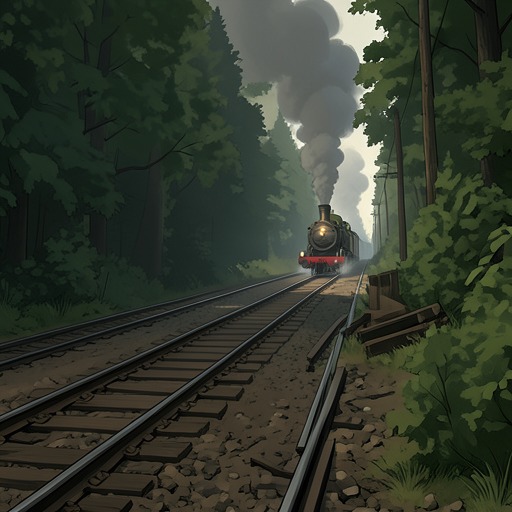
WaldenThe Fitchburg Railroad runs close to Walden Pond, linking the narrator’s woods to the village while carrying the machinery of commerce into the landscape. It is at once a practical route, a social connection, and an object of critique: its speed and punctuality promise progress, but the narrator asks what that progress costs in human lives, attention, and woodland. Its presence makes modernity tangible, from the causeway underfoot to the whistle crossing the trees and the crowds arriving and departing by rail.
Route and Everyday Connection
The line touches the pond about a hundred rods south of the narrator’s dwelling. He usually walks to the village along its causeway, describing the railway as his link to society. The connection is reciprocal in an ironic way: freight-train workers bow to him as a familiar figure, apparently taking him for an employee because they pass him so often. He accepts the association imaginatively, wishing he could be a track-repairer somewhere in the orbit of the earth. The railroad is not merely distant machinery; it shapes his ordinary passage between solitude and the village.
The locomotive whistle carries that connection beyond the track itself. It penetrates the woods in summer and winter, resembling the cry of a hawk over a farmer’s yard, but announcing the movement of restless city merchants. The sound imports commercial activity into the rural setting even when the narrator is not aboard a train. Its recurring passage makes the boundary between the woods and the wider economy audible.
Speed, Wages, and the Value of Travel
The railroad’s appeal is measured against the time and money it claims to save. A friend wonders why the narrator does not accumulate money and take the cars to Fitchburg to see the country. He counters with a thirty-mile journey: the fare is ninety cents, almost a day’s wages, while he can walk the distance before night and has walked at that rate for weeks. In his comparison, the traveler on foot reaches the destination while the passenger works to earn the fare and arrives later. The argument turns travel from a contest in speed into a question of what one must exchange for convenience.
The line also embodies the haste to improve means without improving ends. Railroads lead to Boston or New York, but the narrator doubts that reaching those destinations answers any important need. He compares the proposed magnetic telegraph from Maine to Texas to a costly connection whose endpoints may have nothing significant to communicate. The railroad’s capacity to carry people quickly is therefore not, by itself, proof that their journey matters.
Labor Beneath the Rails
The narrator’s sharpest reversal is that passengers do not simply ride on the railroad: the railroad rides upon them. Its sleepers, he observes, are men—Irishmen or Yankees—whose bodies support the rails. The image exposes the labor concealed beneath the smooth passage of the cars, and makes the railway’s apparent freedom dependent on workers’ exertion. The question of whether people should spend their days and nights forging rails rather than improving their lives becomes a criticism of progress that treats its human foundations as expendable.
That labor is visible in the railroad’s material traces around the pond. The narrator buys the boards of James Collins’s shanty; Collins is an Irishman working on the Fitchburg Railroad. The house is described as an unusually fine shanty, and its dismantled boards become building material for the narrator’s dwelling. The transaction joins the narrator’s modest domestic project to the life of a railway laborer, while the shanty’s reuse makes the railroad’s working world part of the very fabric of his home.
A New Measure of Village Time
The railway alters the daily rhythm of the village. The starting and arrival of the cars become its epochs: trains come and go with such regularity, and their whistle carries so far, that farmers set their clocks by them. A technology of transport thus becomes a local timekeeper, reorganizing everyday attention around scheduled movement. The same sound that penetrates the narrator’s woods also regulates the surrounding community.
When the narrator meets an engine and its train moving with planetary motion—or, more precisely, like a comet—the spectacle combines immense speed with uncertainty about its destination. The comparison enlarges the train into a force of modern life, impressive in motion yet difficult to comprehend from the roadside. Its velocity does not resolve the question that governs the account: whether greater speed serves a worthwhile human purpose.
Environmental Cost and Lasting Significance
The railroad’s impact extends from sound and labor into the changing landscape. Looking back after leaving the pond, the narrator says woodchoppers have further laid waste the woods; the rambling paths and occasional views of water through the trees will no longer be available as they were. The trunks on the bottom, the old log canoe, and the dark surrounding woods have disappeared from the remembered scene. The loss is not presented as an abstract consequence of development: it changes how people encounter the pond, which villagers increasingly approach as a source of piped water for washing dishes rather than as a place to bathe.
He personifies the railroad as an Iron Horse whose harsh neigh is heard throughout the town and whose foot has muddied Boiling Spring. This image gathers the railway’s effects into a single intrusion: its reach is mechanical and commercial, but its consequences are physical, altering water and woodland. The contrast is especially pointed beside the narrator’s recollection of warmer, springlike patches of swamp where skunk-cabbage persists even in midwinter. Nature continues to renew itself, but that renewal exists alongside a landscape being cut, redirected, and put to use.
The Fitchburg Railroad therefore occupies a double role in the account. It connects the narrator to the village and gives farmers a dependable clock; it also makes the costs of industrial convenience visible in wages, human labor, lost woods, and disturbed water. Its line is a route through the countryside, but also an argument about what counts as progress and whether the speed of a machine can compensate for the life and landscape laid beneath it.