the State
WaldenThe State, rendered in Thoreau’s argument as the political authority whose claims reach into ordinary life, is also an institution he charges with complicity in slavery and aggressive war. It appears at once as an agent of coercion—a tax refusal ends in jail—and as the object of a broader moral indictment: when government organizes oppression, Thoreau argues, conscientious people must stop sustaining it.
Authority in Everyday Life
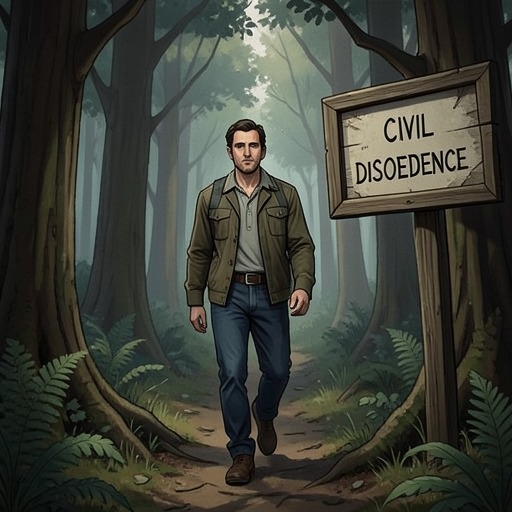
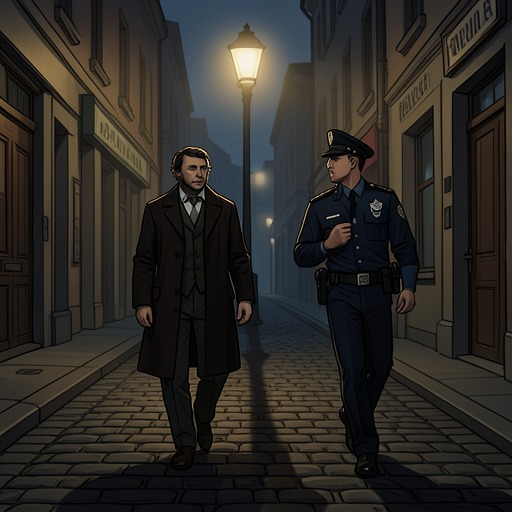
Thoreau’s encounter with the State is not staged as a political ceremony. Near the end of his first summer in the woods, he goes to the village to retrieve a shoe from the cobbler and is seized and jailed for refusing to pay a tax or recognize the authority of the government. The errand’s small, practical purpose makes the arrest’s intrusion especially stark: political authority follows him even when he has gone to the woods for other reasons.
The refusal is not presented as an attempt to evade an ordinary obligation for private convenience. Thoreau identifies the government he will not recognize as one that buys and sells men, women, and children like cattle at the door of its senate-house. The tax thus becomes a point of contact between personal conduct and institutional wrongdoing: paying it would mean material cooperation with a State whose authority he regards as morally compromised.
His response to arrest also defines the encounter. He says he could have resisted forcibly, with more or less effect, but preferred that society run amok against him because it was the desperate party. Released the next day, he obtains his mended shoe and returns to the woods in time to eat huckleberries on Fair Haven Hill. The brief sequence sets the machinery of confinement against the continuity of ordinary life; after the State has asserted its force, his return to the woods resumes the independent routine that the arrest interrupted.
The State and Local Poverty
Thoreau’s scrutiny of political authority sits alongside his attention to the unequal conditions of local life. Considering his neighbors, the farmers of Concord, he observes that many have labored for twenty, thirty, or forty years. He then asks how the poor minority fares, suggesting that those whose outward circumstances place them above the savage may coexist with others degraded below that condition. The question shifts attention from the visible security of a town’s more established residents to the poverty hidden within the same society.
He points to the shanties bordering the railroads, describing them as a mark of civilization that does not guarantee the well-being of the people living beside it. This local contrast complicates any simple claim that public order or material improvement is proof of just government. The State’s legitimacy is tested not only by its formal authority but by the social conditions that its order contains and leaves unresolved.
Other lives in the surrounding landscape make that history concrete. Thoreau records that Cato Ingraham lived east of the bean-field as the enslaved man of Duncan Ingraham, who built him a house and allowed him to live in it. Down the road on Brister’s Hill lived Brister Freeman, whom Thoreau identifies as a formerly enslaved Black man. These accounts locate enslavement in the familiar geography around Concord rather than at a safely distant remove. They also show how the State’s moral problem belongs to a social world structured by ownership, permission, and unequal freedom.
Organized Injustice and Resistance
In “Civil Disobedience,” Thoreau enlarges the argument from the single tax refusal to a political crisis. When oppression and robbery are organized, he says, the machinery that carries them out should no longer be allowed to operate. He names two conditions together: one-sixth of the population of a nation that claims to be a refuge of liberty is enslaved, and a foreign army has unjustly overrun and conquered a country, placing it under military law. The reference to the invaded country makes the charge pointed: the country under military rule is not the United States; the United States is the invading army.
The pairing of slavery and the war against Mexico makes his test of government concrete. In his reasoning, these are not separate matters to be regretted while ordinary political cooperation continues unchanged. They are evidence that the nation’s professed liberty and its actual conduct have come apart, making resistance an urgent duty for honest people. The State is therefore judged not by its declared ideals alone but by the people it holds in bondage and the violence it carries across its borders.
Thoreau also rejects the calculation that a people must preserve its existence as a nation at any moral cost. He argues that the people must cease holding slaves and making war on Mexico, even if doing so costs them their existence as a people. Against the inconvenience of such action, the argument gives priority to justice: survival as a political community cannot excuse the practices that have made that community unjust.
Withdrawal of Support
The argument ends by turning from diagnosis to a practical demand. Thoreau says that those who call themselves abolitionists should at once effectively withdraw their support, both in person and property, from the government of Massachusetts. The breadth of the demand matters: opposition cannot remain merely an inward judgment or a public label if a person continues to furnish the government with participation and material backing.
This call extends the logic of his own refusal. In the jail episode, a tax refusal brings him into direct conflict with the State; in the later argument, the same principle becomes a proposed collective action against an institution implicated in slavery and war. The point is not that the State lacks power to compel obedience, but that its authority cannot settle the question of right. By making noncooperation the consequence of conscience, Thoreau presents government as dependent on the support of the people it governs—and therefore vulnerable when they withdraw it.