Spring (season)
WaldenSpring (season) in Walden is both a recurring natural season and a way to measure time through attention to the living landscape. Its arrival offers the narrator a model of simplicity and renewal; its sounds, thawing earth, and stubborn winter greenery make change perceptible, while memories of cleared woods show that seasonal return does not undo human damage.
Renewal and lived time
Each morning, the narrator finds in nature an invitation to make his life equally simple and innocent. This daily awakening makes time feel less like a schedule than an opportunity to begin again: the season’s promise is renewed through attention, and ordinary mornings acquire the character of a fresh moral choice.
The narrator also distinguishes contemplative hours from time lost to work. Such hours, he says, were not subtracted from life but added beyond its usual allowance; he understood through them what he calls the Orientals’ contemplation and forsaking of works. Spring’s rhythms belong to this alternative measure of duration, in which the day is experienced through observation rather than judged only by what has been produced.
Weather and the changing landscape
Long rainstorms in spring and fall are among the narrator’s most pleasant hours. Confined indoors through both afternoon and forenoon, he is soothed by the rain’s ceaseless roar. Weather does not merely interrupt activity: the sustained sound gives the hours a distinct texture, and remaining at home becomes a form of attentive participation in the season.
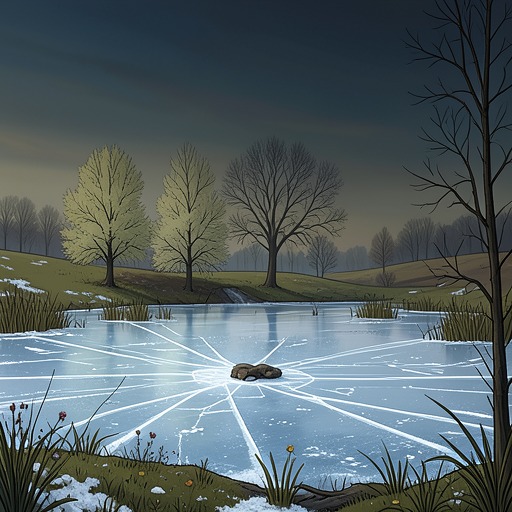
The pond’s own changes invite a longer view. Its water remains green and clear across generations, and the narrator imagines it already existing on the spring morning when Adam and Eve were driven from Eden, breaking up under a gentle rain. The image sets seasonal renewal against human chronology: people and nations pass, while the pond’s water continues. The imagined biblical time is poetic reflection, not a claim that the pond’s age can be established from observation.
The pond’s modest scale also matters to how it is known. Its scenery, though beautiful, does not approach grandeur and may mean little to someone who has not lived by its shore or frequented it. Its edge is mostly a steep belt of smooth, rounded white stones, with only one or two short sand beaches; a single leap can carry a person into the water in many places. Spring’s changing conditions are therefore encountered in a particular, closely observed place, not in an abstract landscape.
Seasonal persistence and perception
Even in midwinter, the narrator sometimes finds a warm, spring-like swamp where grass and skunk-cabbage remain green, and a hardier bird waits for spring’s return. The season is thus not confined to a sharply marked calendar interval: its signs appear as pockets of warmth and perennial growth inside winter. This observation makes renewal less a sudden transformation than a persistence that can be detected before the wider landscape changes.
Thawing earth offers another kind of evidence. The narrator takes particular delight in the forms assumed by sand and clay as they flow down the sides of a deep railroad cut. He sees in the moving material the earth’s energy at work, and the exposed sand becomes, in his analogy, something like the vital tissue of an animal body. Here natural-history attention turns toward metaphysical interpretation: the observed thaw is concrete, while the language of the globe’s vitals expresses the larger meaning he draws from it.
Memory, clearing, and loss
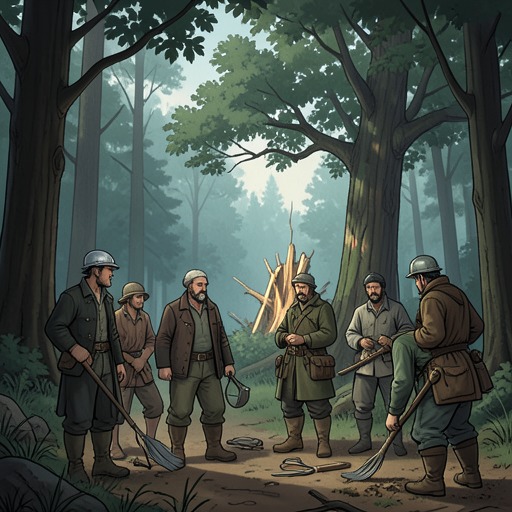
Spring’s promise is shadowed by what has happened to the woods around the pond. Looking back, the narrator says that woodchoppers have further laid waste the landscape since he left its shores. The former aisles of trees, with occasional views of water, will no longer offer the same paths for wandering; he imagines that his Muse may fall silent because the groves that once gave the birds a place to sing have been cut down.
The transformation is material as well as remembered. Trunks that once lay on the pond bottom, an old log canoe, and the dark woods surrounding the water are gone. The narrator contrasts these losses with villagers who scarcely know where the pond lies, suggesting that a place can persist physically while receding from local knowledge and use. Seasonal renewal does not restore the vanished trees or the familiar landscape they made.
Spring therefore holds two kinds of return in tension: grass and skunk-cabbage persist, thawing sand moves, and the pond’s water endures, but cleared woods remain absent. The season makes change visible without promising that every loss can be reversed; its significance lies in the close attention through which persistence, alteration, and memory can be held together.