Dirac Angestun Gesept and the Sirian government
WaspDirac Angestun Gesept and the Sirian government stand on opposite sides of a contest over internal resistance: the government seeks to bring political organization within reach of its laws, while D.A.G. can frustrate that effort by remaining difficult to identify. Their conflict is not presented only as a clash between a state and a named opponent. It also turns on a more unsettling question: how much of a feared movement is real, how much is concealed, and how much can be produced by the government’s own response to it.
The State Tries to Make Opposition Legible
The government’s clearest countermove is legislative. Under the War Emergency Powers Act, the Jaimec Ministry of Defence orders organizations, societies, parties, and other corporate bodies to register. The requirement reaches beyond a group’s name: organizations must give the addresses of their habitual meeting places and provide a complete membership list. This is an attempt to transform political association into information the authorities can collect, compare, and act upon.
The order’s threatened consequences make registration more than routine administration. After the twentieth of the month, continued organizational activity is associated with a treasonous offence punishable by death. The law thus places D.A.G. in a stark position: comply in a way that exposes its structure, or risk having continued activity treated as treason. The narrative describes Gesept as forced toward either confession or the strangling-post, emphasizing how the state turns disclosure into a condition of survival.
Yet the registration scheme rests on an assumption that the movement can be mapped through ordinary membership. D.A.G.’s advantage is that its members may not know they belong to it. A person can be designated a member without possessing the knowledge that would make that status meaningful to the authorities’ search for informers. The government’s demand for names and meeting places therefore confronts an organization whose apparent membership does not necessarily correspond to a conscious, traceable association.
An Enemy Both Real and Difficult to Measure
The story makes the scale of opposition deliberately unstable. Mowry hears a conversation describing the revolutionary movement as a menace on other worlds as well as Jaimec. What he takes from it is that Dirac Angestun Gesept is not simply a nightmare invented by Wolf to frighten Jaimecan politicians: the rebellion extends across more than a hundred planets. At the same time, its strength is described as pseudo-strength, greatest on Gesept’s home world, Diracta. The government faces a movement presented as widespread, but its apparent scale is not equivalent to a straightforward measure of its actual power.
That uncertainty matters because the narrative also exposes how the idea of internal opposition can be deliberately manufactured. Mowry recalls a step-by-step technique taught at college: an enemy must be convinced that an internal opposition exists, whether that opposition is real or imaginary. The principle is not evidence that the Sirian government invented Gesept or D.A.G. Rather, it shows that the perception of a movement can itself become an instrument in political conflict. The state’s response may be directed not only at identifiable acts but at the threat as it is imagined, reported, and amplified.
The distinction between hidden membership and constructed menace sharpens the conflict. D.A.G.’s concealed structure makes it hard to expose through informers; the possibility of a phantom opposition makes it hard for authorities to know whether their information describes an organized enemy or an image of one. In either case, the government must act under uncertainty, and that uncertainty leaves room for coercion as well as manipulation.
Crackdown, Arrest, and the Threat of Punishment
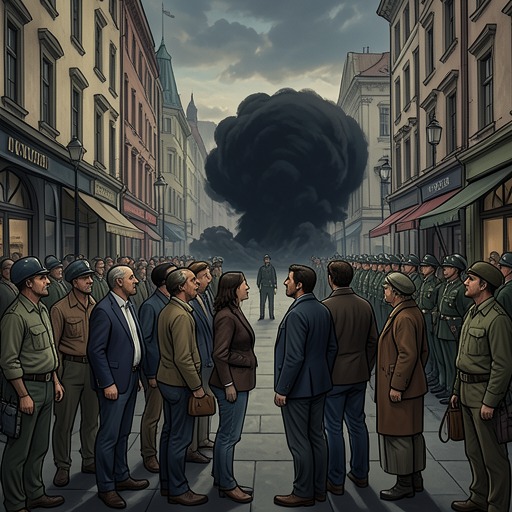
The reach of the state’s response appears in the language of public notices and emergency control. A newspaper headline announces that Pertane is under martial law, that the mayor has declared a travel ban and that drastic action is being taken against Gesept. These notices place the political confrontation within the everyday geography of the city: the government’s struggle with a named opponent is accompanied by restrictions imposed on a population as a whole.
The reported arrest of forty-eight members of the Sirian Freedom Party gives that threat a concrete, but troubling, form. A newspaper says they have been seized by forces of law and order and will be dealt with appropriately. Mowry judges them doomed, whoever they are or whoever the authorities think they are; he also allows that the account itself could be an officially concocted lie. The passage does not settle whether the arrests happened as reported. Instead, it shows how a government announcement can make the label of traitor consequential even when the identities, guilt, or existence of those labeled remain uncertain.
The practical force of martial law is also visible in the efforts to control departure from Pertane. About sixty routes radiate from the city’s perimeter, with major roads toward Shugruma and Radine likely to be more heavily guarded. At a checkpoint, a sergeant asks Mowry for an exit permit. Mowry claims not to need one and adopts the authority of a four-star general. The exchange illustrates the pressure created by the government’s restrictions, while also showing that their enforcement depends on encounters in which credentials and claimed authority are assessed.
Political Authority in Practice
The conflict between Gesept and the government is therefore expressed through both sweeping declarations and small procedural encounters. The registration order demands names, addresses, and organizational visibility; the martial-law notices announce collective restrictions; the checkpoint reduces those controls to a question about a permit. Elsewhere, a prison official scrutinizes a requisition, calls it irregular even while accepting that its form is in order, and then prepares a receipt by copying its details. Such procedures do not establish a direct episode between Gesept and the official, but they help define the institutional world in which the government’s power operates: documents classify people, authorize transfers, and determine who can move.
The government’s campaign against Gesept consequently has two interlocking dimensions. It seeks to identify and punish an internal enemy through law and enforcement, yet the movement’s concealed membership and uncertain strength resist simple classification. Meanwhile, the possibility of an invented or inflated opposition makes the state’s own declarations difficult to take at face value. The relation remains unresolved in these scenes: the authorities announce drastic measures, but the gap between a political label and a verifiable organization continues to shape what those measures can mean.