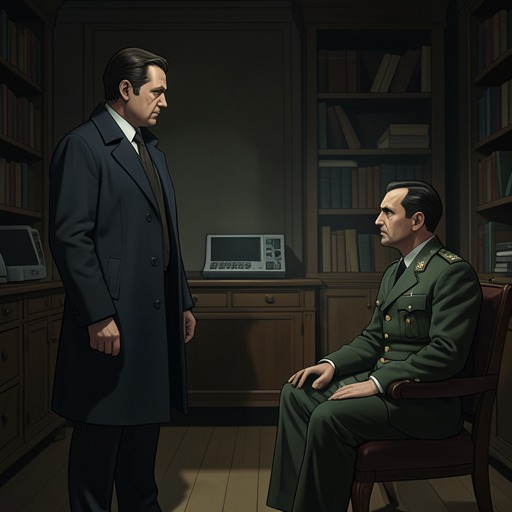
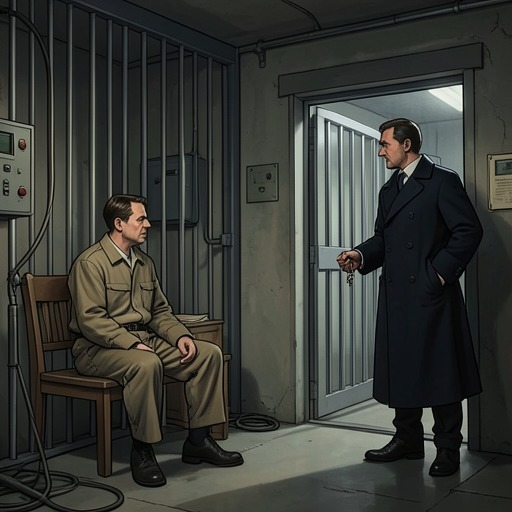
James Mowry–Gurd and Skriva
WaspJames Mowry–Gurd and Skriva is a relationship formed through a single consequential bargain: Mowry recruits Gurd and Skriva for an attack on Colonel Hage-Ridarta, offers them money, and ties further payment to public confirmation of the target’s death. The arrangement brings Mowry’s covert objective into contact with Gurd and Skriva’s practical concern about risk and reward. Their alliance is not presented as friendship or shared conviction; it is a collaboration negotiated through an intermediary, tested with questions, and secured with cash.
Formation of the Alliance
Mowry arrives after being delayed by a police raid on the street. He remarks on the cops’ surly appearance and asks whether the others have robbed a bank. Butin Arhava gestures toward his companions and introduces Gurd and Skriva. Mowry acknowledges them with a curt nod. The clipped greeting establishes the initial distance between the parties: they are being brought together for business, not introduced through any existing personal bond.
Arhava has already presented Mowry’s proposition to the two men, and reports that they are interested. His role is that of broker, carrying the offer across the gap between Mowry and the potential recruits. Mowry does not need to establish the arrangement from scratch in their presence, but the conversation still has to convert preliminary interest into an agreed undertaking. Arhava’s eager manner gives the exchange a commercial edge, while Mowry’s measured responses keep the purpose and terms under his control.
The first clear division of concerns appears when Skriva asks whom they are expected to attack and how they can be sure of payment. Mowry answers the first question directly: the target is Colonel Hage-Ridarta. The second question remains central to the negotiation. Skriva is not simply asking what the job entails; he is testing whether Mowry’s promise has enough substance to justify taking part. The transaction therefore depends on both a named objective and a credible means of compensation.
Money, Trust, and Terms
The men’s different reactions make the alliance more than a simple exchange of instructions. Skriva says he hates the idea, then asks to see five thousand. Mowry slips him a package under the table, and Gurd and Skriva check its contents in their laps. The discreet handover provides the bargain with a material guarantee, but it does not end their doubts. The package is inspected privately, away from the open exchange of words, as though trust must be verified rather than assumed.
Gurd continues to question whether they will receive the larger sum, even after the initial money has been produced. His concern is explicitly about payment not yet obtained: Mowry insists that they will get it, and promises more when news of Hage-Ridarta’s death appears in the papers or on the radio. The proposed payment is thus divided between money delivered before the job and a further reward contingent on a public report. For Mowry, the news serves as an observable marker that the operation has reached its intended result; for Gurd and Skriva, it is the condition attached to the rest of their compensation.
That difference in emphasis defines the partnership. Mowry speaks with assurance about the promised reward and links it to a particular future circumstance. Gurd keeps returning to whether the money will actually materialize; Skriva demands both the target’s identity and proof of the immediate payment. Neither man’s questions establish that he shares Mowry’s political or strategic purpose. What the exchange supports instead is a narrower form of cooperation: they consider the assignment because it has a specified target and a financial inducement, while Mowry relies on payment and promise to enlist them.
Connection to Hage-Ridarta’s Death
The bargain’s stated objective acquires its consequence when a later newspaper item reports that Colonel Hage-Ridarta, commanding officer of 77 Company S.M., was found dead in his car at midnight. He had been shot through the head, and a gun was found nearby; the report describes the death as suicide. This account follows the terms Mowry set out: the death has become public news, the very circumstance he named when promising further payment.
The report also gives the arrangement a double aspect. Mowry has identified Hage-Ridarta as the victim and made the death the measure by which the recruits’ success and payment will be recognized. Yet the public account casts the shooting as suicide, rather than openly identifying it as an attack. The contrast between the men’s private conversation about whom to strike and the newspaper’s explanation of how the colonel died shows how the operation’s apparent outcome can be separated from its public interpretation. The evidence connects the negotiated assignment to the death, while the report’s wording supplies a cover story rather than an admission of the bargain.
As a relationship, the alliance is consequential but narrowly drawn. Its defining actions are Mowry’s recruitment, the discreet transfer of money, Gurd and Skriva’s scrutiny of the payment, and Mowry’s promise of a further reward upon public confirmation. The text does not establish a continuing personal attachment or describe their later dealings. Instead, it shows a temporary partnership built to accomplish a specific act: Mowry supplies the target and the terms, while Gurd and Skriva enter the scheme with their attention fixed on whether the promised money will be paid.