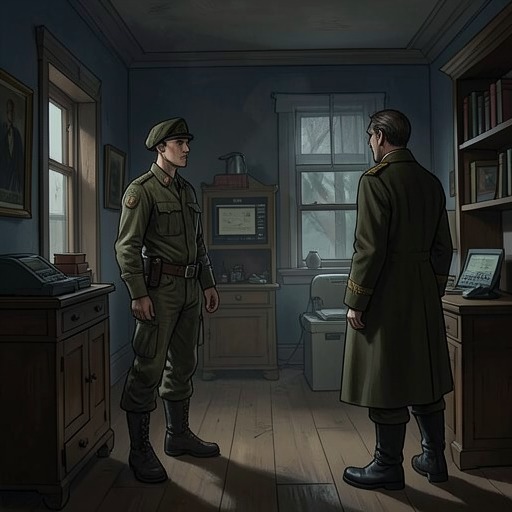
Mowry and Terran Command
WaspMowry and Terran Command are bound by an operational partnership that becomes a contest over the timing and terms of his service on Jaimec. Command supplies orders, expects regular reports, and plans for the possibility that Mowry has been captured; Mowry, in turn, carries out the campaign while resisting an order that would bring his own work to an end.
Reporting and the Decision to Stay
Command’s instructions require Mowry to use the transmitter and send an up-to-date report on every visit to the cave. The reporting routine is therefore more than a channel for information: it is the means by which Command can monitor a field operative whose circumstances it cannot directly control. Mowry understands the requirement, but does not immediately comply. He weighs duty against his desire to remain on Jaimec, and the prospect of leaving sharpens that conflict.
The prospect is not abstract. Command’s plan would leave a successor on Jaimec, replacing a known operator with an unknown one for tactical reasons. Mowry resents the logic from the position of the person being replaced. His own assessment is that the Kaitempi may have caught his scent, but that does not make them better at the pursuit than he is. The difference between Command’s strategic calculation and Mowry’s local judgment gives their partnership its tension: the institution considers the value of an operative it can replace, while the operative sees unfinished work and believes he remains effective.
Mission Progress and Operational Autonomy
Mowry’s decision to delay contact is tied to his sense of the campaign’s sequence. He has completed Phase One and part of Phase Two; Phase Three remains, intended to build pressure until the enemy is occupied with defending its rear. He sees himself as still performing his assigned function by disrupting the enemy, and decides not to signal Command just yet. Instead, he will continue long enough to establish his right to stay through to the bitter end, whether or not Command approves.
This is not a rejection of the mission itself. Mowry’s resistance arises within the work: he has already advanced its earlier phases and wants to continue the pressure campaign. Yet withholding a report changes the balance between field initiative and command oversight. The same persistence that makes him useful also makes him difficult to manage. He treats continued service as something he can justify through results, while Command’s reporting rule presumes that the decision about his deployment belongs to the organization.
Contact Restored and Plans Revised
When Mowry finally makes radio contact, he identifies himself as “JM on Jaimec” and begins speaking rapidly. The exchange confirms that Command can still reach him, but also reveals that it has been planning around the possibility that he is no longer available. After a long silence, the distant voice tells him that it does not want events to quieten down: it wants them to spread, and directs him to start work on Phase Nine.
Mowry’s response makes the mismatch between his understanding and Command’s current plan explicit. He says he is only on Phase Four and asks what has happened to Phases Five through Eight. Command tells him to forget those intervening phases because time is short. A ship is approaching Jaimec with another operative aboard, sent to handle Phase Nine because Command thought Mowry had been captured. The replacement plan that had angered Mowry is thus no longer merely a prospective transfer: Command has already dispatched another wasp on the assumption that he may have been lost.
Mutual Dependence and Friction
The radio exchange shows both the reach and the limits of Command’s authority. It can redirect the operation, compress its schedule, and send another operative to Jaimec; it cannot make Mowry’s field experience interchangeable with its own plans. Conversely, Mowry’s ability to act independently does not free him from the larger campaign. His work remains part of a sequence whose priorities Command can revise when circumstances change.
Their relationship consequently rests on a practical contradiction. Command needs an operative capable of sustaining disruption on Jaimec, but plans for his replacement when it believes he has been captured. Mowry accepts the mission’s purpose and has advanced its early phases, yet tries to secure more time on the planet by withholding a report. When contact resumes, the disagreement is not settled so much as overtaken by urgency: Command has moved ahead to Phase Nine, while Mowry is still reckoning with the sequence he thought he was carrying out.