James Mowry–Butin Arhava
WaspJames Mowry and Butin Arhava’s relationship turns surveillance into negotiation. Arhava first confronts Mowry with a gun, but Mowry answers the threat with money, drawing him toward a possible role in the plans; when Arhava later asks for a percentage for introducing other men, Mowry refuses to promise him a cut. Their connection is neither trust nor simple hostility: it is a shifting bargain in which money attracts Arhava, while Mowry retains control over what he will pay and to whom.
A confrontation under surveillance
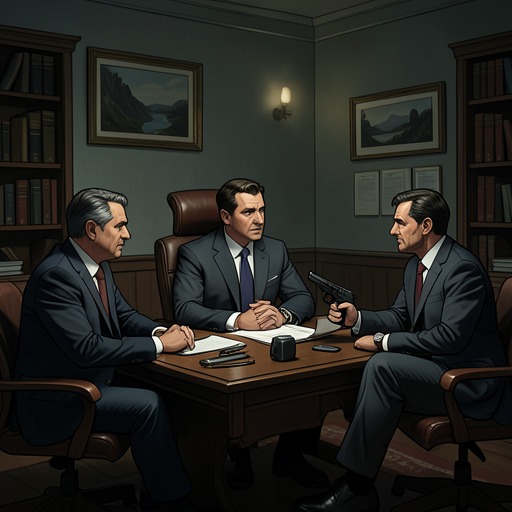
At Cafe Susun, trouble is expected, and Mowry welcomes the prospect. Arhava, who has been following him, reveals the snout of Pigface’s gun over the table and points it at Mowry’s middle. His complaint is direct: he does not like being followed. The gesture makes their first recorded exchange a test of leverage, not a friendly approach. Arhava has the weapon and the advantage of having tracked Mowry; Mowry, however, is unruffled enough to say that Arhava’s presence suits him.
Arhava asks whether Mowry knew he was behind him all along. Mowry confirms that he did, then turns the confrontation into a proposition: he wants to give Arhava a thousand guilders. The abrupt offer changes the terms without dissolving the threat. Mowry does not deny the surveillance or appeal to personal trust; he treats the encounter as an opening for a transaction. Arhava’s armed suspicion and Mowry’s composed offer remain present at once, establishing the guarded, practical character of their association.
Money as leverage
The proposed payment soon rises sharply. When the amount is stated as twenty thousand guilders, Arhava reacts by warning Mowry not to say it so loudly and looks around the room. His response shows that the sum is not merely an inducement between two men: speaking of it openly creates a risk he is alert to. The contrast is pointed. Mowry names the money; Arhava immediately attends to who might hear.
Mowry presses the financial appeal by representing himself as someone who reeks of money and telling Arhava, in effect, that he is drawn to its scent and must act if he wants to keep benefiting from it. Arhava nods, puts a hand in his pocket, and fondles the thousand guilders. Yet the physical handling of the money does not amount to an unqualified acceptance of the work: he says that he does not do that kind of job and that it is not quite his line. The moment holds attraction and reservation together. Mowry has made the offer tangible, but Arhava still marks a boundary around what he is willing to do.
From contact to intermediary
In a later negotiation, Arhava asks what percentage he will receive for introducing the boys. The question gives his role a more specific shape: he is not only the man who followed Mowry or the recipient of a proposed payment, but also an intermediary seeking compensation for bringing others into the arrangement. His request makes the relationship broader and more complicated, because the issue is no longer only what Mowry might pay Arhava directly; it is whether Arhava should earn a share from the men he has introduced.
Mowry does not give him a figure. He says he does not know and turns to Skriva to ask how much. That response leaves the commission unsettled and shifts the calculation into the group’s hands rather than granting Arhava a private agreement. The scene therefore presents Mowry’s dealings with him as part of a larger negotiation: Arhava can bring people to the table, but that contribution does not automatically give him authority over the terms.
The refused cut
The narrative subsequently identifies Mowry’s refusal to give Arhava a cut as the better course, because it leaves the others to fight the question out among themselves. The refusal is consequential precisely because Arhava has asked for a percentage after performing a useful introduction. Mowry declines to settle the matter in his favor, and the resulting dispute reveals something about the group that a smooth payment might have concealed.
This pattern defines the connection. Arhava’s appetite for money is visible in his handling of the thousand guilders and in his request for a commission, but he also shows caution, first by monitoring the room when the larger sum is spoken and then by distinguishing the proposed work from his usual line. Mowry, meanwhile, recognizes the value of Arhava’s access and uses money to recruit or reward him, yet does not surrender control of the bargain. Their relationship advances through offers, introductions, and withheld percentages: cooperation is possible, but it remains conditional and contested.