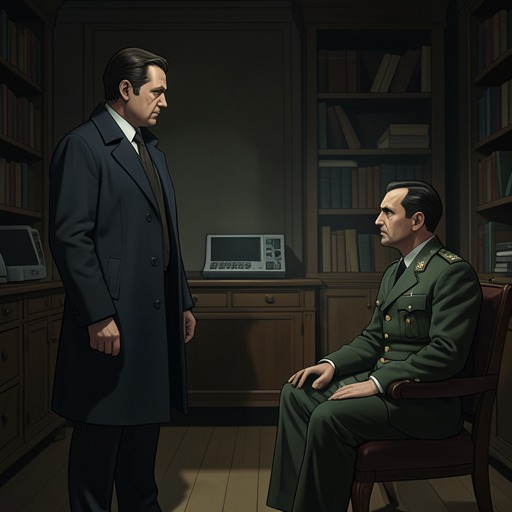
Mowry and Skriva's Cooperative Relationship
WaspMowry and Skriva's Cooperative Relationship is a working alliance built around paid assignments, practical coordination, and guarded trust. Its importance becomes clearest in the prison operation involving Gurd: Mowry depends on Skriva not only to take part, but also to help bring additional people into a dangerous plan.
Terms of the Partnership
Mowry treats the relationship as business from the outset. Leaning against a car door, he offers Skriva another, different job and produces a package; the excerpt identifies neither the package’s contents nor the precise task attached to it. The exchange establishes Mowry as the source of assignments and materials, and Skriva as someone whose participation Mowry is trying to secure.
The terms become explicit when payment is discussed. Mowry offers five thousand guilders apiece, fifty thousand for the whole lot. The figures indicate a substantial batch of paid work, though the available passage does not specify what is to be done with each item. Mowry also says he can verify whether the items have actually been fixed. Payment is therefore paired with oversight: he expects performance, not merely agreement.
His warning that they should not let the partnership end makes the relationship’s transactional basis unusually plain. The warning is not evidence of a settled, intimate trust; it is Mowry’s effort to protect a useful arrangement by tying continued cooperation to the work being done. Skriva’s silent whistle at the sum registers the scale of the offer, but the passage does not establish his response beyond that gesture.
Contact Under Suspicion
Later, Mowry’s contact with Skriva carries a different tension. Mowry is nearing the point of taking alarm, conscious that something about the situation suggests an ambush and that he remains alive and free. Skriva’s voice then comes through asking who is there. Mowry identifies himself as Skriva’s benefactor, presenting the relationship through the practical help he has provided rather than through personal familiarity.
Skriva says that this is no place to talk and proposes that they meet, asking where Mowry is. The exchange shows that their cooperation is continuing, but under conditions in which open communication feels unsafe. It does not establish that Skriva planned an ambush; instead, the scene places Mowry’s suspicion beside Skriva’s decision to move the conversation elsewhere. Their shared work requires contact, while the danger surrounding it makes that contact itself a source of uncertainty.
Cooperation in the Prison Plan
The partnership takes on a more consequential form in the preparations to get Gurd out of prison. Mowry describes a plan that depends on obtaining the number and location of Gurd’s cell, the timing of Kaitempi visits, and details of the routine those visits follow. The passage refers to a money-loving person who will supply this information, but does not identify that person as Skriva. The distinction matters: Skriva is part of the wider operation, but the evidence does not make him the source of the prison intelligence.
Mowry asks Skriva to find a couple more helpers. Their assigned role is deliberately limited: they are to sit in the cars, keep quiet, and look tough. Mowry offers each five thousand guilders. The request shows Skriva acting as a recruiter and practical organizer within Mowry’s plan, while Mowry sets both the task and its price. It also extends the partnership beyond the two men: Skriva is expected to bring in people whose presence can support the operation without requiring them to know or do more than their specified part.
As the operation reaches the prison, its scale becomes visible in physical terms. The jail comes into sight, with great steel doors set in high stone walls; the two cars roll toward the doors and stop. Mowry gets out, and Skriva follows. That action confirms their immediate participation together at the threshold of the prison, but does not by itself establish the outcome of the extraction.
Character and Narrative Function
The relationship is defined less by personal disclosure than by what each man can contribute. Mowry offers assignments, money, checks on completion, and strategic direction. Skriva accepts contact, agrees to meet, and is asked to supply additional helpers. The record presents a partnership of utility whose terms are repeatedly tested by risk: Mowry fears a possible ambush, insists on accountability for paid work, and still entrusts Skriva with a role in an operation aimed at a guarded prison.
That combination gives the alliance its dramatic force. Its continued existence is never treated as an abstract bond; it is enacted through packages, sums of guilders, a request to recruit, a guarded conversation, and the arrival of two cars at the prison doors. The partnership enables Mowry to extend his plans through other people, but the available evidence also preserves the limits of what is known: it shows coordinated work and declared business, not the full extent of either man’s private loyalty or the final result of their prison undertaking.