Pertane telephone-tap hoax
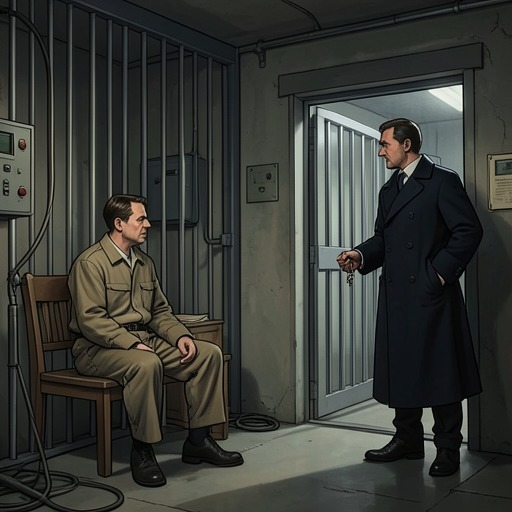
WaspThe Pertane telephone-tap hoax is James Mowry’s attempt to make a small, staged sign of surveillance provoke a much larger security response. He gives Gurd and Skriva ten clip-on gadgets to install near Pertane’s centre, with the devices hidden from the street but their cables left visible. The intended chain runs from a passerby noticing the wires, to an investigation of Jaimec’s telephone system, to the discovery of several more taps—and then to authorities confronted with unanswered questions about who is listening and why.
Purpose and Political Background
Mowry’s plan rests on a broader calculation about the limits of wartime authority. The narrative observes that even a powerful government’s rule is never absolute and that war does not make public effort total. Mowry is looking for the space between official control and public opinion, particularly the room in which minority views persist. Earlier, after fragmentary conversations on buses and in bars, he returns to his hotel confident that Pertane has enough potential scapegoats. The hoax belongs to this climate of suspicion: its effect depends not simply on a device being found, but on people and authorities trying to explain what its presence means.
The operation is therefore political as well as practical. A genuine investigation would have to widen beyond the visible wires if officials took them seriously. Mowry expects a hurried examination of Jaimec’s entire telephone system to uncover several additional taps, shifting the problem from a single odd installation to a broader, more alarming pattern. The hoax is designed to make uncertainty multiply as the search expands.
The Installation and Its Deliberate Visibility
Mowry presents Skriva with a package containing ten small gadgets, each fitted with clips and a length of thin cable. He specifies an unusual arrangement: the gadgets are to be fastened to telephone lines in or near Pertane’s centre, where they cannot be seen from the street, while the cables are left hanging in plain view. Concealment and exposure work together. The apparatus itself is hidden, but the conspicuous loose ends invite discovery and make it difficult for anyone who notices them to dismiss the possibility of tampering.
Skriva immediately identifies the apparent flaw. If the cables can be seen, he reasons, someone will trace them back to the gadgets; hiding the devices seems pointless if their presence is likely to be exposed. His objection clarifies the plan’s reversal of ordinary clandestine practice. Mowry is not trying to keep every trace invisible. He wants the visible trace to be found, while controlling what that discovery appears to reveal. The gadgets are bait for an investigation, not simply equipment to be concealed.
Mowry also makes clear that the work is a partnership with obligations. He tells Skriva he can check whether the installations have actually been made and warns him not to pretend otherwise; Skriva takes the package despite thinking the scheme is mad. The exchange gives the operation a concrete human cost: Mowry relies on Skriva to carry out a risky task, but frames cooperation as something he will verify rather than leave to trust alone.
The Expected Investigation
After the installation is arranged, Mowry spends an hour walking the streets before bed and turning over the day’s work. He anticipates that someone will become curious, that the matter will be referred for investigation, and that officials will respond by examining Jaimec’s telephone system in haste. In his forecast, that search will reveal several more taps. The apparent discovery of the planted devices thus serves as the opening move in a larger institutional reaction.
The scene stops at Mowry’s prediction rather than documenting the authorities’ eventual response to these particular gadgets. Its significance lies in the mechanism he expects to set in motion: a visible clue draws attention; attention broadens the search; broader scrutiny uncovers other evidence; and the resulting uncertainty leaves officials facing a set of ominous questions. The hoax’s force comes from making the authorities do the work of enlarging the incident themselves.
Suspicion, Scapegoats, and Rumor
The earlier search for an adequate supply of scapegoats helps explain why the telephone ruse matters beyond the technical question of whether a line has been tapped. If officials discover a pattern without a clear explanation, suspicion can attach to people already vulnerable to accusation. Mowry’s calculation about minority opinion and his confidence that Pertane contains possible scapegoats place the planted cables within a wider effort to exploit the gap between what the authorities can prove and what they fear may be happening. The evidence does not identify who the additional taps belong to, so the hoax’s intended effect is clearer than the eventual assignment of blame.
Elsewhere, the book shows how deliberately seeded claims can travel far beyond their point of origin. In a separate episode, a report of disasters at Shugruma and Gooma is accompanied by alleged firsthand warnings of bacteriological warfare; by mid-afternoon it has reached thirty people, with projections of a thousand by early evening, ten thousand by midnight, and a hundred thousand the following morning. That rumor is distinct from the Pertane telephone-tap operation, but the contrast illuminates the novel’s recurring interest in manufactured uncertainty. In Pertane, Mowry sets out to provoke an official search; in the later episode, alarming claims spread through successive tellings. Both episodes make information itself a force capable of enlarging fear, even when its origin or reliability remains in doubt.