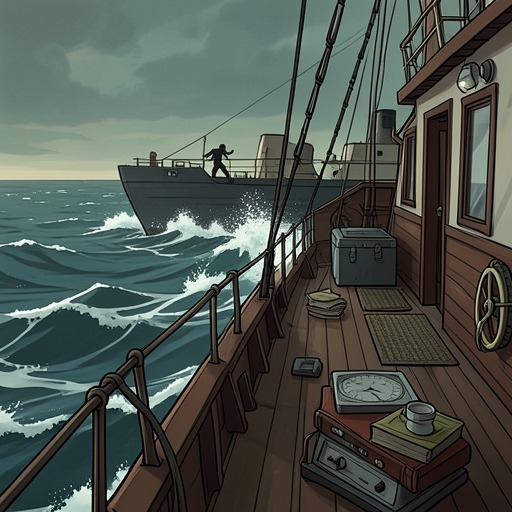
Alapertane limpet-mine sabotage attempt
WaspThe Alapertane limpet-mine sabotage attempt shows Mowry turning disguise, routine information-gathering, and a simple length of cord into a carefully staged attack on two ships. He places a twenty-hour-delay mine on each vessel, but the scene ends without establishing whether either device detonates or causes damage; its immediate result is a pair of devices attached to the ships and a narrow escape from notice at the dockside.
Preparation and Assumed Identity
Mowry approaches the docks with a thick wad of papers and thirty identities to choose from, each devised for a specific task. Half a dozen of these identities would permit him to roam the docks and inspect shipping. For this operation he selects papers identifying him as a minor official of the Planetary Board of Maritime Affairs. The choice is practical: it supplies a plausible reason to ask about ships and their berths, while making an otherwise conspicuous inquiry appear like ordinary official business.
The broader circumstances make the need for caution explicit. Gurd and Skriva remain dangerous liabilities while the hunt continues. In the dockside sequence, Mowry carries out the necessary inquiries and the planting himself; the passage does not show either man taking part. His papers do more than conceal who he is: they furnish the authority that lets him move through a public workplace and ask for operationally useful details without openly announcing his purpose.
Gathering Dock Information
At the office, Mowry taps the counter with the impatient manner of an oldster in a hurry. He asks for departure times and dock numbers, presenting himself as someone entitled to the information and too pressed for time to linger. The junior clerk answers with a schedule of four vessels. The excerpt identifies the Kitsi and Anthus as due at eight-time, at docks three and one respectively, and the Su-cattra at nineteen-time, dock seven. Mowry's inquiry thus turns a borrowed identity into precise knowledge of where ships will be found.
He makes the information-gathering look unremarkable: he produces a pencil and sheet of paper and peers fussily over his glasses as the clerk speaks. These small businesslike gestures sustain the official persona while he records the schedule. The scene's method is incremental rather than forceful: access comes through the appearance of routine, and the details acquired at the counter prepare the later move from public office to the quay.
Planting the Mines
Mowry takes a limpet mine from his case and sets its timing switch for a twenty-hour delay. He threads thin cord through the mine's holding loop, then checks the dockside. No one is on the dock itself, although sailors are working on the Su-cattra's upper deck. He steps out of a shed, crosses the ten yards between it and the ship, and drops the device into the narrow strip of water alongside the quay.
The mine sinks to about eight feet below the surface but does not immediately catch. Mowry works the cord to turn its magnetic face toward the vessel; it then attaches with a clang loud enough to resound across the ship. The noise creates a moment of exposure. A sailor notices it, looks out, and returns to his chore; the passage records no alarm or search following the sound. The attachment succeeds, but the clang makes clear how close the operation comes to attracting attention.
Mowry repeats the procedure with the Su-limane. He fixes the second mine amidships, eight feet below the surface, also setting it for a twenty-hour delay. Its clang brings three curious sailors to the side of the ship. They take their time looking, see nobody, shrug, and forget the disturbance. Their casual response lets the sabotage remain undiscovered in the moment, though it does not establish what happens when the delay expires.
Immediate Result and Limits
After placing the second mine, Mowry heads for the exit gates and passes two officers returning to their ship, engrossed in conversation. The detail sustains the scene's emphasis on ordinary movement and missed recognition: the threat is concealed within routine dock traffic, while Mowry leaves without the passage describing a confrontation or arrest. The account confirms the placement of two timed devices, not an explosion, a sinking, or any other later consequence.
The episode's decisive tension lies between exact preparation and uncertain outcome. Mowry has chosen a cover suited to the docks, obtained berth information under that cover, and attached mines to two ships despite the noise of each operation. Yet the devices' delayed timers keep the consequence beyond the scene, and the sailors' indifference resolves only the immediate danger of discovery. The action therefore records a successful planting, while leaving its wider effect unresolved.