Mowry’s escape from Alapertane
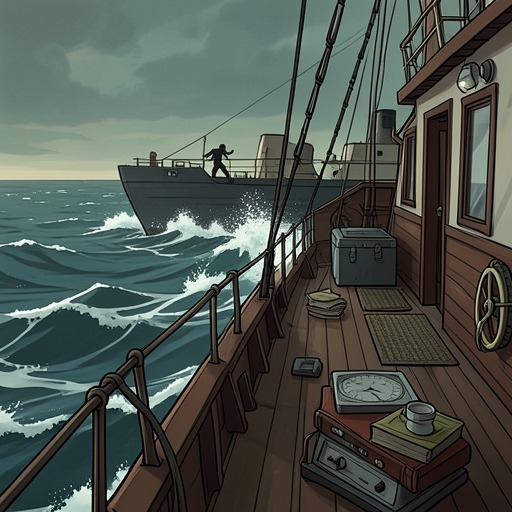
WaspJames Mowry’s escape from Alapertane turns a police search into a race of improvisation: when his car becomes a liability, he uses a delayed Limpet mine and a wired case to complicate the search, then takes a cruiser and eventually abandons it to reach the forest on foot. The escape depends less on outrunning the authorities than on repeatedly changing what they are looking for and where they expect to find him.
The search closes in
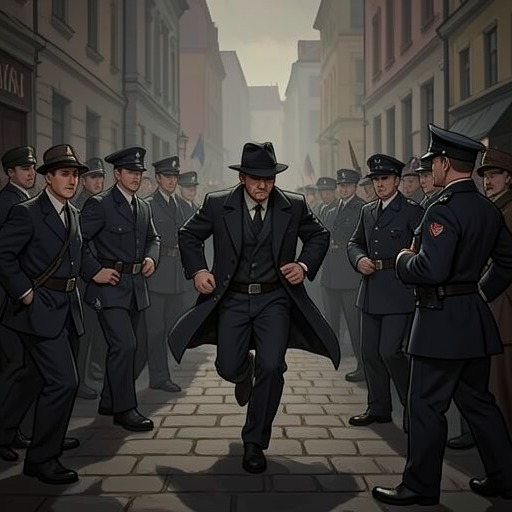
After making his way along the road and rounding the corner near the gates of dock three, Mowry sees the car park and his own car about a hundred yards away. The police activity is no longer casual: he recognizes that the officers are following a definite trail and deduces that they are looking for the dynomotor’s serial number. The discovery turns the car from a means of escape into evidence that can lead the authorities directly to him.
Mowry retreats behind the corner to consider his options. The car he might take instead is locked, and he has neither a key nor time to pick the lock. That failed alternative leaves him with little opportunity to make a quiet substitution. He opens his case, takes out a spare Limpet mine, sets it for a one-hour delay, lies in the road, and inches under a cruiser to attach it. The maneuver is conspicuous in its physical circumstances: seven people see him go underneath the vehicle and emerge, but none treats his actions as extraordinary. Their failure to recognize what he has done gives him a brief opening, not lasting safety.
Distraction and misdirection
Mowry snatches up his case and leaves at a pace close to a shambling run. Looking back at the next corner, he sees one of the policemen sitting in the cruiser and using it. He has placed a delayed device beneath the vehicle, but the nearby officers have not yet reacted to the act they witnessed. The interval between their seeing him and understanding the danger is part of the escape’s narrow margin.
He later leaves the case in the entrance to the main post office. Its lock is wired, and an officer trying to open it with a key could set off a serious incident at the precinct station. The case therefore creates a second danger for the authorities, distinct from the delayed mine beneath the cruiser. Mowry recognizes that the discovery of his dynomotor has already warned Alapertane; the two anticipated bangs would bring the city fully awake and alert. He needs to get out before the authorities can respond by adopting the sort of measures used in Pertane.
The pursuit also catches him out socially. A man assesses him as a renter in a hurry, says that he looks all right, but advises Siskra to call and report him. Mowry is already out the front, down the street, and around two corners before Siskra finishes dialing. Yet the episode does not present every escape as a clean victory: Mowry recognizes that he has been out-thought and that the hunt is a move ahead of him. His quick departure beats the call, but the warning shows how ordinary observation can carry the search forward.
Taking the cruiser
At another point in the pursuit, Mowry gets into a cruiser, closes its doors, and starts the dynomotor while the officers’ attention is elsewhere. On a bus, one policeman is berating a frightened passenger as his two companions watch with cynical amusement. Their attention to that exchange masks the click of the cruiser’s locks and the low whine of its motor. Mowry rolls the vehicle from the verge onto the road and switches on its powerful headlights; the beams reveal the road ahead as he drives into the night.
The stolen cruiser gives him mobility, but it cannot end the pursuit. Twenty-five den from Alapertane, its radio yelps as the powerful long-range transmitter in Pertane broadcasts. The radio’s abrupt signal connects the local chase to a wider search effort and warns Mowry that information can travel farther than the officers immediately behind him. He has to treat the road network, the vehicle, and the communications system as parts of the same danger rather than assume that distance alone will make him safe.
When he passes a side road before noticing it, Mowry brakes, reverses, and turns into it. A glow strengthens above a rise on the road he has just left. He chooses a different route rather than continue along a stretch where approaching lights could expose him. Later, he reaches a farm and pauses to look it over, but the evidence of the escape does not establish that he stays there. The route remains a sequence of decisions under pressure: use a road while it serves his purpose, then leave it when the pursuit threatens to make it predictable.
The last miles and the forest
Mowry succeeds in reaching a point within nine den of his destination without being detected, although the car gives up while passing through a cutting on the final dangerous stretch. The mechanical failure ends the advantage of the cruiser at precisely the moment the remaining road matters most. He leaves it and continues on foot, reaching the main road and moving quickly while watching for armed figures ahead. The change from driving to walking costs speed, but it also removes his dependence on a vehicle that could fail or direct attention to his route.
He eventually reaches the forest as daylight grows. Tired and hungry, he has to rest for ten minutes in every hour, yet continues as quickly as he can. His progress is therefore neither effortless nor secured by the earlier tricks: after using a delayed device, abandoning a wired case, taking a police vehicle, and switching roads, he finishes the escape through persistence on foot.
The account also emphasizes the uncertainty of the pursuit’s geography. Mowry believes the searchers are four hours ahead of where he really is and will probably look farther afield. That mistaken estimate gives him a chance to put distance between himself and the search, but the episode closes on movement rather than confirmed safety: he has entered the forest and is continuing through it, still tired, hungry, and alert to the possibility of being found.