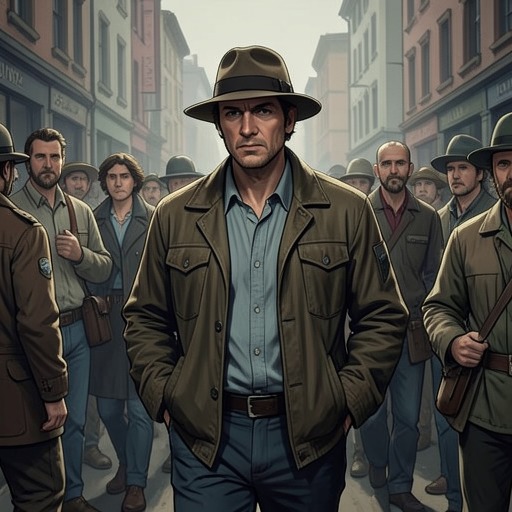
Mowry’s escape from martial-law Pertane
WaspJames Mowry’s escape from martial-law Pertane is a passage through a cordon won not by force but by a performance of authority. With a travel ban in effect and troops surrounding the city, he exploits the soldiers’ deference to rank: at a checkpoint, he bluffs his way past a sergeant and a young lieutenant, then drives on toward the forest. The episode turns the machinery of military control into his means of escape, as obedience and appearances briefly serve him better than open resistance.
The city under restriction
Pertane is presented as a city under martial law. A travel ban has been announced, and the mayor declares that the population will stand firm. For Mowry, however, the immediate question is not how the city will endure the restrictions but whether he can get beyond them before he is caught. The surrounding military presence makes remaining inside a shrinking option: freedom lies in reaching the open country, while staying in the city means waiting for capture.
The perimeter is not a single sealed wall. About sixty routes radiate from Pertane, but the principal roads, including the wide, well-used highways to Shugruma and Radine, are expected to be more heavily guarded. Mowry recognizes that the troop cordon may contain a weak point. Its strength lies in the number of armed men; its vulnerability lies in the need to spread them across many possible exits. The distinction shapes the escape: he must find a way through the military arrangement rather than challenge its full force.
The checkpoint bluff
Mowry approaches a group of soldiers who are tending their automatic weapons and appear bored. No police officer or agent is visible. He slows his vehicle but keeps its dynomotor running, preserving his ability to move, as the soldiers watch with curiosity. A broad, squat sergeant comes from behind a truck and asks, “Have you got an exit permit?” Mowry answers, “Don’t need one,” adopting the authority of a four-star general. He opens his wallet and displays the Kaitempi identification card.
The display does not immediately settle the matter. The sergeant brings over a very young, worried-looking lieutenant, who marches up, salutes, and examines the situation. Mowry again presents the card and speaks to him as if offering a fatherly warning to someone inexperienced. The lieutenant gives the card only a hurried glance. He acknowledges Mowry as a colonel but insists that orders remain orders, then tries to demonstrate his own efficiency in front of the troops.
That effort creates the opening Mowry needs. The lieutenant turns and shouts, “Pass one!” The soldiers obey, opening the block for a single vehicle. Mowry crawls through, curving around the tail of the first truck. The scene’s reversal is precise: the checkpoint is not overcome because the soldiers reject their orders, but because the lieutenant’s attempt to enforce them ceremonially produces a gap. Mowry’s confident manner and the insignia card lend the performance enough weight for the troops to follow the command without stopping him.
From the cordon to the forest
Once past the checkpoint, Mowry continues at reckless speed along a twisting, badly surfaced road. He passes through small, sleepy Palmare, expecting local vigilantes might fire at him; none do, and only a few people glance from their windows. The quiet passage contrasts with the military obstruction behind him. His escape depends not only on crossing the main cordon but on continuing through places where another challenge might arise, without pausing long enough to invite one.
He eventually reaches the Pertane–Valapan route without encountering anything on the track and accelerates toward the forest entrance. Army vehicles are present, and the situation outside the city carries its own risks: people avoid going in because they fear being detained there for weeks. At the identifying tree and tombstone, however, the road is clear in both directions. Mowry takes the opportunity, drives straight over the verge, and enters the forest.
The escape’s turning point
The episode moves from a political restriction imposed on an entire city to a narrow, tactical decision at a roadside barrier. The travel ban and military perimeter establish the scale of the danger; the card, the lieutenant’s salute, and the shouted order show how that danger can be navigated through staged authority. Mowry does not dismantle the cordon or defeat its soldiers. He passes through their obedience, then leaves the road at a recognizable forest landmark when a brief opening appears.
His route also gives the escape its measured progression: from the guarded exits around Pertane, through the checkpoint, past Palmare, onto the Pertane–Valapan road, and finally over the verge into the forest. The destination is reached through successive opportunities rather than a single decisive confrontation. In this sequence, the most important act is the lieutenant’s command to let one vehicle through—and Mowry’s readiness to make that command his exit.