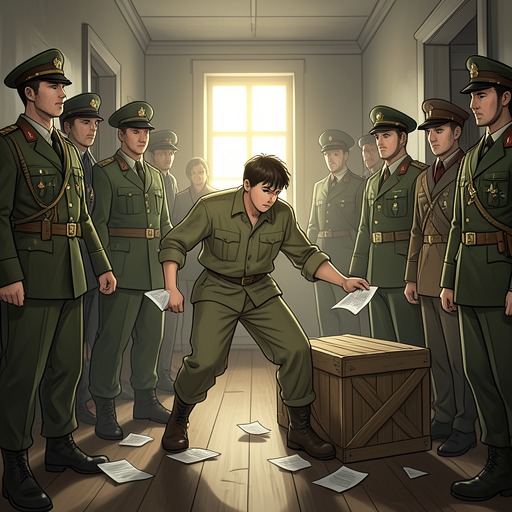
Hector's escape from the Kerak starship
WatchmenHector's escape from the Kerak starship is a decisive demonstration of ingenuity under confinement: while officially permitted to move through limited areas of the vessel, he studies its layout, creates a deliberate power failure, slips through the resulting confusion, and departs in the captain's personal shuttle. The escape shifts control from the Kerak captain to Hector and forces the Kerak command to conceal the incident rather than risk bringing the Star Watch into Kerak.
Confinement and the Contest of Trust
Hector is being held aboard an orbiting Kerak starship under an arrangement that the Kerak captain claims was reached between a superior officer and the Star Watch Commander. The captain insists that a Kerak officer does not lie under any circumstances and offers Hector freedom to roam most of the ship, while excluding the control center, power plant, and air locks. The offer is presented as generous, but it also establishes the boundaries of a controlled imprisonment: Hector may move, yet the areas most relevant to escape remain guarded.
Hector responds not with open defiance but with suspicion. He asks how he can know that the captain is telling the truth, and the question briefly provokes the officer's anger. The captain's assertion of institutional honor cannot resolve the practical problem of captivity; it merely makes the power struggle more explicit. The escape grows out of this unresolved distrust, as Hector treats every permitted movement as an opportunity to test the ship's defenses rather than as evidence that the Kerak authorities can be trusted.
The captain's frustration deepens because Hector refuses to behave like a subordinate. After being warned not to enter the computer area again, Hector accepts the order with a shrug, does not salute, does not wait for dismissal, and walks away whistling. To the captain, this casual conduct is not a minor breach of etiquette. It signals that the Star Watchman does not recognize the ship's military hierarchy as morally or personally binding. The captain later realizes that the computer programmer was only the first casualty and fears that Hector will drive the entire crew insane, an apprehension that becomes literal when the vessel loses power.
Reconnaissance and Preparation
The ship's observation center gives Hector the information he needs. It contains viewscreens displaying nearly every part of the ship's interior as well as exterior views of the planet below, since the vessel is orbiting Kerak's capital planet. From this position Hector learns the relationships among the bridge, navigation section, communications center, and other technical stations. The navigation section is idle because the ship is parked in orbit, while the communications center is guarded; the observation center therefore becomes both his vantage point and his planning room.
Hector uses the captain's confidence in the restrictions to create a routine. Once the guards begin allowing him to roam certain sections alone, he spends long hours mapping the mammoth vessel and identifying his ultimate objective: the Ministry of Intelligence, where a dueling machine is located. His immediate escape is therefore part of a larger purpose. Leaving the ship will not end his involvement with Kerak; it is meant to carry him toward the intelligence ministry and the machine, and the preparation combines patient observation with a willingness to exploit a narrow opening.
The plan depends on making ordinary supervision seem harmless. During one of his customary walks from his quarters toward the communications center, Hector allows the guards to see him seated among a dozen Kerak technicians. Their vigilance relaxes. He then saunters toward the stairwell leading down to the switching equipment on the deck below. The maneuver nearly fails when he misses the second rung of a metal ladder and falls to the lower deck. For a long moment he lies face down, trying to appear invisible or dead; after cautiously looking up and finding that no one has noticed, he continues. The episode reveals that the escape is not effortless bravado but a chain of calculated risks repeatedly threatened by accident.
The Manufactured Power Failure
At the switching equipment Hector finds the leads from the main power plants and the communications antennas. He removes a printed circuit element from a standby console and uses it to bridge the power-lead connectors with the antenna circuit. The connection appears to violate the rules of physics, but Hector knows from an earlier experience aboard a Star Watch ship what the supposedly accidental misconnection will do. His knowledge of systems, not brute force, supplies the decisive weapon.
The circuit takes approximately fifteen seconds to draw the power plants' energy into the short circuit. The result is striking precisely because it is quiet: there are no sparks, smoke, or explosion. Every light and motor aboard the vessel simply goes off at once. Emergency systems activate immediately, but the dim auxiliary lighting and the crew's surprise, bewilderment, and anger produce the confusion Hector needs. A failure that looks initially like a technical emergency is actually a timed diversion, designed to erase the distinction between a guarded prisoner and a rescuer moving through a ship in disorder.
Hector follows a route he has planned in advance to the main air lock. He reaches the captain's shuttle and waits inside it for the main power to return. The sequence depends on patience as much as daring: he does not launch into an uncertain blackout, but remains concealed until the ship's normal systems revive. When the main lights flicker and return to full brightness, the air-lock pumps begin humming, and the outer hatch opens. Hector nudges the throttle, guides the small craft out of the lock, and pulls away from the orbiting starship.
Discovery and Consequences
The captain is not present when the escape begins. He has returned in his personal shuttle because he sensed that something was wrong with the ship before he could identify any visible cause. The suspicion is confirmed when he docks: emergency lights are faint, spacesuited deck hands must crank the outer hatch shut, and auxiliary pumps require nearly fifteen minutes to restore normal air pressure. The physical symptoms of the failure delay his access to the bridge and give Hector the time needed to exploit the emergency.
As the captain and his junior officer hurry from the pressurized end of the air lock toward the bridge, they leave the shuttle empty and unguarded. Hector steps out from that compartment with a wary, serious face and the flicker of a self-satisfied smile. He adjusts the temporarily inert air pumps and hatch controls, seals himself inside the small craft, and studies its controls. The ship's emergency has thus been turned inside out: the officers believe they are responding to a breakdown, while the prisoner is quietly converting their response into his departure.
It takes the captain roughly ten minutes to reconstruct what has happened. He connects the deliberate misconnection in the switching equipment with Hector's disappearance and then with the unauthorized departure of his personal shuttle. The recognition is both technical and humiliating: the escape has left a clear trail, but only after the prisoner has crossed the crucial threshold and is already moving away. The captain admits that Hector has escaped just as the Kerak authorities were preparing to send him back.
The immediate danger is that planetary patrols may detect the shuttle and destroy it because Hector cannot satisfactorily identify himself. The captain briefly welcomes that possibility, but rejects it because losing Hector would bring the entire Star Watch into Kerak. Instead, he orders the communications staff to issue a flight plan falsely identifying the shuttle and an auxiliary boat as carrying personnel and officers to the Ministry of Intelligence. He also prepares another boat for immediate departure with his best men. Hector's escape therefore creates a double crisis: Kerak must pursue him while simultaneously disguising the pursuit, because an overt failure could expose the detention to the Star Watch.
Narrative Function and Significance
The episode follows the pattern of an escape plot while reversing the expected balance between captive and captor. Hector has no access to the command structure, no formal authority, and no guarantee that the shuttle will be easy to operate. His advantage comes from reading the ship more accurately than the people who control it. The captain possesses rank and armed personnel; Hector possesses time, observation, technical memory, and the nerve to turn a guarded system into an instrument of flight.
The escape also exposes the limits of military control. The captain's restrictions appear comprehensive, but they depend on the guards believing that permitted movement remains harmless. Hector's apparent idleness among the technicians, his informal manner, and even his whistling encourage the crew to underestimate him. The same hierarchy that regards him as an undisciplined civilian-like nuisance makes it possible for him to pass through the vessel until he reaches the equipment that matters.
Most importantly, the breakout changes the strategic stakes beyond Hector's personal freedom. His intended destination is the Ministry of Intelligence and its dueling machine, while the Kerak command fears that his loss will summon the Star Watch to Kerak. The stolen shuttle is therefore not merely a vehicle of escape. It is the object that carries the conflict from a contained shipboard detention into a wider confrontation involving planetary patrols, Kerak's intelligence apparatus, and the authority of the Star Watch.