Chinaski’s 1967 blue Volkswagen
WomenChinaski’s 1967 blue Volkswagen is a prized possession whose importance emerges when it is threatened, lost, and returned. He keeps it polished and waxed, carries a whisk broom in the glove compartment, and treats its continued presence as a reassurance he can rely on. The car’s theft turns an ordinary object into the focus of a crisis; its recovery does not resolve the surrounding uncertainties, but lets Chinaski register that he has not lost everything.
Care and Attachment
After his earlier Mercury Comet falls apart, Chinaski buys the 1967 Volkswagen and takes care to keep it clean. The whisk broom tucked in the glove compartment makes that care concrete: the car is not merely useful transportation, but something he maintains with particular attention. Its polished condition distinguishes it from the failed car it replaced and gives it a steady place in his life.
That attachment surfaces sharply during his departure from Lydia. As she beats on the car, Chinaski moves it forward slowly so as not to injure her. Once clear, he drives away, but the sight of Lydia alone in the moonlight leaves him ill and sad; he recognizes that he loves her. The car carries him out of the immediate confrontation, yet the scene makes clear that physical escape does not settle his emotional attachment.
Theft and the Car’s Material Vulnerability
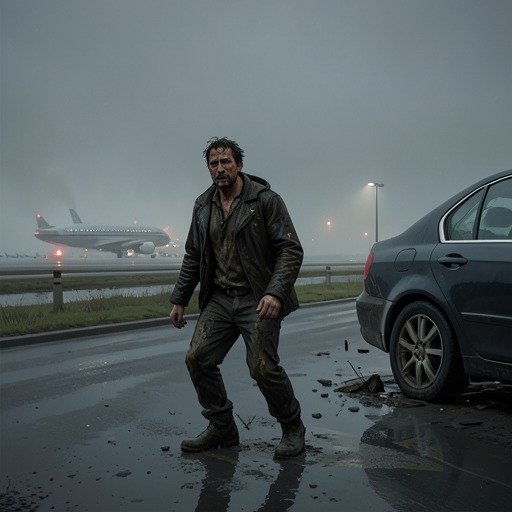
Later, after Chinaski and Katherine return to the parking lot beneath the freeway, the Volkswagen is gone. Chinaski notes that the 1967 model was considered the last good Volkswagen, a judgment that helps explain why the car matters to him as more than a replaceable possession. The theft is accomplished through the familiar coathanger-and-hotwire method while they are watching fights, turning the car’s careful upkeep into no protection against its sudden disappearance.
At a coffee shop, Chinaski calls for a cab and repeats his personal rule: "Take my woman, but leave my car alone." He says he might kill a man who took his car, though not one who took his woman. The contrast is deliberately extreme, measuring the car’s emotional claim against the instability of his romantic life. It also converts an absent object into the subject of the night: at home, with beer and vodka available and too drunk to call the police, he paces and talks about the Volkswagen rather than making love to Katherine.
Imagined Ruin and Recovery
With no immediate way to act, Chinaski imagines young people racing the car along the Coast Highway, smoking marijuana and laughing, then imagines it being reduced in the Santa Fe Avenue junkyards to scattered parts: bumpers, windshields, wheels, seats, and engine components. This inventory gives the theft a second, imagined consequence. The missing car is not only absent from its parking place; in Chinaski’s mind, its recognizable wholeness is already at risk of being broken apart.
The police eventually recover the Volkswagen. It is intact and in good condition apart from a dead battery, and Chinaski has it taken to a Hollywood garage to be put in order. After Katherine says goodbye to him in bed, he drives her to the airport in the blue car, identified by its plate, TRV 469. The recovery restores the car to use and lets it carry him through another parting, rather than leaving it as the ruined object he had pictured.
A Small Reassurance
After driving Katherine to the airport, Chinaski returns to the parking lot and gets into the Volkswagen thinking, "I've still got this. What the hell, I haven't lost everything." The car starts. That simple mechanical response closes its arc in these episodes: the vehicle has been vulnerable to abandonment, theft, and imagined dismantling, but it is present and working when he needs it.
The Volkswagen’s significance lies in the contrast between Chinaski’s declared priorities and the wider precariousness around him. He can care for and recover the car, but the car cannot prevent a painful departure or make his relationships secure. Its value is therefore both practical and emotional: it is a well-kept possession, a recurring focus of anxious attention, and, at the end of this sequence, a modest proof that something remains dependable.