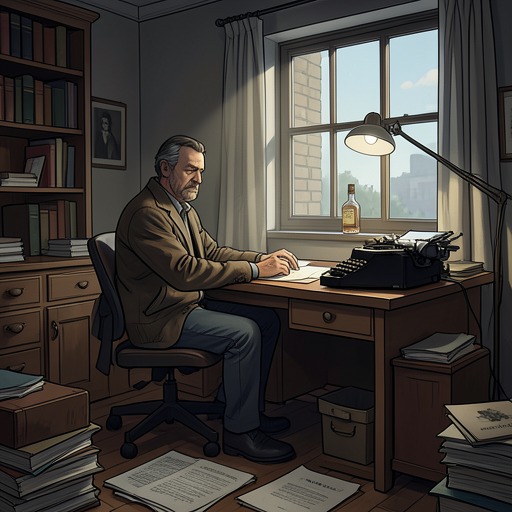
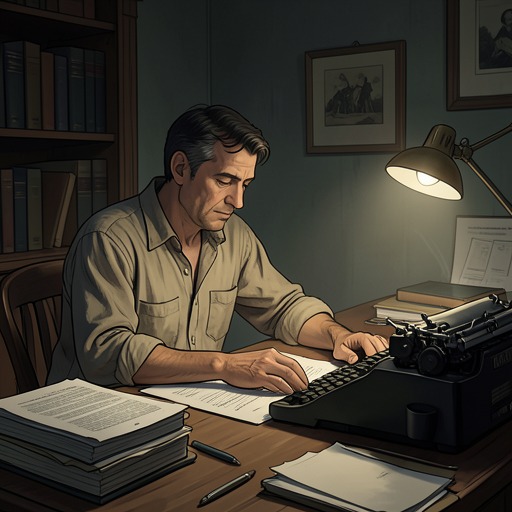
Henry Chinaski’s typewriter
WomenHenry Chinaski’s typewriter is both a working instrument and a material record of his life as a writer: when Lydia Vance ransacks his home, it is among the possessions she takes, and she later destroys it in the street. Its transformation from an everyday tool into the focus of a violent confrontation makes the damage to Chinaski’s books and belongings physically unmistakable.
The Typewriter in the Ransacked Home
After a night at the harness races, where he loses $32, Chinaski returns home and finds the lights on and the rooms overturned. Drawers have been pulled out, bed covers lie on the floor, and the bookcase has been emptied of his books—including about twenty he wrote himself. The typewriter is gone along with his toaster, radio, and paintings. He immediately thinks Lydia is responsible. She has left the television behind because she knows he never watches it, a detail that makes the removal of the other objects seem selective rather than indiscriminate.
Hidden, Then Destroyed
The typewriter is not simply carried away: Lydia has hidden it, together with Chinaski’s radio and toaster, behind a small bush beside the driveway of the neighboring apartment house. She retrieves the machine and runs into the center of the street with it. The narration emphasizes its physical weight and old-fashioned standard design before describing the destruction: Lydia lifts it above her head with both hands and smashes it onto the pavement, scattering the platen and other parts. She picks it up again and brings it down a second time.
The Object as the Scene’s Focus
As Lydia destroys the typewriter, she screams, "DON'T TELL ME ABOUT YOUR WOMEN!" The words make the machine the scene’s tangible target in a conflict about Chinaski’s other relationships. Rather than remaining an unobtrusive tool of composition, it becomes conspicuous through its weight, its raised silhouette, and its broken components. Its destruction turns the loss of a writer’s instrument into a public, physical act of accusation; the scattered parts record the force of the confrontation without resolving the conflict that produced it.
Aftermath and Significance
Lydia jumps into her car and drives away. The police cruiser arrives fifteen seconds later, and Chinaski gives the officers the description of her orange Volkswagen, called the Thing, including the letters HZY. The typewriter’s destruction is thus part of a larger episode in which books and household possessions disappear or are damaged, while the television remains untouched. For Chinaski, the ruined machine marks the material cost of the rupture; for the narrative, it concentrates that rupture into a single object whose ordinary function has been violently overturned.