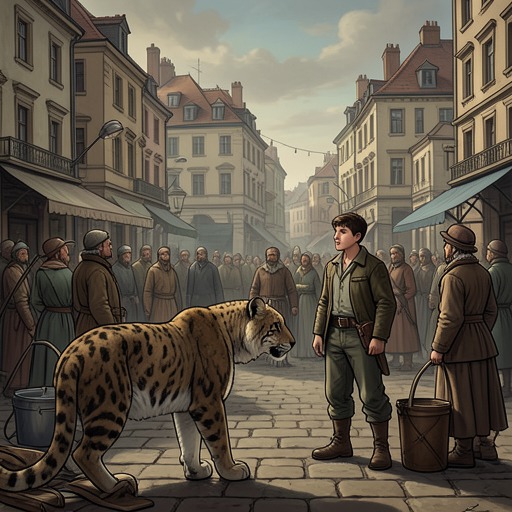
Carag estranged from his birth family
WoodwalkersCarag’s estrangement from his birth family is the emotional cost of leaving the puma life for human society, and it remains unresolved even as he finds a place at Clearwater High. He departs after a painful farewell, then spends the next year and a half unable to locate his family; later, acceptance at school sharpens rather than erases his longing to share that new life with them.
The Departure
As Carag prepares to leave, his human eyes fill with tears: being only a puma does not feel like enough, though he cannot explain that feeling to his family. His mother laments that they will not be able to help if he needs them. He hopes she might transform and show that she, too, is partly human and understands his experience, but she remains in puma form.
The goodbye is physical and uneven. Carag embraces Mia, his father, and then his mother, pressing against their furred necks. His mother sends him a mental warning to stay careful. His father does not move when Carag embraces him and refuses to look at him. Carag tries to read this as anger that will pass, but the gesture makes the separation feel precarious: he cannot know whether his father is turning away for good.
Carag retrieves his clothes from their hiding place and walks down the valley in human form, barefoot, through woods and clearings until he reaches the first buildings. At the police station in Jackson Hole, he claims not to know who he is or where he comes from. The deception succeeds: taken for human, he receives the papers he needs. His departure is therefore not simply a journey away from his family; it requires him to conceal his origins in order to enter the human world.
Keepsakes and the Failed Search
When Carag prepares to leave for Clearwater High, the carved horn chain made by his mother goes into his backpack. Its history ties it to the family’s practical survival as well as to his affection for her: although she fears humans, she goes into town twice a year to sell such objects and replenish the money kept in the family’s hiding place. The chain travels with Carag as a small, tangible connection to the people he is leaving behind.
The reunion he hopes for does not follow. A year and a half after trying to see his family again, Carag has not found them. He suspects that they may have changed their hunting territory, but cannot tell whether his departure caused that change or whether something else happened. They could be hundreds of kilometers away among the mountain peaks, and he has no idea how to find them or whether they have forgiven him. The uncertainty is not just about location: Carag is cut off from any knowledge of what has happened to his family and of how they now regard him.
A New Home, an Absent Family
The separation persists alongside Carag’s adjustment to life among humans. In autumn, with winter approaching early in the Rocky Mountains, he recognizes that surviving alone in the mountains would be possible for an adult puma, but he is not yet an adult. His thoughts return to the family he cannot find, even as the immediate demands of his new circumstances press in on him.
Later, after his foster family has left Clearwater High, Carag leans against the entrance-hall wall and exhales in relief, but the relief gives way to sadness. He imagines finding his mother in the mountains and telling her, his father, and Mia that he has been accepted at the school and can learn to live in both worlds. That imagined reunion joins his two lives in a way reality has not yet allowed: the school offers him a future, while his birth family remains the audience he most wishes could witness it.
Significance of the Estrangement
Carag’s separation has no confirmed resolution in these episodes. His father’s refusal to meet his eyes, the lost trail through the mountains, and Carag’s unanswered question about forgiveness leave the relationship open rather than settled. At the same time, the mental warning from his mother and the horn chain she made preserve signs of care across the distance. His longing is therefore sustained by both absence and connection: he does not know whether his family can help or welcome him, but he continues to imagine bringing them into the life he is building.