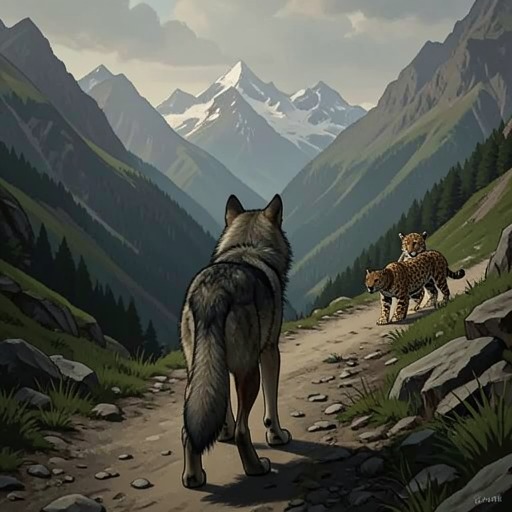
Carag’s separation from his family
WoodwalkersCarag’s separation from his family is both a search without an answer and a wound that repeatedly opens under pressure. He does not know where his parents or his sister Mia are, and he cannot tell whether they have moved on, rejected him, or met some worse fate. Andrew Milling turns that uncertainty into leverage by offering to find them if Carag joins him; Carag’s response is an emphatic refusal to accept that his family is dead, followed by a renewed longing for the home and shared life he has lost.
The Unanswered Absence
Carag’s family is physically out of reach, but their absence also unsettles his sense of belonging. After Milling suggests that Carag’s failure to find his family is a bad sign, Carag springs up and insists that they must have gone elsewhere, seeking a different territory. He refuses to accept that they are dead. The force of his denial shows how little he knows: he can imagine a reason for their disappearance, but cannot confirm it. He runs from Milling before he can be drawn further into the conversation, crossing the hall with its great fireplace, the heavy carved entrance door, and a parking lot full of large vehicles.
That escape does not restore his composure. Carag reaches his room in a few agile puma bounds, crawls beneath the covers, and trembles without being able to stop. Through the night, the uncertainty about his family shares space in his mind with memories of Milling’s violence and questions about how dangerous Milling may be. In the morning, Carag is unwilling to tell Brandon what happened. The silence leaves the encounter unresolved, while Carag’s distress makes clear that the question of his family is not a distant worry that Milling has simply raised for discussion.
Searching for Traces
Carag’s hope is tested by what he cannot find. During a camping trip at Madison, he waits until the others are asleep, slips out of his sleeping bag, and takes his puma form among the pine needles. He moves quietly through the trees, unnoticed by anyone still awake at the campground. The search is practical and physical: he checks trees for scratches and urine, examines old prey remains, and scents the valley, looking for signs that might lead him to his family.
The search yields no trace of them. The only animal signs he finds belong to an old female puma, several black bears, and a badger enlarging the entrance to its den. These details establish the limits of what Carag can learn from the land: the valley is inhabited, and it carries evidence of other animals, but nothing that identifies his own family. His relatives remain absent even in the environment where he hopes their traces might speak for them.
Grief, Memory, and Belonging
When Milling’s suggestion brings the loss sharply back, Carag tries to reassure himself that Mia is safe somewhere in the Rocky Mountains. Yet reassurance does not settle the questions that follow. He wonders whether his parents and sister are still angry with him, whether they deliberately left the region to forget the son they had rejected, or whether the silence has some other explanation. The possibilities are painful precisely because he cannot distinguish among them. For a while, other events have crowded out thoughts of his family; now their absence returns with renewed force.
Carag’s longing is not limited to knowing where they are. He misses his parents and Mia, the mountains themselves, games in the undergrowth, curling up together in a comfortable nest of dry grass, and the excitement of a hunt shared with others. The recalled scenes give separation a concrete shape: it means losing familiar places and ordinary forms of companionship as well as losing contact with specific relatives. His hope for their safety survives, but it exists alongside the fear that they may have chosen to leave him behind.
Milling’s Offer and Its Stakes
Milling’s proposal exploits exactly this combination of hope and uncertainty. He acknowledges that he does not know where Carag’s parents are, but claims that his power could enable him to discover their whereabouts, something Carag has been unable to do alone. He makes that help conditional on Carag joining him and sets a deadline of the following evening. The offer is therefore not proof that Milling can reunite the family; it is a promise whose appeal depends on Carag’s desperate wish to find them.
Carag feels the pull of the proposal as a sharp ache and folds inward in his chair while memories of his family and mountain life surge back. At the same time, his trust in Milling is compromised: afterward, Carag wonders how Milling knew details about his life at the Ralston home and at school, and suspects that the man may have been spying. The offer thus intensifies the central uncertainty rather than resolving it. Carag has not yet learned where his family went, whether they are safe, or whether they want to be found; the possibility of reunion remains entangled with Milling’s demand for allegiance.