Clearwater High
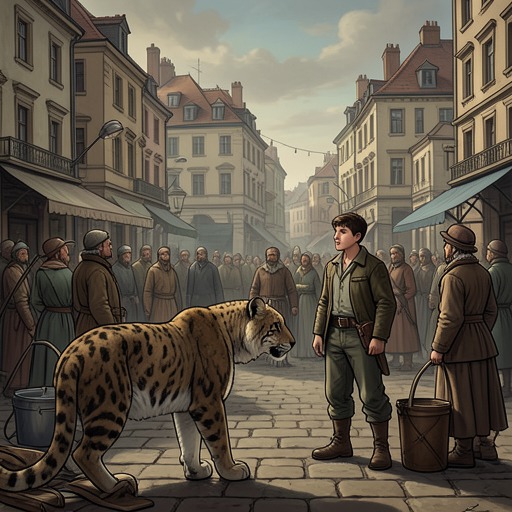
WoodwalkersClearwater High is a boarding school for Woodwalkers, established by Lissa Clearwater to help young shapeshifters live in both human and animal worlds. Its campus is designed to join rather than separate school life from the surrounding landscape, while its rules protect students’ secrecy and regulate the risks of sharing a community across predator and prey species. For Carag, arriving there marks the beginning of a new education—and of conflicts that test whether the school’s protections can withstand the loyalties and dangers beyond its walls.
Purpose and Origins
Lissa Clearwater tells Carag that she founded the school three years earlier for young people who want to learn how to manage life in both worlds. Woodwalkers are rare, she explains, but they include many animal kinds. A second school in Florida, run by her older son Jack, serves those who need water, including dolphins, alligators, and sharks. Clearwater High is therefore one part of a wider educational arrangement for shapeshifters, not an ordinary school with a single kind of student.
The school offers year-round admissions, and Carag can begin soon after Lissa approaches him. She presents its instruction as practical as well as academic: students learn to transform more easily and to deal with difficult humans. That purpose responds to the precarious position of Woodwalkers, who must navigate human society without revealing what they are. Lessons also prepare students to deceive human researchers when necessary by behaving like entirely ordinary animals.
The institution’s resources carry consequences beyond its educational work. Andrew Milling’s donations helped make the school what it is and paid for its western wing. When Carag warns Lissa that Milling may intend to harm humans, she asks for concrete evidence and refuses to treat his accusation as established fact. She emphasizes Milling’s public support for the school and advises Carag to learn from him. The exchange makes the school’s dependence on a powerful benefactor a source of tension: the place that offers Carag safety and instruction is also materially connected to a person he fears.
Campus and Daily Life
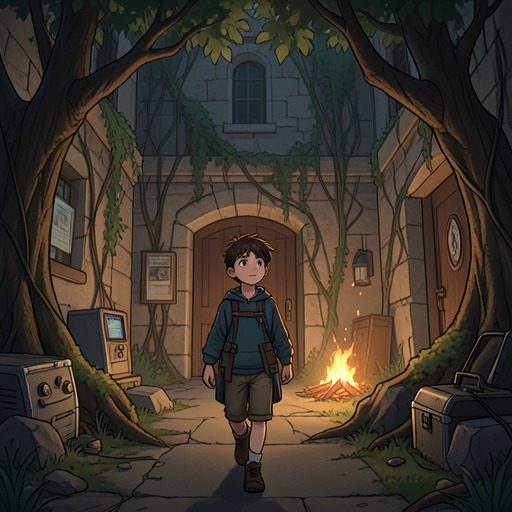
The school stands not far from Jackson Hole. From the visitor entrance, its rough brick walls, extensive glass, and steel sign give it the appearance of a recognizable institution. Beyond that front, the building blends increasingly into its setting. Holly leads Carag around the side to the west wing, where rooms are set among apparently piled granite blocks topped with grass and small trees; her own window is a round pane fitted into one of the stones. The contrast between the formal entrance and the concealed, rock-like student quarters makes the campus’s relationship with the landscape visible in its architecture.
Brandon describes a roughly square main building organized around a large central garden. Student dormitories and private teachers’ rooms occupy the first floor; classrooms, the auditorium, and faculty offices are on the ground floor. Storage rooms and a laboratory lie in the basement, which students may enter only with a teacher’s permission. This restriction places some parts of the school under explicit adult supervision, even as the campus provides students with shared spaces for ordinary social life.
The refectory sits beneath a glass dome that can open in the sun like the two halves of a shell. More than thirty students eat there in human form, apparently in accordance with school rules. Beside the dining area, the relaxation space has sofas, padded baskets, cushions, tables, open laptops, a table football game, and board games. These details describe a residence as much as a classroom: students eat, study, and spend unstructured time together in surroundings that accommodate very different bodies and habits.
The school’s schedule allows students to stay awake as long as they wish, provided they arrive punctually for class the next day. That policy accommodates students who are active at night or need little sleep. When Carag returns shortly before midnight, other students are still up, and Trudy, an owl shapeshifter, flies overhead. The school’s daily order is thus built around a mixed community rather than a single human timetable.
Rules, Safety, and Discipline
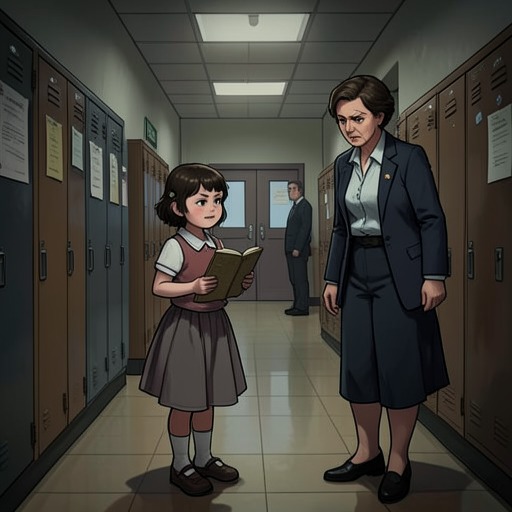
Clearwater High’s regulations manage the hazards of a community in which some students are predators and others are potential prey. Rule Three bars predators from looking down on or harming prey. Carag sees the rule invoked when Jeffrey intimidates Nimble, a rabbit shapeshifter, and then deliberately shows his fangs. Nimble retreats despite appealing to the regulation. The incident exposes a difference between a rule’s stated protection and a student’s ability to enforce it in the moment.
Other provisions govern transformation and conflict. Students may transform during school hours only with a teacher’s permission, and fights between students are allowed only in the class devoted to fighting and survival. When Carag is about to confront Jeffrey’s group, Bridger holds him by the shoulder, sends the wolves away, and challenges him over both possible violations. Carag admits that he has not yet read the rules Lissa gave him on his first day. His introduction to school discipline comes not as abstract orientation but as an immediate limit placed on anger.
The rules also guard the boundary between Woodwalkers and humans. Rule Two requires members of the school to prevent outsiders from learning that Woodwalkers exist and prohibits filming transformations. Rule Four requires anyone about to attack prey to check first that it is not another shapeshifter. Rule Seven forbids territorial marking inside the building and its enclosing wall, except at a student’s own bedroom door. After the confrontation with Jeffrey, Carag reads the full regulations so that he will not break more of them. Together, these provisions address secrecy, mistaken attacks, aggression, and the competing territorial instincts of students sharing one campus.
The surrounding land extends the school’s protection beyond its buildings. Lissa Clearwater has bought as much nearby land as she could afford, and Bridger explains that within a five-kilometer radius students are protected even in their animal forms. That boundary matters because Carag later strays far from the school’s safe territory while in the forest. He remembers that cougar hunting season runs from October through March and that a license to kill one is easy to obtain. The school’s protection is substantial, but it is geographical rather than unlimited.
Teaching, Examinations, and Student Life
The curriculum combines conventional subjects with instruction specific to Woodwalker life. Carag attends History with Bill Brighteye and Biology with Lissa Clearwater; other teaching addresses researchers, survival, transformation, and relations with humans. A midyear examination period in December determines who may join the subsequent learning trips. Students who fail must repeat the first three months of study, so the prospect of the exams gives academic performance practical consequences.
The examination in Fighting and Transformation makes the school’s distinctive education public within the student community. A gong summons students to the auditorium, a bright hall with steeply pitched rough-beam rafters and white glass panels that admit light while preventing outsiders from seeing in. Dry earth covers the floor at the center; students of the second and third years sit on cushions around the perimeter, while new arrivals must demonstrate their abilities first. Lissa and the other teachers occupy the honored front row. Before the examination, Bill Brighteye reminds students to put away cameras and phones because transformations must not be recorded. The architecture and the warning serve the same purpose: the students’ abilities can be examined without becoming evidence for outsiders.
The institution also tries to teach control rather than mere power. When Brandon struggles in Fighting and Transformation because he hesitates to attack Bill Brighteye, Holly worries that he will earn poor marks and fail the December examination. Carag suggests that they practice with Brandon so he can learn that being an animal can be enjoyable. The episode shows how school performance, confidence in animal form, and emotional adjustment are intertwined; the exam assesses a capacity Brandon has not yet learned to use freely.
Conflict and Narrative Significance
The school can provide shelter without resolving every danger brought into it. Carag’s warning about Andrew Milling meets Lissa’s skepticism in part because the school has benefited from his money. Later, Lissa summons Carag, Holly, and Brandon to her office after they are caught in a trap connected to a retaliatory scheme. The wolves who appear pleased as the three leave the classroom help Carag recognize that the summons is not routine. Lissa reprimands Carag and Brandon, warning against provoking human hostility and telling Carag to judge whether an action will serve its intended purpose before acting. The school’s concern for secrecy thus shapes discipline even when students believe they have reasons to intervene.
Clearwater High also functions as Carag’s residential home, though his family ties remain elsewhere. Lou returns home every Friday and comes back on Sunday evening, while Carag is expected to visit his foster home every other weekend. The rhythms of boarding-school life provide time away from Jackson Hole, but do not erase the difference between his birth family, his foster family, and his life among Woodwalkers. The campus becomes the setting in which those separate loyalties meet new friendships, rivalries, and responsibilities.
Near the end of the year, Lissa authorizes students to use the basement for a large celebration shortly before Christmas break. Two free rooms and the corridor have already been decorated by the time Carag looks around in amazement. The gathering offers a communal counterpoint to the school’s exams, rules, and dangers: Clearwater High is not only a protected training ground but also a place where students make a shared life. Its central significance lies in that double role. It shelters a hidden population while teaching young Woodwalkers how to inhabit a world in which safety, belonging, and secrecy never quite coincide.