Jackson Hole
WoodwalkersJackson Hole is both Carag’s adopted human home and a place where the limits of that identity repeatedly surface. Its main street first overwhelms him with the unfamiliar abundance of shops, people, and cars; later, the town becomes the setting for his school life with the Ralston family and the return point from which he faces the nearby wilderness he knows as a puma.
First Arrival and the Main Street
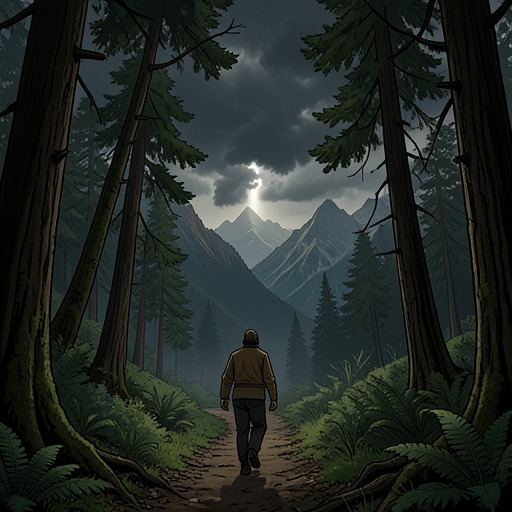
Carag reaches Jackson Hole on foot after leaving his family. In human form and barefoot, he comes down from the wooded slopes, crosses woods and clearings, and approaches the first buildings. At the police station, he claims that he no longer knows who he is or where he came from. The deception succeeds: the officers take him for a human and give him the papers he needs. Jackson Hole thus becomes the starting place of his imposed human biography, not because he arrives with a settled identity, but because he finds a way to pass as someone whose past is unknown.
His first experience of the main street is a sensory shock. He and Mia arrive in clothes that are faded, stained, and poorly fitting, with pine needles in their hair and dirt on their hands, yet Carag is too excited by the crowds to care whether anyone is watching. The polished cars fascinate him and repel him with their powerful smell. Shop windows display hats, stones, clothes, mugs printed with faces, and food; he presses his face against the glass, absorbed by objects and choices that have no counterpart in his former life.
A sign for ice cream brings that unfamiliarity into his body. Carag can read the flavors listed on it because his mother taught him to read, but he has never been told what ice cream is. The sweet, buttery aroma is followed by a rumbling in his stomach and, more urgently, fur beginning to emerge beneath his shirt. In Jackson Hole, curiosity about an ordinary human treat coincides with the threat that his animal form will betray him. The town’s storefront is therefore more than a marker of modern human life: it is the setting for an early collision between learning to inhabit that life and remaining a puma.
Jay’s Adopted Life
By thirteen, Carag is known as Jay and has attended seventh grade at Jackson Hole Junior High School for only a couple of weeks. He began late because he first needed private lessons at his adoptive family’s home to learn about the human world. His short, sand-colored hair and green-gold eyes help him pass as an ordinary student; jeans, sneakers, and a backpack complete that appearance. Almost everyone at school has grown accustomed to him, though the qualification that this is not true of everyone leaves his acceptance incomplete.
The Ralston home makes the same divided existence tangible in domestic form. Carag returns there from school, where the family’s black Labrador, Bingo, habitually barks at him with its fur bristling. Carag usually ignores the dog, attributing its hostility to an aversion to felines. On another visit, however, he responds as a puma in human guise: he bares his human teeth and hisses, and Bingo retreats whimpering with its tail between its legs. Donald, Carag’s adoptive father, is left wondering what happened. The exchange briefly reverses the household’s apparent order: the dog’s instinct recognizes an animal presence, while Carag’s response reveals how difficult it is for him to keep that presence contained.
Family, School, and the Wilderness Nearby
Jackson Hole is also where Andrew Milling’s family story becomes attached to the surrounding mountains. Milling recounts that, after the birth of his daughter June, he and Evelyn moved there from Los Angeles because Evelyn wanted to live among the mountains. She loved snow, and she and June played in it, sometimes in their second forms. In his telling, the move begins as a choice for a shared life in a landscape they enjoy. The hunting season, which Milling says he warned them about, gives that landscape a more dangerous dimension; the account presented here establishes the risk without yet disclosing its outcome.
For Carag, the town is also the base of an adoptive family’s idea of an outing. Anna welcomes him home with vegetable lasagna, and Donald announces that they will camp in Yellowstone the next day. Carag has to pretend to share their enthusiasm. He already knows Yellowstone’s stones and blades of grass, and he expects the animals that recognize him as a puma to laugh at him for sleeping in a nylon tent. The contrast is pointed: what the Ralstons imagine as an excursion into the wild is, for Carag, familiar territory reached from the human home he is expected to perform.
A Home That Does Not Settle Identity
Carag’s returns to Jackson Hole expose how little outward familiarity guarantees a sense of belonging. After several weeks at Clearwater High, he stands in his unchanged bedroom and feels like a stranger. He has been trying to be Jay, the ordinary boy in the Ralston household, but recognizes that this description does not contain who he is: despite his human appearance, he is Carag. The room has not changed; his relation to it has. Jackson Hole can provide him with papers, schooling, a bed, and a family routine, but those supports do not erase the identity he carries beneath them.
The town’s narrative significance lies in this unresolved double function. It is the place where Carag successfully passes as human and where ordinary encounters—a shop window, a school routine, a family meal, a dog at the door—make that performance visible as effort. At the same time, its proximity to the mountains and to Yellowstone connects human domestic life with the animal world Carag already knows. Jackson Hole is not simply a refuge from the wild or a rejection of it; it is the threshold on which his two lives repeatedly meet.