Sierra Lodge
WoodwalkersSierra Lodge is Andrew Milling’s ski resort in Jackson Hole and the setting for his first extended private conversation with Carag. Its impressive mountain hospitality gives way to an intensely personal account: in a room cleared of other diners, Milling traces his wealth and influence to a vow of revenge after the deaths of his wife, Evelyn, and their daughter, June.
Ownership and Setting
Milling owns Sierra Lodge as one part of a wide-ranging business empire. Donald describes him as among the most important men in the western United States, with interests in an oil company, a film-production company, Silicon Valley businesses, and the resort. The lodge therefore represents more than a place to ski: it is one visible expression of the wealth and reach Milling has deliberately accumulated.
The property is a large ranch built of wood and gray stone, with smaller wooden cabins around it for guests. It stands at the foot of the mountains. From the great picture window in the main hall, visitors can see Grand Teton, its peaks covered by the first snow of September. Inside, hikers in expensive boots sit by a granite fireplace nearly as large as the entrance to Clearwater High. The fire warms the room, but its smell of embers unsettles Carag, who keeps away from it and recalls that he never shared his former classmates’ enthusiasm for campfires.
The lodge’s human guests also shape Carag’s experience of arrival. The shapeshifter woman sent to drive him there has partly transformed into a snake, her forked tongue flicking from her mouth. In the company of humans, she stays quiet and leads him to the ranch dining room, furnished with comfortable wooden pieces and floor lamps. The polished hospitality of the place is thus encountered through Carag’s wary, animal-sensitive perspective as well as through its architecture.
The Meeting with Carag
Milling arranges the meeting after telling Carag that he is pleased with his progress at school. He insists that Carag call him Andrew, then instructs him to meet the next evening at seven at the restaurant in Sierra Lodge. The conversation is presented as a proposal, but Carag recognizes its force as an order. When he asks how he will get there, Milling says that he will send a driver if the school cannot provide one.
Carag arrives by that arranged ride, and the lodge’s imposing setting sharpens the imbalance between host and guest. He recognizes Milling’s scent before seeing him: it carries the warning of a dominant male capable of defending his territory. Milling greets him with affection, while Carag meets his eyes rather than displaying submission. The exchange makes the restaurant feel like more than neutral ground. Even before the conversation turns to the past, both the physical territory and the terms of their relationship are in view.
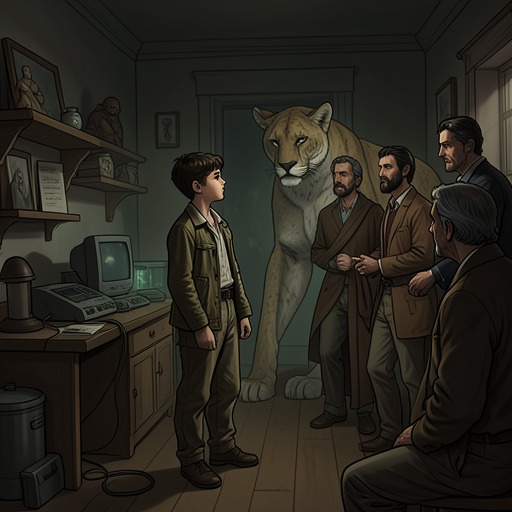
The private character of the meeting is carefully maintained. When the meal arrives, the tables around them are marked as reserved but remain empty. Milling dismisses the waitress and asks to be left alone with Carag, since their subject is not intended for human ears. The restaurant’s apparent vacancy is therefore functional as well as atmospheric: Milling has arranged a setting in which he can speak openly about Woodwalkers without human listeners. Carag notices the meal Milling has been served—lightly seared slices of beef heart—but Milling initially leaves it untouched and continues talking.
Evelyn, June, and the Lodge’s Hidden History
At the restaurant, Milling recounts his earlier life. While working on a project, he met Evelyn, a young production manager whom he describes as beautiful and difficult to approach. He was delighted to discover that she, like him, was a mountain-lion shapeshifter. She came from the island of Vancouver, and Milling says that he fell in love with her within days, although winning her over took longer because she was already engaged. He remembers their eventual life together as happy.
The account moves from courtship to family. After their daughter June was born, Milling says, their happiness grew. They left Los Angeles for Jackson Hole because Evelyn wanted to live among the mountains and loved the snow. She and June would run through it, often in their animal forms. The mountain setting of Sierra Lodge consequently belongs to the history he tells: it is situated in the kind of landscape Evelyn chose, and the account links Milling’s public life in Jackson Hole with the private family life he once built there.
His tone changes as he describes what followed. He says that he resolved to damage humans as much as possible, and that fulfilling this purpose required him to become rich and powerful enough that nobody could stop him. He presents the accumulation of wealth as focused labor toward a single objective, not as an accidental by-product of success. When Carag asks about the hunter, Milling says that the man was later found in the forest; Carag understands the implication. The account turns the luxurious restaurant into a place where a personal loss is disclosed alongside the motive behind Milling’s broader campaign against humans.
Narrative Significance
Sierra Lodge brings together Milling’s public authority and private grievance. Its scale, costly comfort, and position beneath the mountains make his influence tangible; its emptied dining room allows that authority to become intimate and unsettling. The meeting also places Carag within a conflict he cannot treat as abstract: he hears how Milling’s family history became the source of a deliberate project of power and revenge.
The lodge’s role is therefore not limited to hospitality or business. It is both a controlled meeting place and the setting for a reversal in Carag’s understanding of Milling: the powerful resort owner speaks not only as a wealthy public figure but as a husband and father whose bereavement has hardened into a plan against humans. The same mountain world associated with Evelyn and June’s chosen home stands around the conversation, while the empty tables and untouched meal hold the narration in the tense interval before Milling turns to the food and resumes his account.