Clearwater High Rule 4: Check that prey is not a woodwalker before attacking
WoodwalkersClearwater High Rule 4: Check that prey is not a woodwalker is a school safeguard against attacks on students in animal form: before attacking prey, a Woodwalker must make sure it is not another Woodwalker. Carag singles it out as especially important, a practical rule for a community whose members can appear to one another as predator and prey.
Rule and Purpose
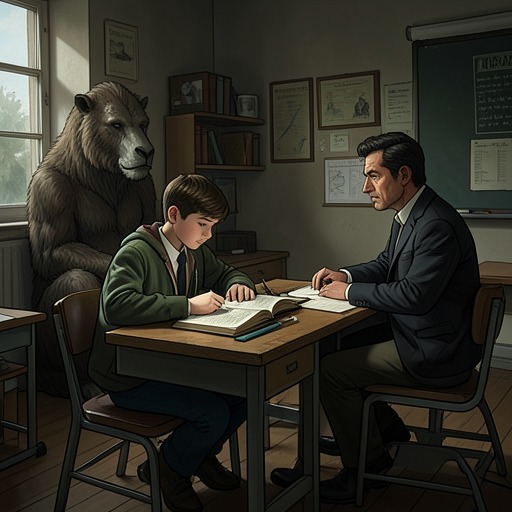
After his first day at Clearwater High, Carag reads the school regulations carefully so that he will not inadvertently break more of them. Rule 4 addresses a danger specific to a school of shapeshifters: an animal that looks like prey may be a fellow student. Its instruction is a required check before an attack, rather than a blanket ban on predatory behavior.
Carag’s emphasis on this rule makes its stakes clear. He has only recently returned to life as a puma and is drawn to the freedom and instincts of that form; during a nighttime excursion, he surveys a clearing where wapiti are grazing. The rule places a boundary around those instincts: the appearance of prey alone is not enough to establish that an attack is safe.
Place Among the School Rules
Rule 4 belongs to a broader set of regulations that Carag studies after arriving. He also notes the requirement to keep Woodwalkers’ existence secret from outsiders, including a ban on filming transformations, and the prohibition on marking territory inside the school grounds and its boundary wall. Together, these provisions address different risks of a shared school: exposure to humans, harm between students, and animal territorial behavior in communal space.
The neighboring predator-prey rule, Rule 3, is invoked publicly when Nimble protests Jeffrey’s treatment of him. That confrontation shows that Clearwater High’s protections are not merely abstract: students can call on the rules when predator status is used to intimidate prey. Rule 4 addresses a distinct but related problem—not mistreatment after a student is recognized as prey, but the danger of failing to recognize a fellow Woodwalker before an attack begins.
Learning and Practical Stakes
Carag encounters the regulations while still learning how Clearwater High manages life between human and animal forms. In a confrontation with Jeffrey’s group, teacher Bridger stops Carag from escalating the dispute and asks whether he had been about to transform. Bridger reminds him that students may transform during school hours only with a teacher’s permission, and also points out the rule limiting student fights to the combat-and-survival class. The exchange establishes that the rules govern conduct in specific circumstances; Carag’s later careful reading is his response to having arrived without knowing them.
The need for the prey-identification rule extends beyond school disputes. In a survival lesson, Carag learns that puma hunting season runs from October through March and that a hunter needs only a license to kill one. Later, away from the school’s safe territory in winter, he hears hunting dogs and realizes that a fresh track could lead them to him. These dangers do not show Rule 4 being invoked, but they sharpen the distinction it protects: an animal body may belong to a Woodwalker, and mistaking that body for ordinary prey can have irreversible consequences.
Significance
Rule 4 makes recognition a condition of attack. In a school community where animal forms carry real predatory capacities, the regulation converts the general need to live alongside different kinds of students into a precise pause before violence. Its importance lies in that pause: a potential target must first be considered not just as prey, but as possibly one of the school’s own.