Woodwalker secrecy from humans
WoodwalkersWoodwalker secrecy from humans is a daily survival practice for Carag: he must appear human while keeping his shapeshifter identity and knowledge of the hidden Woodwalker world from people who do not know it exists. It gives him a way into human society, but turns ordinary interactions—with police, classmates, and his adoptive mother—into tests of what he can safely reveal.
Identity and Concealment
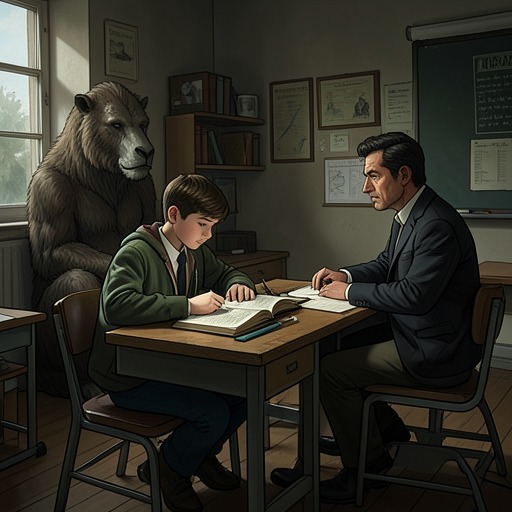
The concealment begins with a public story that Carag has lost his memory. Newspapers and television call him a mysterious boy who appeared from the forest, and people assume he cannot say who he is because he remembers nothing. The truth is the opposite: his memory works perfectly, and he recalls the day he first received permission to approach humans. The false account protects the identity he cannot disclose while making his arrival legible to the human world.
Carag makes that cover story work by walking in human form, barefoot, from his family’s hiding place through woods and clearings to the police station in Jackson Hole. There he claims not to know who he is or where he came from. The plan succeeds: the police take him for a human and provide the papers he needs. The deception is not merely a disguise in appearance; it supplies him with a recognized human identity and a route into ordinary institutions.
Living Between Human and Woodwalker Worlds
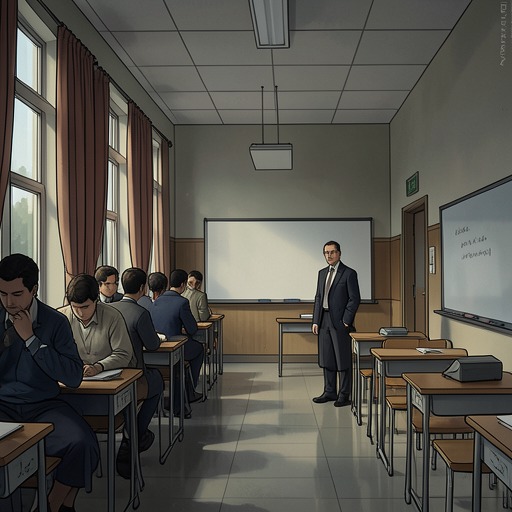
At thirteen, Carag is known as Jay and attends seventh grade at the Junior High School in Jackson Hole. He has only recently started school because he first needed private lessons at his adoptive family’s home to learn about human life. Sand-colored hair, green-gold eyes, jeans, sneakers, and a backpack help him pass as an unremarkable student. His human appearance makes concealment possible, but does not resolve the deeper question of where he belongs.
Before meeting other shapeshifters, Carag wonders whether his parents, his sister Mia, and he might be the only Woodwalkers in the world. His adoptive mother, Anna Ralston, urges him not to treat difference as a reason no one will be his friend, but she does not know how radically different he is. The gap between what she can offer and what he cannot tell her makes secrecy an intimate barrier, not just a public one.
That divide resurfaces when Carag returns to his unchanged bedroom after spending weeks at Clearwater High. A planned family camping trip to Yellowstone feels alien to him: the landscape is already familiar, and the animals know him as a puma, not as Jay. He recognizes that he is not simply the ordinary boy he has been trying to perform. His human appearance remains, but his sense of self is Carag’s.
Rules, Exposure, and Everyday Risks
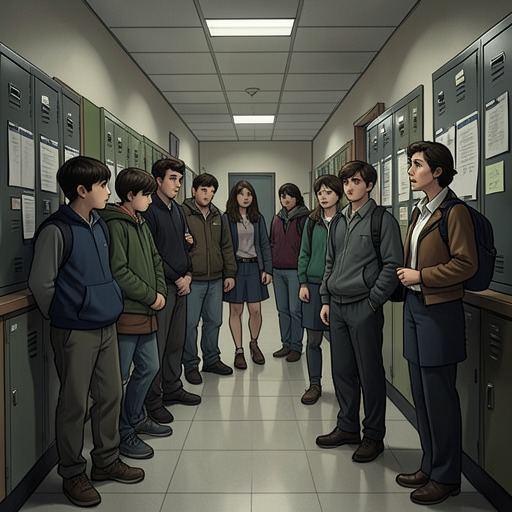
At Clearwater High, the presence of Woodwalkers is managed through rules that govern conduct among students. Clearwater High Rule 3: Predators must not mistreat prey is invoked when the rabbit shapeshifter Nimble objects to Jeffrey’s treatment of him. Jeffrey responds by partially transforming to display his teeth, making the danger behind the school’s interspecies rules visible. When Carag is held back from retaliating, Bill Brighteye also reminds him that students may transform during school hours only with a teacher’s permission and that fights are allowed only in the designated class. These rules regulate the hidden community from within; they do not mean that human outsiders are being told what the students are.
The distinction between hidden reality and human explanation becomes especially precarious when Carag’s adoptive family encounters a bison at the school. Donald Ralston challenges the headmistress about whether Jay is safe in a place where such an animal appears. The headmistress answers that the school sometimes uses live animals for stimulating biology lessons and presents the incident as contact with nature. The exchange shows how an ordinary human explanation can cover an event that would otherwise expose the Woodwalkers’ existence.
Carag also guards the boundary through small omissions. When Marlon approaches the room he shares with Brandon, Carag notices that the door bears his real name, Carag, rather than Jay. He tries to turn the others away, but Marlon has already passed him; the sign exposes how easily a private identity can surface in a shared space. Later, when Anna tells him he can talk to her about anything, Carag says yes while knowing he cannot tell her what matters most to him. Her concern is genuine, but intimacy cannot overcome the secret he must keep.
Protection and Cost
Secrecy protects Carag from being recognized as a Woodwalker, but it also leaves him alone with information that could alter his relationships. The public misreads him as an amnesiac, while Anna’s care rests on an incomplete understanding of who he is. At school, Carag encounters others who share his hidden nature, yet their rules and conflicts make clear that belonging in that community does not remove the need for discipline or caution.
The concealment also has a physical edge. During the puma hunting season, which runs from October through March, Carag learns that a license to kill a puma is easy to obtain. Far from the protected area around school and possibly beyond Grand Teton National Park, he hears hunting dogs and considers the danger that a fresh track in the snow could lead them to him. With no clothes or shoes, changing into human form would leave him exposed to the cold; remaining a puma carries the danger of hunters. The secrecy that lets him live among humans therefore exists alongside a landscape in which being recognized—or pursued—can become a matter of survival.