Clearwater High exam rules
WoodwalkersClearwater High exam rules make assessment a test not only of student ability but also of restraint and responsibility. They prohibit copying, restrict assistance and recording during examinations, and tie students’ results to whether they may join later learning trips or must repeat part of the school term.
Scope and Stakes
Lissa Clearwater tells the students to give their best in the midyear examinations scheduled for December. The results determine access to the school’s learning trips: only students who pass may take part, while those who do not must repeat the first three months of study. The requirement gives examinations consequences beyond a mark, making them a threshold for participation in the school’s next phase of learning.
The rules apply to students newly arrived at Clearwater High as well as those further along in their studies. At the Combat and Transformation examination, the new students are called to demonstrate their abilities first; second- and third-year students are seated around the auditorium and will take their turn afterward. The setting makes assessment public within the school community, but the restrictions on assistance and recording preserve the conditions under which each student is judged.
Academic Integrity and Conduct
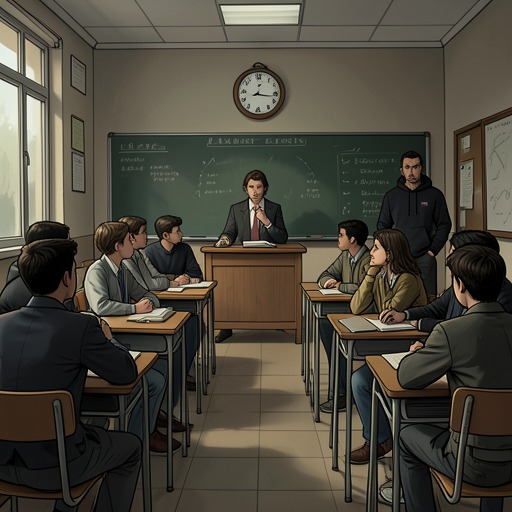
Copying is explicitly treated as unacceptable. During a test, Carag glances at Leroy’s answer and follows it, reasoning that Leroy usually earns good grades. Isidore Ellwood catches him and rebukes him for copying, striking the back of his head with a rolled notebook as he passes. Carag considers reporting the blow but decides against it, fearing that Ellwood would hate him even more. The scene distinguishes the school’s prohibition on cheating from Ellwood’s personal use of physical force; the latter is not presented as an established exam penalty.
The episode shows how the rule works in practice: copying is noticed and challenged, even when a student assumes that another’s answer is reliable. Carag’s decision not to report Ellwood also leaves the enforcement moment uneasy. The school’s stated standards regulate student conduct, while his reluctance to seek help reflects the difficult relationship between a student and the teacher who has caught him.
Secrecy and Examination Procedure
At the Combat and Transformation examination, Bill Brighteye reminds students to put away cameras and smartphones because transformations must not be filmed. The restriction protects the woodwalkers’ secret from being captured and potentially exposed beyond the school. It is not merely a classroom convenience: the examination involves transformations that cannot safely be documented.
Sarah Calloway adds that students must not offer suggestions or cheer for participants, and tells them to keep their thoughts in check. The rule therefore limits assistance whether it is voiced as advice, expressed as encouragement, or conveyed through thought. Together, the restrictions establish an examination conducted without recording or prompting, so that each participant must demonstrate their own ability under controlled conditions.
Results and Significance
The rules’ academic stakes become personal when Carag cannot reach his puma form during the Transformation exam. He returns to his seat and apologizes to Ellwood; the result is that he has not passed that examination. This failure makes the school’s progression policy immediate rather than abstract, though the evidence does not state whether Carag ultimately has to repeat the first three months or miss a learning trip.
Across the examination scenes, Clearwater High’s rules link individual competence to collective obligations. Students must demonstrate their abilities without cheating or assistance, while also preventing transformations from being recorded. The pass requirement determines who advances to learning trips, but the secrecy rules explain why the manner of examination matters as much as its outcome.