The barrier was not made to be broken is a central rule of the Micmac burying ground, delivered as a warning by the ghost of Victor Pascow to Louis Creed. It forbids crossing the deadfall that separates the Pet Sematary from the deeper woods where the ancient burial ground lies, and violating it unleashes catastrophic consequences.
The door must not be opened is the central prohibition of Pet Sematary, a rule delivered by the ghost of Victor Pascow to Louis Creed in a dream-vision that proves to be a literal warning. It forbids crossing the deadfall barrier beyond the Pet Sematary and entering the Micmac burying ground, the place where the dead can be returned to life. The rule is grounded in the novel's governing logic: the power of that ground is ancient, restless, and corrupting, and to use it is to invite destruction upon everything one loves. Pascow's command is the story's moral and supernatural keystone, and Louis's violation of it drives the entire catastrophe.
The year 1900 marks the birth of Jud Crandall, a pivotal figure in the novel's exploration of death, resurrection, and the dark power of the Micmac burying ground. Jud's life, spanning the entire twentieth century, serves as a living chronicle of the town of Ludlow and its secret, and his personal history with the supernatural—beginning with his dog Spot's resurrection in 1910—directly shapes the tragic trajectory of the Creed family.
1910 is the year in which Jud Crandall's dog Spot first died, an event that initiated Jud's lifelong, ambivalent relationship with the Micmac burying ground beyond the Pet Sematary. The dog's death and subsequent resurrection—engineered by the drunken old-timer Stanny Bouchard—became the template for every later use of the forbidden ground, including Louis Creed's fateful decision to bury Church there decades later. The year 1910 thus marks the beginning of the story's central supernatural cycle: the temptation to reverse death, the cost exacted by the Wendigo-touched place, and the secret that passes from one generation to the next.
1942 is the year Timmy Baterman, a young man from Ludlow, left to fight in World War II; his death in Italy the following year and his father's subsequent attempt to resurrect him using the Micmac burying ground form the central cautionary tale that Jud Crandall recounts to Louis Creed in an effort to dissuade him from attempting the same with his son Gage.
1943 is the year in which Timmy Baterman, a young soldier from Ludlow, is killed in action in Italy and, after his father Bill Baterman exhumes and reburies him in the Micmac burying ground beyond the Pet Sematary, returns as a malevolent, knowing entity that terrorizes the town before being killed again in a fire that also claims his father.
1951 is the year Jud Crandall and his wife Norma purchased burial plots in Mount Hope Cemetery in Bangor, Maine, a decision that later shaped the logistics of Norma's funeral and burial after her death in early 1984.
April 14, 1965, is the day Zelda Goldman, Rachel Creed's older sister, died of spinal meningitis in the back bedroom of the Goldman family home in Lake Forest, Illinois. Rachel, then eight years old, was left alone with Zelda when their parents went out for a brief visit during the Passover season. The event is the foundational trauma of Rachel's life, shaping her lifelong phobia of death, her inability to attend funerals, and her fierce, irrational protectiveness toward her own children. It is the secret wound that drives her bitter argument with Louis over Ellie's encounter with the Pet Sematary and that resurfaces in nightmares after Gage's death.
Autumn in the novel is a season of transition and decay, marking the shift from the family's hopeful arrival in Ludlow to the first confrontations with mortality and the supernatural. It is the time when the Pet Sematary is discovered, when Ellie Creed begins to grapple with the idea of death, and when the buried secrets of the Micmac burying ground first cast their shadow over the Creed family.
The first day of kindergarten marks Ellie Creed's entry into formal schooling in Ludlow, Maine, and becomes a pivotal moment that exposes the family's divergent attitudes toward death, separation, and the passage of time, while also triggering Louis Creed's first premonition of horror.
July 30, 1943, is the date on which Jud Crandall, along with three other Ludlow men, confronted Bill Baterman and his resurrected son Timmy at the Baterman home, an event that crystallized the horror of the Micmac burying ground's power and became the central cautionary tale Jud later told Louis Creed.
May 17, 1984, is the date of Gage Creed's funeral, the day that marks the formal end of the Creed family's public mourning and the beginning of Louis Creed's secret, desperate plan to resurrect his son from the Micmac burying ground beyond the Pet Sematary.
November 22 is the day before Thanksgiving 1983, when Louis Creed drives his family to Bangor International Airport and sees them off on a flight to Chicago for a holiday visit with Rachel's parents, the Goldmans. Louis stays behind in Ludlow, ostensibly because of work but actually to avoid his hostile father-in-law, Irwin Goldman. This departure leaves Louis alone in the house, setting the stage for the death of the family cat Church later that same evening and the subsequent night journey to the Micmac burying ground.
Spring in Ludlow, Maine, arrives in the narrative as a season of tentative renewal and fragile hope following the long winter of grief and horror that has engulfed the Creed family. It is the season in which Louis Creed experiences his last truly happy day—March 24, 1984—when he flies a kite with his son Gage in Mrs. Vinton's field, a moment of pure, unselfconscious joy that stands in stark contrast to the catastrophe that will follow. Spring also marks the thawing of the ground, the return of migratory birds, and the literal and metaphorical blooming of the Micmac burying ground's dark power, which grows in strength as the season advances, ultimately enabling the resurrection of the dead and the destruction of the Creed family.
The Great War (World War I) serves as a historical marker in the novel, used by Jud Crandall to date the death of his first dog, Spot, and to frame the generational shift in attitudes toward death and the supernatural.
The narrator pawns his waistcoat to give money to a beggar, an act that briefly lifts his spirits but also exposes his precarious dignity and the absurdity of his poverty.
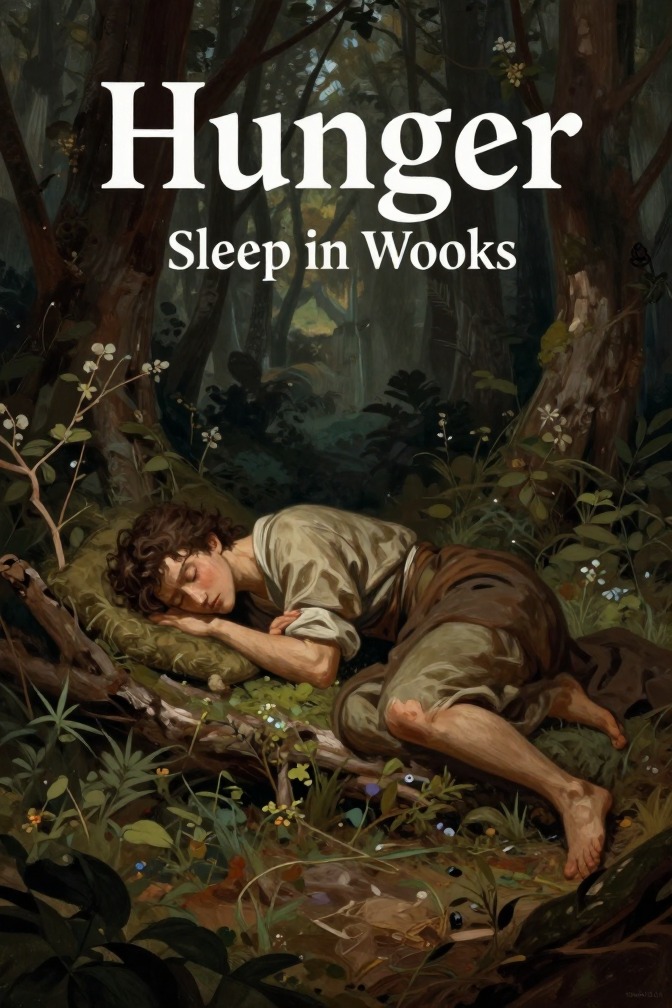
The protagonist's desperate attempt to sleep in Bogstad's Wood after exhausting all other options for shelter marks a critical low point in his physical and psychological decline, exposing the raw vulnerability of homelessness and the onset of hallucinatory delirium.
The narrator's visit to Ylajali's apartment on Tuesday evening is the story's most intimate and emotionally volatile encounter, where a night of flirtation, confession, and physical tenderness collapses into mutual fear and misunderstanding, revealing the unbridgeable gap between his desperate poverty and her sheltered world.
C. Zacharias Bartel is a minor character in Knut Hamsun's *Hunger*, a young artist whom the starving narrator visits late one night in a desperate search for shelter. Bartel's brief appearance underscores the narrator's isolation and the social barriers that poverty erects, as the artist's polite but firm refusal to offer help—due to a female visitor—forces the narrator back into the cold streets.
Missy is a minor but recurring character in Knut Hamsun's *Hunger*, a dandified acquaintance of the unnamed narrator whose encounters with the protagonist consistently expose the narrator's desperate attempts to maintain a facade of respectability and success despite his extreme poverty.
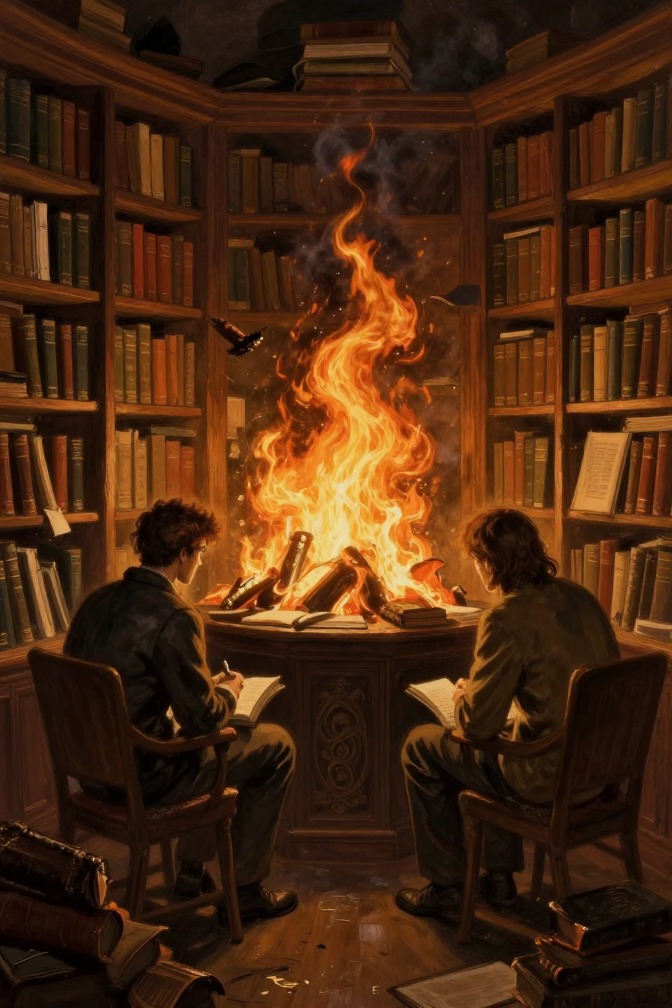
The Allegory of a Conflagration in a Bookshop is an unfinished literary work conceived by the starving protagonist of Knut Hamsun's *Hunger*, representing his final, desperate attempt to produce a commercially viable piece of writing and his ultimate confrontation with creative and physical collapse.
Conscience is a central, agonizing force in Knut Hamsun's *Hunger*, functioning as the protagonist's internal moral compass that he repeatedly tests, violates, and reaffirms throughout his descent into starvation and degradation. It is not a static principle but a dynamic, often painful presence that shapes his identity, drives his actions, and ultimately defines his sense of self-worth against the backdrop of extreme poverty.
Honor is the central moral axis of Knut Hamsun's *Hunger*, a fragile, internalized code that the starving narrator repeatedly tests, violates, and reasserts as his physical deprivation deepens. It functions as both his last claim to dignity and the source of his most acute suffering, driving the novel's psychological drama.
Inspiration in Knut Hamsun's *Hunger* is a volatile, quasi-divine force that descends upon the starving narrator in unpredictable bursts, enabling him to produce brilliant work but also driving him to the brink of madness. It is the sole counterweight to his physical decay, yet its arrival is capricious, often triggered by extreme deprivation and as quickly extinguished by the harsh realities of his existence.
Theft in Knut Hamsun's *Hunger* is not a simple act of criminality but a complex moral and psychological event that marks the protagonist's deepest crisis of honor and self-worth. It functions as a recurring temptation, a concrete transgression, and a catalyst for shame, confession, and a desperate attempt at moral restitution, ultimately revealing the corrosive effects of extreme poverty on the narrator's conscience.
The Five Shillings Theft is a pivotal event in Knut Hamsun's *Hunger* in which the starving narrator, desperate and disoriented, inadvertently accepts five shillings in change from a provision shop boy who mistakenly believes he has already paid for a candle. The narrator keeps the money, spends it on a meal, and is immediately consumed by guilt, shame, and fear of discovery. This episode marks his first deliberate dishonesty and becomes a moral crisis that he attempts to resolve by giving the money away to a cake vendor, only to later confess the theft to the shop boy in a fit of anguished pride. The event crystallizes the novel's central tension between the narrator's hunger-driven survival instincts and his fragile, fiercely guarded sense of honor.
The Happolati Invention is a pivotal episode in Part I of Knut Hamsun's *Hunger*, in which the starving narrator, driven by curiosity and a volatile mood, fabricates an elaborate fictional identity for a man named Happolati and his family during a chance encounter with an old man in a park, escalating his lies into a manic performance that reveals his psychological unraveling.
The half-sovereign is a recurring unit of currency in Knut Hamsun's *Hunger* that functions as a threshold between survival and collapse, a measure of the protagonist's fluctuating fortunes, and a charged object around which questions of honor, shame, and human connection crystallize. It appears at decisive moments: as the hoped-for payment for an accepted story, as a gift from the editor that staves off death, and as an anonymous alms from Ylajali that the protagonist first throws away in a fit of pride and then bitterly regrets losing.
Uncle is the narrator's recurring euphemism for the pawnbroker in Knut Hamsun's *Hunger*, a figure who systematically consumes the protagonist's possessions as he descends into destitution, symbolizing the relentless erosion of his material existence and dignity.
Castle Hill is a prominent location in Christiania where the protagonist frequently retreats to write, reflect, and struggle with hunger and despair, serving as a symbolic space of both creative aspiration and psychological collapse.