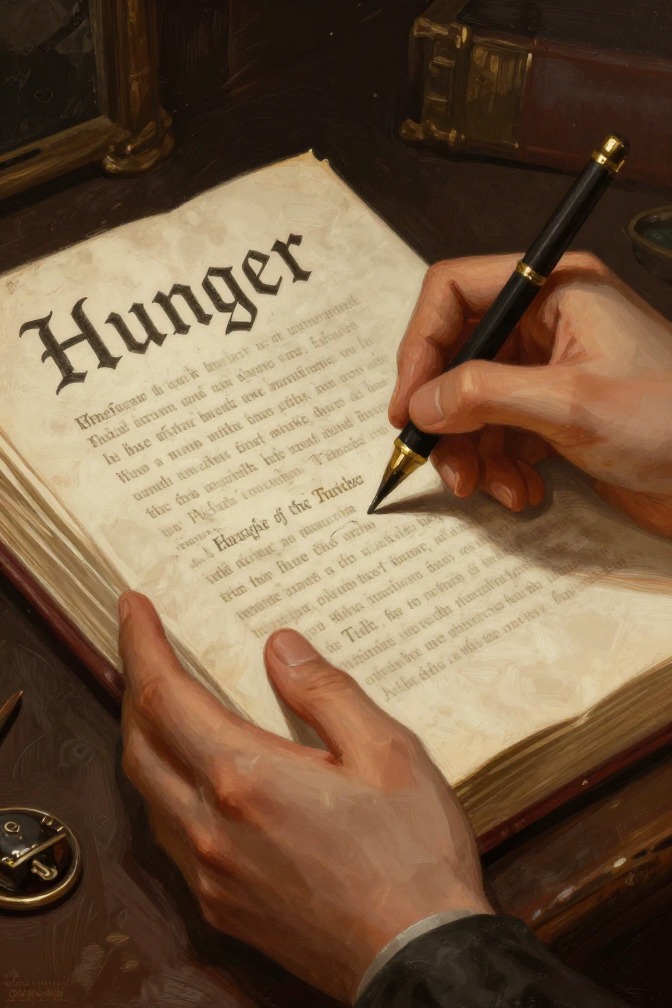
The protagonist destroys his own manuscript in a fit of despair and rage after failing to complete it, an act that crystallizes his mounting frustration, creative impotence, and the physical and psychological toll of starvation.
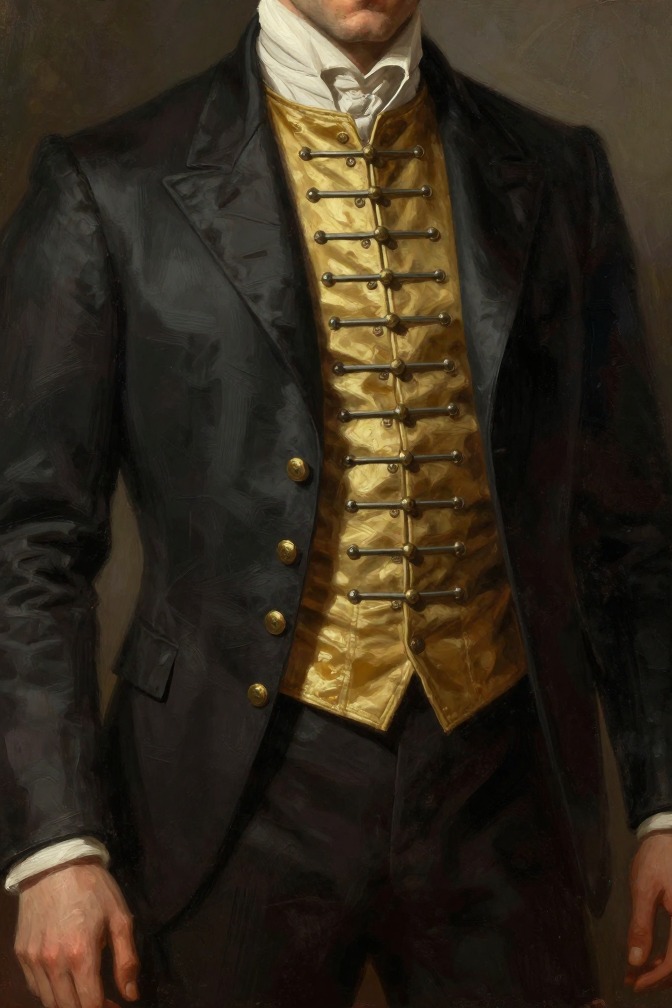
The narrator pawns his waistcoat to give money to a beggar, an act that briefly lifts his spirits but also exposes his precarious dignity and the absurdity of his poverty.
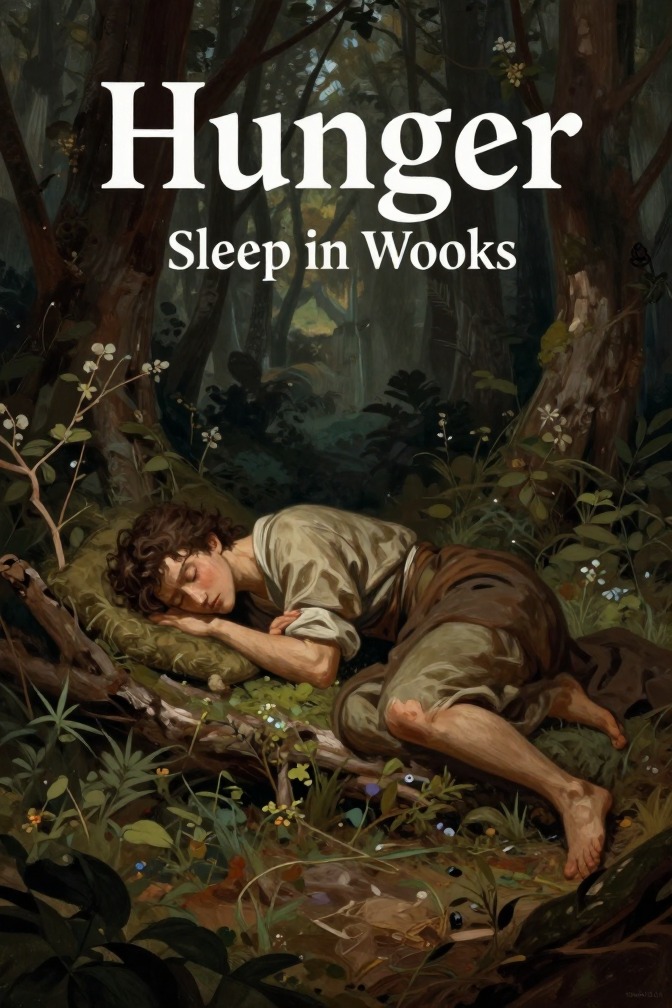
The protagonist's desperate attempt to sleep in Bogstad's Wood after exhausting all other options for shelter marks a critical low point in his physical and psychological decline, exposing the raw vulnerability of homelessness and the onset of hallucinatory delirium.
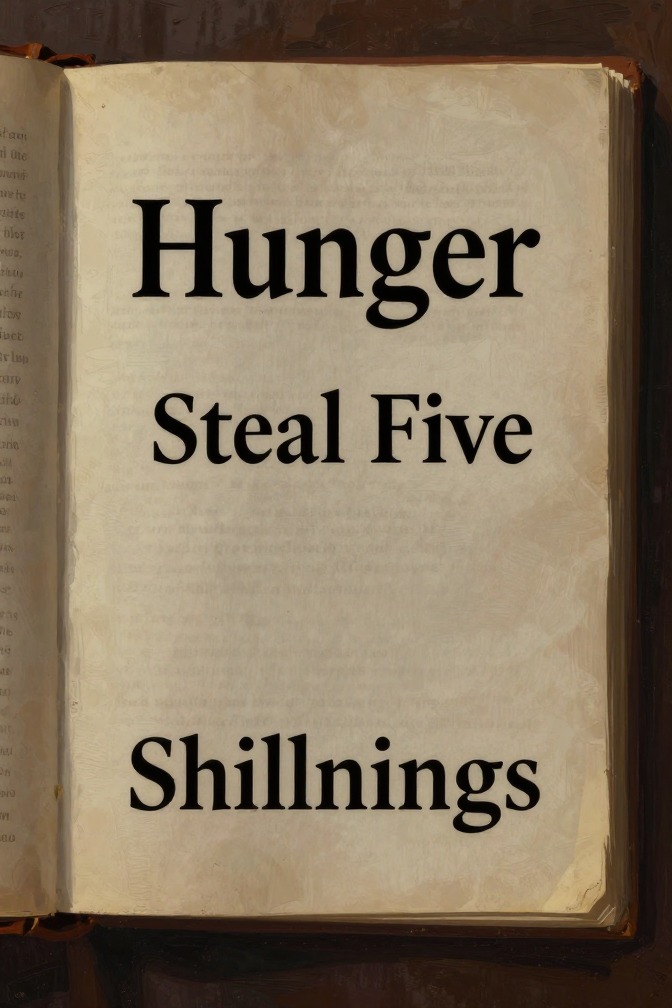
The Five Shillings Theft is a pivotal action in Knut Hamsun's *Hunger*, where the starving narrator, in a moment of confusion and desperation, accepts five shillings in change from a shopkeeper who mistakenly believes he has paid for a candle. This act, his first outright theft, marks a profound moral crisis and a turning point in his descent, as he grapples with guilt, shame, and the erosion of his honor.
The narrator's visit to Ylajali's apartment on Tuesday evening is the story's most intimate and emotionally volatile encounter, where a night of flirtation, confession, and physical tenderness collapses into mutual fear and misunderstanding, revealing the unbridgeable gap between his desperate poverty and her sheltered world.
C. Zacharias Bartel is a minor character in Knut Hamsun's *Hunger*, a young artist whom the starving narrator visits late one night in a desperate search for shelter. Bartel's brief appearance underscores the narrator's isolation and the social barriers that poverty erects, as the artist's polite but firm refusal to offer help—due to a female visitor—forces the narrator back into the cold streets.
Missy is a minor but recurring character in Knut Hamsun's *Hunger*, a dandified acquaintance of the unnamed narrator whose encounters with the protagonist consistently expose the narrator's desperate attempts to maintain a facade of respectability and success despite his extreme poverty.
Mrs. Gundersen is the landlady of the protagonist's attic room in Christiania, whose persistent demands for unpaid rent and eventual eviction notice serve as a constant, material pressure that drives the narrator deeper into homelessness and desperation.
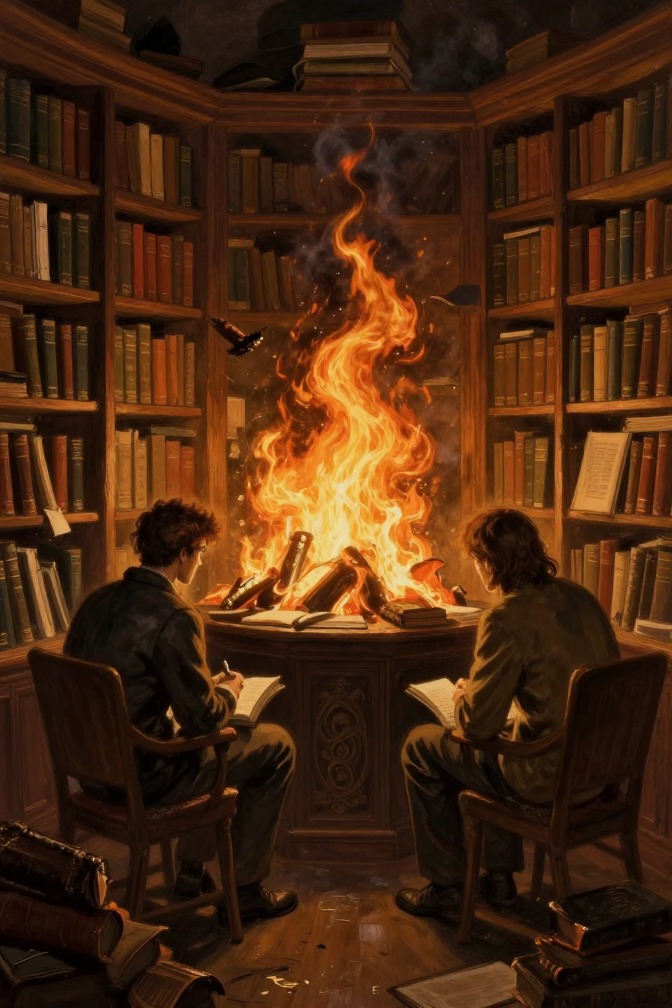
The Allegory of a Conflagration in a Bookshop is an unfinished literary work conceived by the starving protagonist of Knut Hamsun's *Hunger*, representing his final, desperate attempt to produce a commercially viable piece of writing and his ultimate confrontation with creative and physical collapse.
Conscience is a central, agonizing force in Knut Hamsun's *Hunger*, functioning as the protagonist's internal moral compass that he repeatedly tests, violates, and reaffirms throughout his descent into starvation and degradation. It is not a static principle but a dynamic, often painful presence that shapes his identity, drives his actions, and ultimately defines his sense of self-worth against the backdrop of extreme poverty.
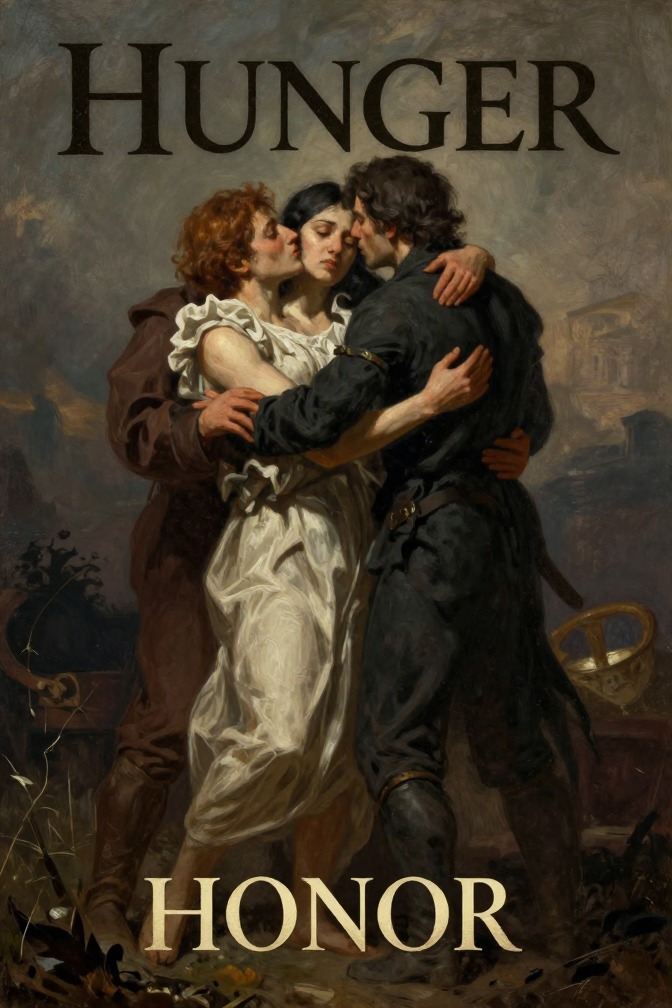
Honor is the central moral axis of Knut Hamsun's *Hunger*, a fragile, internalized code that the starving narrator repeatedly tests, violates, and reasserts as his physical deprivation deepens. It functions as both his last claim to dignity and the source of his most acute suffering, driving the novel's psychological drama.
Inspiration in Knut Hamsun's *Hunger* is a volatile, quasi-divine force that descends upon the starving narrator in unpredictable bursts, enabling him to produce brilliant work but also driving him to the brink of madness. It is the sole counterweight to his physical decay, yet its arrival is capricious, often triggered by extreme deprivation and as quickly extinguished by the harsh realities of his existence.
The Five Shillings Theft is a pivotal event in Knut Hamsun's *Hunger* in which the starving narrator, desperate and disoriented, inadvertently accepts five shillings in change from a provision shop boy who mistakenly believes he has already paid for a candle. The narrator keeps the money, spends it on a meal, and is immediately consumed by guilt, shame, and fear of discovery. This episode marks his first deliberate dishonesty and becomes a moral crisis that he attempts to resolve by giving the money away to a cake vendor, only to later confess the theft to the shop boy in a fit of anguished pride. The event crystallizes the novel's central tension between the narrator's hunger-driven survival instincts and his fragile, fiercely guarded sense of honor.
The Happolati Invention is a pivotal episode in Part I of Knut Hamsun's *Hunger*, in which the starving narrator, driven by curiosity and a volatile mood, fabricates an elaborate fictional identity for a man named Happolati and his family during a chance encounter with an old man in a park, escalating his lies into a manic performance that reveals his psychological unraveling.
The half-sovereign is a recurring unit of currency in Knut Hamsun's *Hunger* that functions as a threshold between survival and collapse, a measure of the protagonist's fluctuating fortunes, and a charged object around which questions of honor, shame, and human connection crystallize. It appears at decisive moments: as the hoped-for payment for an accepted story, as a gift from the editor that staves off death, and as an anonymous alms from Ylajali that the protagonist first throws away in a fit of pride and then bitterly regrets losing.
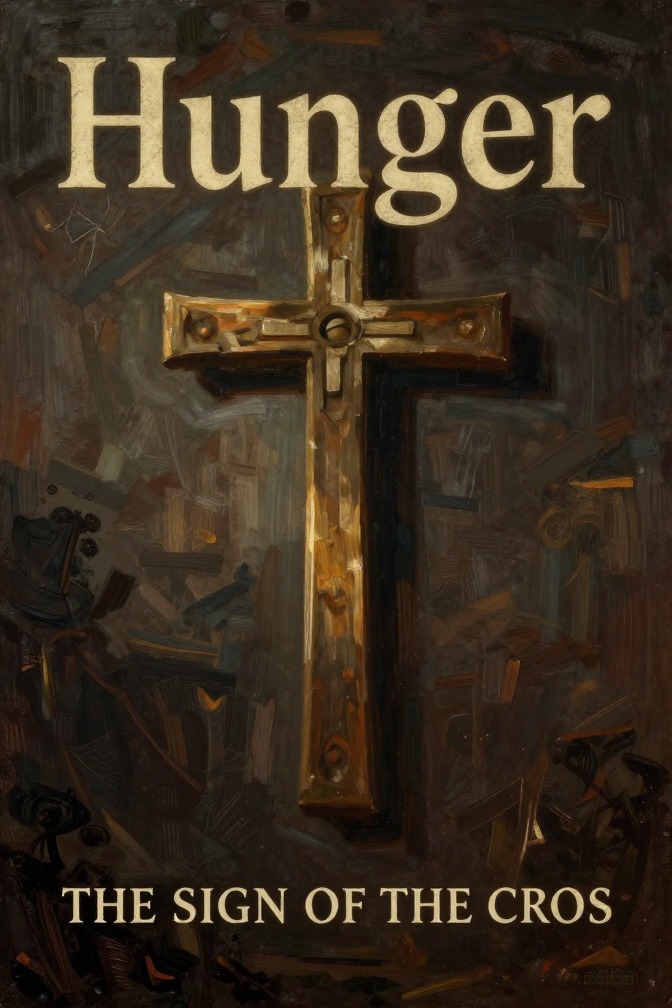
The Sign of the Cross is a one-act drama conceived by the starving narrator of Knut Hamsun's Hunger, a work he feverishly plans and begins writing during the depths of his physical and mental collapse, only to abandon it in despair when his creative faculties fail him.
Uncle is the narrator's recurring euphemism for the pawnbroker in Knut Hamsun's *Hunger*, a figure who systematically consumes the protagonist's possessions as he descends into destitution, symbolizing the relentless erosion of his material existence and dignity.
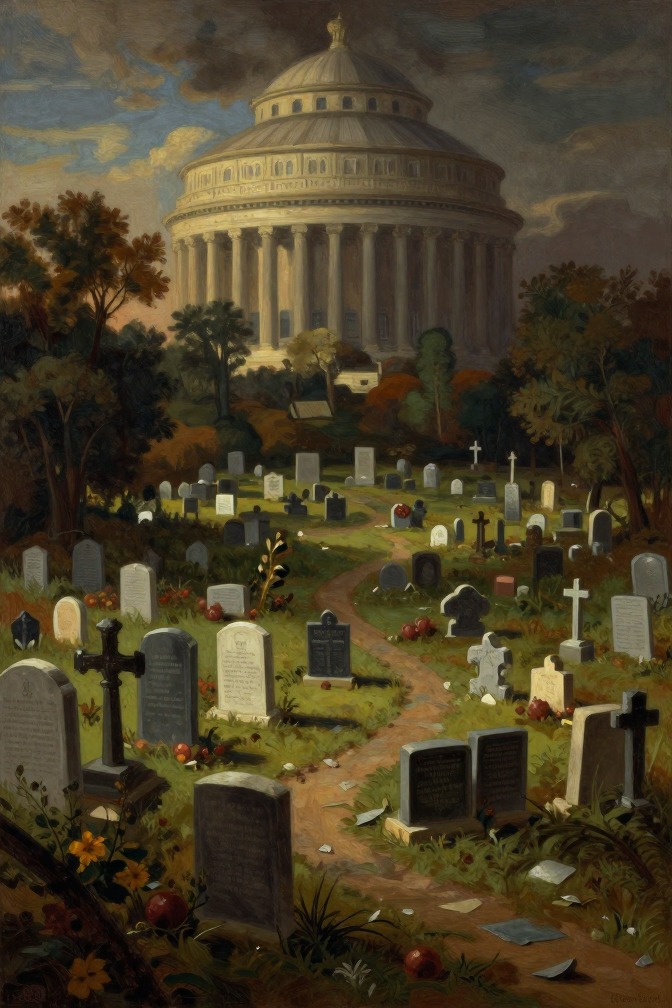
Our Saviour's Cemetery is a recurring location in Knut Hamsun's *Hunger*, serving as a site of refuge, creative struggle, and psychological deterioration for the unnamed protagonist during his wanderings through Christiania.
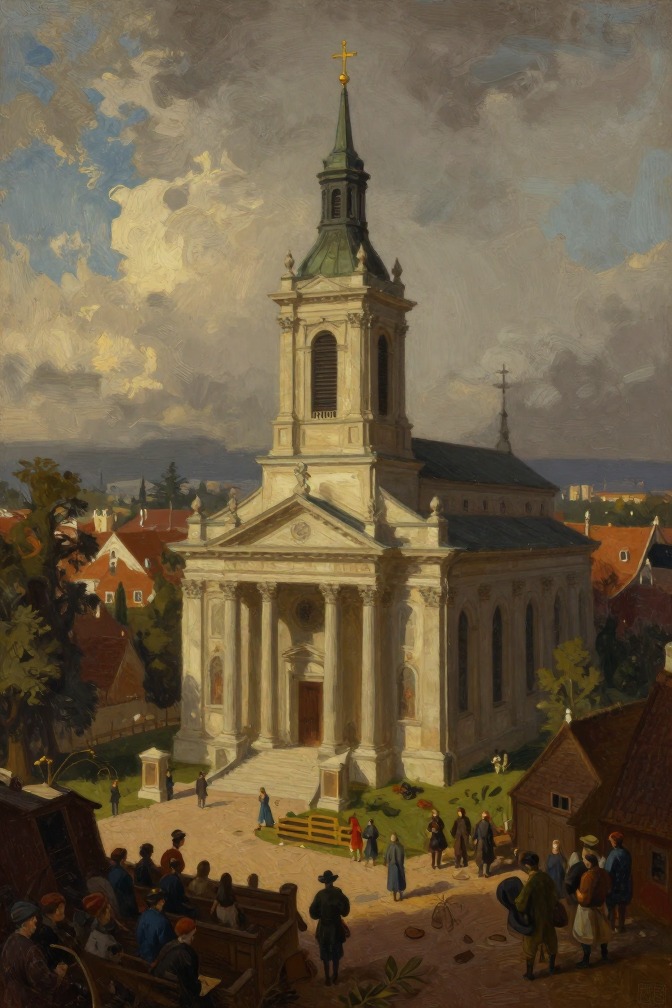
Our Saviour's Church is a central landmark in Christiania that serves as a recurring site of the narrator's physical and psychological struggles, marking the passage of time, his hunger, his moments of despair, and his fleeting encounters with hope and inspiration.
The Shaving Book is a small booklet of barber's tickets that the protagonist carries as a token of residual respectability and a last material resource, which he ultimately attempts to barter for food during his starvation in Christiania.
Aftenpost is a Christiania newspaper that the protagonist reads for situation-vacant advertisements and whose posted edition he consults during his wanderings, serving as a recurring marker of his desperate search for employment and his deteriorating social standing.
John Coffey heals Melinda Moores, the warden's wife, from a terminal brain tumor in a secret nighttime visit orchestrated by Paul Edgecombe and his fellow guards, an event that confirms Coffey's supernatural healing power and deepens the moral crisis surrounding his impending execution.
After John Coffey heals Melinda Moores, the group returns to E Block and releases Percy Wetmore from the restraint room. As Percy walks up the Green Mile, John Coffey reaches through the bars of his cell, pulls Percy to him, and transfers the brain tumor—the dark, swirling matter he had drawn from Melinda—into Percy's body. Percy immediately goes catatonic, then draws his revolver and shoots William Wharton dead, emptying all six chambers into the sleeping prisoner. The event reveals John Coffey's power to not only heal but also to transfer suffering into another person, and it seals Percy's permanent mental collapse.
The night journey to save Melinda Moores is the clandestine operation in which Paul Edgecombe, Brutus Howell, Harry Terwilliger, and Dean Stanton smuggle the condemned prisoner John Coffey out of Cold Mountain Penitentiary to the home of Warden Hal Moores, where Coffey miraculously heals the warden's wife of a fatal brain tumor. This event is the moral and narrative fulcrum of the novel, transforming Coffey from a passive victim of the justice system into an active agent of grace, and forcing the guards who participate to confront the terrible irony that they are about to execute an innocent man who has just saved a life.
Kathe Detterick, one of the nine-year-old twin daughters of Klaus and Marjorie Detterick, was abducted, raped, and murdered in June 1932, a crime for which John Coffey was wrongfully convicted and executed. Her death, along with that of her sister Cora, forms the central injustice of the novel, and the circumstances of the crime—the killer's manipulation of the girls' love for each other to silence them—become a key revelation about the true nature of evil.
The black insects are a physical manifestation of the sickness, pain, and death that John Coffey draws out of those he heals. They appear as a swirling cloud expelled from his mouth and nose after he has absorbed an affliction, first turning white and then vanishing into the air. The insects represent the tangible transfer of suffering from the healed to the healer, and their presence marks every instance of Coffey's miraculous power.
After Percy Wetmore stomps Mr. Jingles, breaking the mouse's back and leaving him dying on the Green Mile, John Coffey calls for the mouse to be given to him. Taking the broken animal in his cupped hands, Coffey inhales deeply, and when he exhales a cloud of black insects that turn white and vanish, Mr. Jingles is restored to life, whole and running again. This event is the second public demonstration of Coffey's supernatural healing power, confirming for Paul Edgecombe and the other guards that his gift is real and not limited to humans, and it deepens their moral crisis over executing an innocent man.
The Night Journey is the central, secret event of Paul Edgecombe's memoir: the midnight expedition in which he and three fellow guards smuggled the condemned giant John Coffey out of Cold Mountain Penitentiary to the home of Warden Hal Moores, so that Coffey could use his miraculous healing power on the warden's wife, Melinda, who was dying of a brain tumor. The journey is the moral and narrative hinge of the story—the point at which the guards' professional duty collides with their private knowledge of Coffey's innocence and his gift, forcing them into an act of desperate, illegal compassion that will determine the fate of everyone involved.
Praise Jesus, The Lord Is Mighty is a recurring exclamation and doctrinal phrase that anchors the folk-Christian worldview of Paul Edgecombe's childhood in the piney-woods churches of the rural South. It appears at moments of miraculous healing, moral reckoning, and narrative reflection, serving as both a sincere expression of faith and a measure of the distance between the simple belief of Paul's youth and the terrible ambiguities he confronts on the Green Mile.
The county courthouse in Tefton, Trapingus County, is the site where John Coffey was tried and convicted for the rape and murder of the Detterick twins, a proceeding marked by racial prejudice and a swift, predetermined verdict.