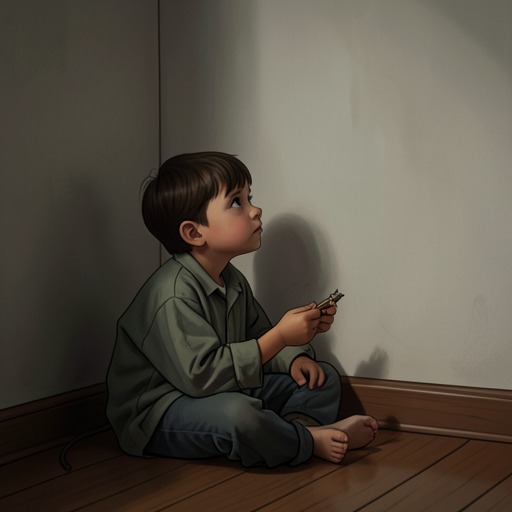
« Le sentiment d’impuissance chronique finit par détruire un être humain »
1Q84The expression “The feeling of chronic powerlessness eventually destroys a human being” is the principle Aomamé gives the Dowager after a self-defense class, and the phrase through which the narrative links Aomamé’s insistence on self-protection to Tamaki’s suffering. Its force changes as the story returns to it: first a warning against resignation, then a way to understand the lasting wound of sexual violence, and finally a devastating echo in Tamaki’s account of feeling imprisoned by her own helplessness.
A Principle of Self-Protection
Aomamé meets the Dowager at the sports club where she works. The Dowager had attended Aomamé’s short-lived, unconventional self-defense class, whose exercises largely involved striking a mannequin. Though the smallest and oldest participant, she moved lightly and could kick with agility. Aomamé admires her directness and imagines that, if necessary, she would not hesitate to kick an attacker in the groin.
At the end of one class, the Dowager suggests that, at her age, she no longer needs to protect herself from an assailant. Aomamé rejects age as the relevant measure. What matters, she says, is how one lives and remaining able to protect oneself; surrendering to the expectation of being assaulted leads nowhere. Her maxim gives powerlessness a cumulative, destructive character: it is not simply a moment of fear, but a condition that can wear a person down.
The Dowager listens in silence and responds that Aomamé is right. A few days later, she sends a note through the club reception with her name and telephone number, inviting Aomamé to contact her when she can. The exchange thus gives the phrase a consequence beyond instruction: Aomamé’s uncompromising account of self-protection becomes the beginning of a connection between the two women.
Tamaki’s Wound
The principle acquires a more intimate meaning in Aomamé’s friendship with Tamaki. After high school, Aomamé continues playing softball at university, earns a special scholarship, and studies sports medicine and martial arts. Tamaki, a strong student at a leading private law university, leaves softball behind and hopes to become a lawyer. Although their paths diverge, they meet weekly for lunch, and their conversation never seems to run out.
In the autumn of Tamaki’s first university year, an older member of her tennis club invites her to his room and forces sex on her. She had felt some sympathy for him and followed him there, but his brutality and disregard leave her shocked. She stops attending the club, falls into depression, loses her appetite, and drops six kilograms in a month. What she had sought, the narration explains, was feeling and consideration; the violence leaves her with a profound sense of powerlessness.
Aomamé urges Tamaki to report the man so that he can be punished. Tamaki instead blames herself for going to his room and believes that making a complaint would now be useless; perhaps, she says, she will eventually forget. Aomamé understands the injury as more than the loss of virginity: it is an assault on Tamaki’s dignity. Her conviction that powerlessness can continue to gnaw at a person gives the earlier maxim a concrete human cost.
Aomamé acts on Tamaki’s behalf by systematically wrecking the assailant’s room. She hides a softball bat in a large plastic tube used for industrial drawings, checks that he will be away, and uses a hammer and screwdriver to break the lock. Wrapping the bat in towels to keep the noise down, she smashes household objects, cuts the telephone wires, tears books and clothes, spreads sauce on the bed, and damages the bathroom fixtures. The extensive destruction is a private punishment, not a remedy for the injury: Tamaki does not report the assault, and Aomamé’s intervention cannot undo what happened.
From Warning to Despair
Years later, Tamaki’s marriage becomes another setting in which Aomamé’s words resonate. The violence begins early and grows worse, yet Tamaki cannot bring herself to leave. She says nothing to Aomamé, fearing that her friend would tell her she had been warned and urge her to leave immediately. The silence makes the earlier principle newly painful: knowing that escape is necessary is not the same as being able to escape.
In the final days before her suicide, Tamaki writes Aomamé a long letter. She says that her life is a daily hell and that she cannot get out; even if she could, she does not know where she would go. She describes herself as locked in the mad prison of her powerlessness, having walked into it, shut the door, and thrown the key away. She calls the marriage a mistake, but locates the deeper problem within herself, believing she deserves the pain and blaming no one. She names Aomamé as the only person she ever trusted and asks to be remembered, ending with the wish that they could have played softball together forever.
Aomamé tries repeatedly to call, then travels to Tamaki’s home in Okusawa, in Setagaya. She rings the gate intercom, receives no answer, and hears only a dog barking. Unbeknownst to her, Tamaki is dying inside: she has tied a rope to the railing of a staircase and hanged herself. When Aomamé learns of the death, she is not surprised and does not feel grief in the ordinary sense. She cuts off the telephone, sits for a long time, and later withdraws from work and daily life. The narration describes something inside her as having broken and been replaced, and a sense that she has crossed a boundary.
The Expression’s Narrative Work
The phrase binds together different responses to powerlessness without making them equivalent. Aomamé’s words to the Dowager insist that self-protection remains necessary at any age; her response to Tamaki’s assault turns that conviction into action. Tamaki’s later letter, however, shows how violence and a sense of entrapment can overwhelm the very capacity the maxim urges people to preserve. The repeated idea therefore moves from assertive advice to a recognition of injury and, finally, to the account of a life that has come to seem inescapable.
Its recurrence also connects two forms of witnessing. The Dowager hears Aomamé state the principle and affirms it; Aomamé, in turn, recognizes the depth of Tamaki’s wound even when Tamaki refuses to report the assault. In her final letter, Tamaki makes that wound speak directly, but her words arrive too late for Aomamé to reach her. The expression’s significance lies in this contrast between the clarity of naming powerlessness and the difficulty of escaping it.