Marcher loin des routes larges
1Q84“Marcher loin des routes larges” (“Walking Far from the Broad Roads”) is both an image drawn from the Gilyaks’ way of travelling and Fukaéri’s account of her own position. Roads promise practicality, but the Gilyaks continue through forest and mud; Fukaéri, in turn, says she does not want to live as she has been living, yet does not want to walk the broad roads either. The expression holds together refusal, difficulty, and the possibility of proceeding by a path that remains one’s own.
The Gilyaks and the road
In Tengo’s account, the Gilyaks do not have courts and do not understand the word “justice.” Their difficulty in understanding outsiders is illustrated by their incomplete grasp of what roads are for. Even where roads exist, they travel through the taiga instead, often in single file with their families and dogs, close to a road but not on it. Their route is not presented as a simple lack of access: it is a different way of moving through space.
Tengo imagines the line of poorly clothed Gilyaks crossing the taiga beside a road, taciturn and composed. Within their apprehension of time, space, and possibility, he reflects, the road does not exist. The image turns an apparently obvious convenience into something culturally contingent. A road may be practical to those who have learned how to use it, yet remaining off it can preserve a different understanding of existence. Fukaéri responds to this image with pity for the Gilyaks, a brief reaction that gives the example emotional weight without resolving its ambiguity.
Fukaéri’s comparison
Later, Fukaéri returns to the Gilyaks in a message to Tengo. She says that they touch her heart and asks why they do not walk on broad roads, but on muddy forest paths. She then makes the comparison personal: she does not want to live as they do, but she also does not like walking on broad roads. The image is not an idealized claim that hardship is desirable. It registers a conflict between rejecting an intolerable life and resisting the familiar route that might appear to offer a straightforward alternative.
Fukaéri names the life she rejects: she does not want to keep being beaten by men, and she does not want a life she describes as dirty and full of worms. Her comparison places a wish for change beside her dislike of the broad road, without specifying a new destination or a settled way forward. The expression therefore conveys neither uncomplicated escape nor acceptance of the existing conditions. Its force lies in the unresolved choice of how to move on.
Writing, memory, and distance
The Gilyak image also becomes a way for Fukaéri to speak about authorship. She says she asked Azami to research the Gilyaks, who live on Sakhalin, and describes them, like the Ainu and Native Americans, as peoples without written signs or documents. She connects this absence of writing to herself: once a story is written down, she says, it is no longer her story. She acknowledges that Tengo changed the written work very well, while maintaining that the result is no longer hers.
That distinction makes the broad road an image for a process of translation as well as a physical route. Tengo’s written version makes Fukaéri’s story legible in a form she herself says is no longer hers; she does not blame him, but insists on the difference between her telling and the text he shaped. Her statement that she will not become a novelist or write something else follows from this separation between her story and its written form. The expression does not simply celebrate withdrawal: it marks the distance between a lived or spoken account and the version that can travel by established literary means.
The image’s final scene
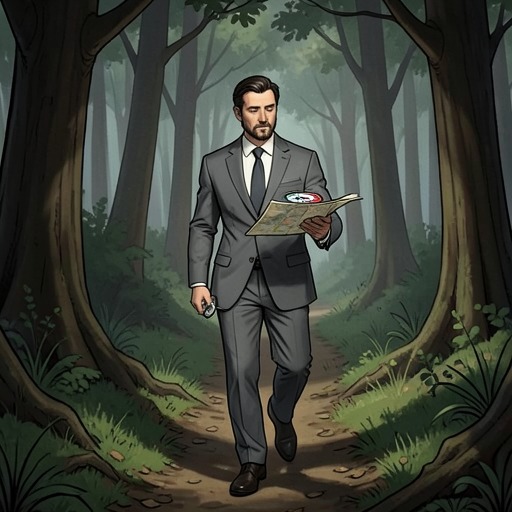
After Fukaéri pauses, Tengo imagines her walking alone and silently, far from the broad roads. The scene returns the expression to movement, but leaves the destination unstated. The imagined figure echoes the Gilyaks’ passage through the taiga while remaining distinct from their family procession: Fukaéri is pictured alone, and the road remains nearby only as the route she has not chosen.
Across these moments, the image shifts from an observation about a people’s travel, to Fukaéri’s account of what she cannot accept, to Tengo’s silent visualization of her onward movement. It allows the novel to hold together cultural difference, the limits of representation, and personal refusal without reducing them to a single solution. To walk away from the broad road is not shown as easy or as a completed escape; it is a way of continuing when the accepted route does not feel like one’s own.