Un monde qui n’est pas celui d’ici
1Q84“A world that is not this one” is the alternate reality Tengo begins to imagine as the setting for a story of his own. Borrowing the two moons from Air Chrysalis, he gives the unfamiliar world a visible sign of difference, then opens a more unsettling possibility: that its past might be rewritten.
A world apart
Tengo explains that his story concerns him, or someone for whom he is a kind of model, but that he inhabits a world other than the one here. His girlfriend asks whether she appears in it. She does not, he says, and neither do the people who belong to the familiar world. The distinction is not simply between two places within a shared cast of characters: each world has its own inhabitants.
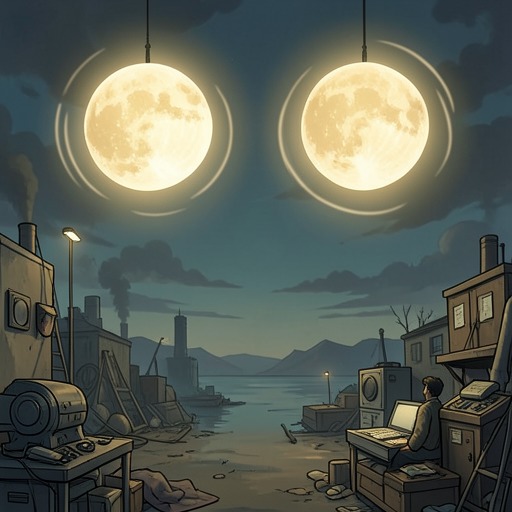
When his girlfriend asks how anyone could tell the two worlds apart, Tengo says he knows which world he is in because he is the one writing the book. She presses the question beyond the writer’s knowledge: what if she herself wandered into the other world? Tengo thinks she would recognize the difference, because there are two moons in its sky. The hypothetical gives the alternate world a perceptible boundary even as its relation to the familiar one remains open.
The two moons as a sign
The moons come from the world of Air Chrysalis, which Tengo has in mind as he considers his new story. He wants to write something much longer and more complex, and to make that story his own. The shared element may become a problem later, but for now the urge to write a world with two moons takes precedence; he leaves what would happen afterward for another time.
His girlfriend turns the image into a simple test of recognition: at night, someone looks up, sees two moons, and understands that this is not the world here. Tengo calls the moons a sign. They make an otherwise uncertain difference visible: a person need not know the history or rules of the other world to notice that its sky does not match the familiar one. Her question about whether the moons might overlap also draws attention to the image’s concrete, observable character, rather than explaining the alternate world through an abstract definition.
Rewriting the past
The conversation shifts from difference in appearance to difference in what can be done. Asked whether people in the other world are especially mad, Tengo says they are not; he imagines them as much like people here. His girlfriend asks what, then, makes it a world other than this one. Tengo answers that he could rewrite the past of the world here. When she asks whether he could alter it as much as he wished, and as he would like it to be, he says yes.
The answer gives the imagined world a power beyond its two moons. It is not presented as a society of fundamentally different people, but as a setting in which the past may be remade. The scale and limits of that power are not worked out in this exchange. Tengo is still reaching for the story: he has a borrowed image, an initial distinction between worlds, and the possibility of rewriting history, while what happens next remains deliberately undecided.
An unfinished story within the novel
The conversation exposes the early imaginative structure of Tengo’s planned book, not a complete account of the alternate world. Its elements come from a specific creative sequence: he takes the double-moon sky from Air Chrysalis, wants to transform that point of resemblance into a longer and more complicated work of his own, and postpones the problem of what follows. The possibility of rewriting the familiar world’s past expands that project without settling its plot.
The phrase therefore holds together two kinds of difference. The two moons provide an outward, recognizable sign; the rewritten past suggests that the world may also differ in how its history is constituted. Yet Tengo’s account leaves the connection between those features unexplained. The other world remains at once a place recognizable by its sky and an unfinished narrative possibility, whose meaning and consequences have not yet been written.