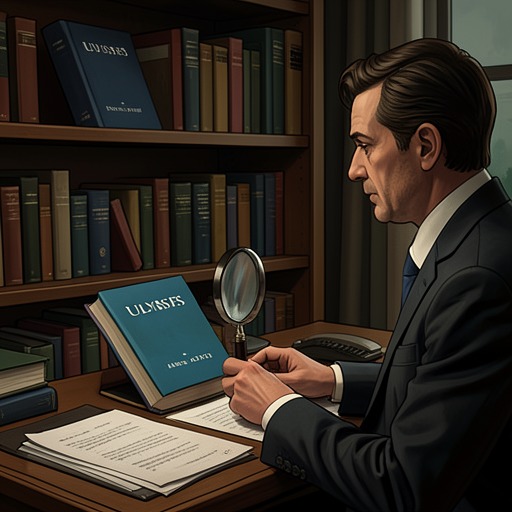
Literary camouflage: minor works conceal masterpieces
2666Literary camouflage: minor works conceal masterpieces is an account of literature as concealment, offered by an old man to Benno von Archimboldi. It overturns the comforting distinction between masterpieces and lesser works: the ordinary book is not simply an imperfect achievement by its visible author, but part of a decoy system that hides a more consequential work and its secret writer. The theory makes literary production resemble military sacrifice, hypnosis, and theatrical play, and concludes with the image of the thieves beside Jesus as cover for the crucifixion.
The apparent hierarchy of literary works
The old man begins from the familiar image of literature as a forest containing both exceptional and ordinary growth. Masterpieces are its lakes, towering or strange trees, flowers, and hidden caves; ordinary books are grass, puddles, vines, mushrooms, and little wildflowers. He says that he once accepted this hierarchy, and believed that writers could produce worthwhile articles and books without creating a masterpiece. He also admits that he had hoped for a career in letters, but came to think his own mind would never produce a masterpiece. That judgment led him to give up writing, though not to stop thinking about what writing and literary value meant.
His subsequent correction is more radical than a claim that neglected books may deserve greater esteem. He rejects the idea that a minor work is simply the creation of a lesser author. The apparent writer may indeed sit at a table, struggle over blank pages, and produce a competent book or poem; the visible evidence of authorship, including the wife who watches him write, seems convincing. But, the old man argues, this is only the work’s exterior, a semblance. The true author is hidden, and the minor work serves a larger design than its apparent maker understands.
The secret author and the work behind the work
In the old man’s formulation, every minor work has a secret author, and that secret author is, by definition, a writer of masterpieces. The ordinary writer supplies the observable labor, but the consequential work belongs to an unseen figure who accepts the dictates of a masterpiece. The distinction between visible production and concealed authorship makes the minor work less a failed masterpiece than a screen behind which the work that matters can remain out of sight.
He sharpens this claim by describing writing as a kind of hypnosis. The craftsman appears absorbed in the words taking shape on the page, while a spouse sees him at work; yet, in the old man’s imagined X-ray view, nothing of the man himself is present in the act. The decent, adequate novel or poetry collection does not arise from the author’s style or will, but from concealment. Its apparent process of creation is therefore also a performance that masks the absent or hidden source of its real significance.
Reading offers the counterpoint. The old man calls it pleasure and happiness, sadness at being alive, and above all knowledge and questions. Writing, by contrast, is almost always empty in his account: the person at the desk produces words without giving the visible work a recognizable interior. The critique is not simply that ordinary writing is poor. It is that the apparent author’s labor can function as a convincing surface, concealing both the work’s true origin and the masterpiece around which the surface has been arranged.
Camouflage, sacrifice, and sanctioned plagiarism
The old man turns the forest metaphor into a military one. Every work that is not a masterpiece participates in a vast camouflage: books are like cannon fodder, foot soldiers, and pieces sacrificed in a larger operation. Their number and resemblance to the masterpiece help divert attention from it. The ordinary work’s apparent independence is thus part of its utility as concealment; like scenery made of wood and canvas, it presents an image that can lead toward a void rather than reveal what lies behind it.
This structure also explains the old man’s unsettling account of plagiarism. If the visible minor work is not authored in the ordinary sense, it can be understood as a form of plagiarism of a masterpiece. He calls it sanctioned plagiarism: the imitation is not an isolated transgression but a system in which minor works reproduce aspects of the work they hide. Their function is at once to mimic and to obscure, producing an appearance of literary abundance while shielding the concealed center.
The concealment does not depend on a single deliberate conspirator. The old man says that academies, boosters, universities, government institutions, patrons, cultural associations, and poetry declaimers all help the forest grow. Their different forms of support allow more works to be produced and reproduced, making the protective thicket denser. He does not claim that each institution consciously knows what it hides; instead, he describes an extensive cultural process whose output proliferates while the decisive object remains unseen.
Play, delusion, and literary ambition
Giving up writing does not end the old man’s involvement with literature. He says that his mind worked better once he stopped writing, and his account shifts from the mechanics of camouflage to the motives and illusions that sustain literary activity. He wonders why a masterpiece must be hidden, then describes writers as people who continue to play at immortality. They misjudge their own work and the work of others, and speak of meeting at the Nobel Prize as though literary recognition were a promised appointment. His theory places ambition, critical judgment, and public honor within the same field of play and delusion.
A gangster film supplies his compact example. A detective kills a crook and says that they will meet in hell; the detective, the dying crook, the director, and the scriptwriter are all playing, though the crook’s remaining field of play is about to disappear with his death. The old man sets that scene beside grand assurances of historical remembrance, national gratitude, heroic battle, immortal love, marble inscriptions, and the time of the Muses. Even a seemingly learned phrase such as “echoes of Greek prose” belongs, in this account, to play and delusion. The examples make literary self-deception part of a broader human habit of turning mortality and uncertainty into performances of lasting significance.
This account is severe, but it is not detached from the old man’s own history. He remembers his hope of making a career in letters, his belief that he could write respectable work, and the realization that he would not create a masterpiece. His decision to stop writing follows from that judgment; his continued theorizing shows that renunciation of literary production does not deliver him from literary questions. The theory remains an act of speech addressed to Archimboldi, and its force comes partly from the gap between the old man’s claim that writing is empty and the elaborate metaphors through which he explains it.
The crucifixion as the final figure
After tea, before Archimboldi leaves, the man who rented him a typewriter gives the theory its starkest emblem: Jesus is the masterpiece, and the thieves are minor works. The thieves are not there to frame the crucifixion, as an innocent interpretation would have it, but to hide it. The image condenses the old man’s argument into a scene of apparent accompaniment that is actually concealment. What seems to clarify the central event instead diverts the eye from it.
The analogy also brings the theory’s several registers together. The masterpiece is a hidden center; the minor works are simultaneously imitations, sacrificial figures, and components of a camouflage. Their presence does not merely establish contrast with the exceptional work. It makes concealment possible. In this way, the old man’s literary account ends not with a program for identifying masterpieces, but with a warning about how easily the visible frame can be mistaken for the thing it obscures.