The desert as a space of disappearance and violence
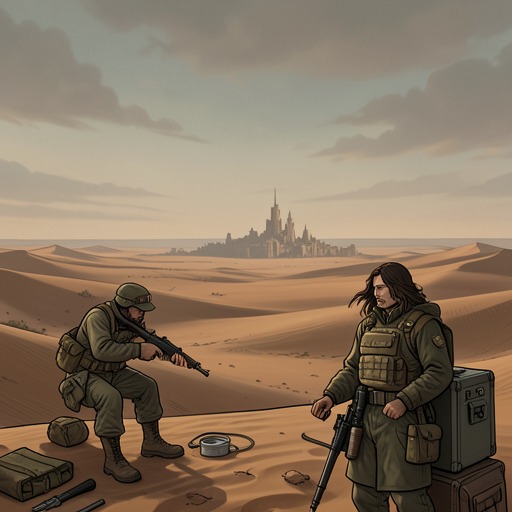
2666The desert as a space of disappearance and violence is both a material geography and a governing image in 2666. Around Santa Teresa, urban expansion presses against industrial parks, unpaved neighborhoods, highways, ravines, and vacant land. Women travel through that connected but uneven landscape for work and home, while bodies are left in places that are difficult to reach, identify, or investigate. The desert’s apparent openness does not make it transparent: distance, inadequate infrastructure, and institutional neglect turn it into a space where people can vanish and evidence can recede.
City, border, and desert
The critics’ drive around Santa Teresa reveals a city without a stable edge. To the west lie poor districts of unpaved streets and houses assembled from scrap; the center combines neglected arcades and plazas with hurried workers and residents carrying bundles. Eastward, carefully tended streets, playgrounds, shopping centers, and the university give way to poorer neighborhoods and rough terrain. North of the city are abandoned factories, bars, souvenir shops, and small hotels; southward, rail lines and soccer fields bordered by shacks lead toward highways and a garbage-filled gully. Beyond them, industrial warehouses mark the horizon of the maquiladoras. The city is not divided neatly into a center and an exterior: work sites, housing, waste grounds, and routes out of town overlap.
That expansion also reaches the border. The critics see a fence separating Mexico from the United States and look across it into the Arizona desert; industrial parks, in turn, are themselves ringed by poor neighborhoods. Santa Teresa appears to be growing by the second, while its surroundings remain difficult to traverse and organize. The boundary between urban space and desert is therefore not a clean line. It is a shifting fringe of roads, settlements, industrial land, and open ground through which people move and from which they can disappear.
The desert’s scale is rendered through the image of the sea. After leaving a field, Lalo Cura thinks that living there is like living at sea: the border is a chain of haunted or enchanted islands, cities and towns are boats, and the desert is an endless sea. The comparison makes settlements seem exposed and discontinuous, surrounded by a terrain that cannot readily be mastered. It also gives the geography an unsettling force of its own: the desert is not merely a blank interval between towns, but the environment that contains and connects them.
Routes through danger
The landscape’s violence is bound to ordinary movement. Margarita Lopez, sixteen, finishes a night shift at a maquiladora at about five-thirty in the morning and begins the roughly fifty-minute walk home. The roads around the industrial park lack adequate lighting, paving, and drainage; much of the waste from the park flows toward Colonia Las Rositas, where it forms a muddy expanse. North of the park, houses lack electricity. The account can establish the beginning of Margarita’s route and the conditions along it, but not what happened after she set out. More than forty days later, children find her body near a shack in Colonia Maytorena. Her journey to work and home has become an unresolved passage through a poorly lit landscape, not a story of individual fault or choice.
The novel repeatedly places industrial work and the desert fringe in the same frame. In July, one young woman is found in a car at an auto repair shop near the Nogales highway; another is found behind tanks along the Casas Negras highway. Both cases encounter the same practical limit: the police have no witnesses or leads. Their discovery sites—roadside, industrial edge, and outlying ground—belong to the working geography of Santa Teresa as much as to its margins. The landscape offers no reliable separation between the ordinary routes of labor and the places where violence is exposed.
Bodies, investigations, and uncertain ground
In March 1996, a ten-year-old girl is found between the Casas Negras highway and the bottom of an unnamed valley. She has no one to claim her; the official account says she did not live in Santa Teresa, but supplies no answer about what brought her there. Her description is sent by fax to police stations around the country, and the case, handled by Inspector Angel Fernandez, is soon closed. A second girl is found a few days later on the other side of the highway. Because the circumstances of the discoveries invite competing explanations about how the bodies arrived there, Juan de Dios Martinez considers the geography as evidence: the highway, the valley, and nearby El Obelisco create possible routes, but none yields a settled account.
El Obelisco’s history sharpens the unease without resolving it. It is described as a way station for people arriving from the south, among the poorest of the poor, who sleep in makeshift shelters and may regard the place as only another stop on the way elsewhere. Some call it El Moridero. The old city boundary once lay farther away, and a rough stack of three stones that served as an obelisk belongs to that vanished map. In the present, the landscape is at once a place of passage, a settlement, and a possible dumping ground. Martinez’s hypotheses—about a vehicle, the number of people involved, and the choice of location—remain questions rather than answers. The narrative makes the reader follow the investigation’s spatial reasoning while showing that reasoning cannot by itself identify the killer or the victims.
The pattern continues beyond the valley. In 1997, a ranch hand finds a partly buried body in desert land marked on city plans for a future development of Phoenix-style houses. The victim is eventually identified as Guadalupe Guzman Prieto, an eleven-year-old who had disappeared weeks earlier. Here, planned urbanization and concealed remains occupy the same ground: the proposed neighborhood gives the site a future on paper, while the body makes visible what that future map leaves out. Other investigations similarly depend on chance discovery. Students and a professor looking for a Yaqui village become lost and find human bones at El Pajonal, a place whose name suggests grassland although the surrounding terrain is desert and stone. The investigators locate the remains poorly buried at the precise spot the visitors indicated, but the victim is unidentified. Searching and finding do not necessarily restore a name.
Erasure and narrative significance
The desert’s violence is not presented as a mystery that landscape alone can solve. It works together with the city’s infrastructure and with the failures of institutions. A woman’s description may be circulated, a body examined, a case assigned, or an identification confirmed through forensic comparison; elsewhere, a case is shelved or closed, and the identity remains unknown. In April, a woman found in a field near Casas Negras has no identification, does not match the records of missing women from Santa Teresa, and is believed to have been dead for months. The case is shelved. Such outcomes make the desert a space not only of physical disappearance but also of administrative and social erasure.
The recurrent movement from factories and neighborhoods to highways, valleys, fields, and dumps gives the killings a dispersed geography rather than a single scene of violence. Santa Teresa’s growth produces more edges and routes than its institutions appear able to account for; the landscape gathers the consequences of that mismatch. The sea metaphor captures the result: victims and settlements are surrounded by a space that seems immense, while the facts that might connect one disappearance to another remain fragmentary. By making readers encounter routes, boundaries, failed searches, and incomplete identifications, the novel turns the desert into a structure of knowledge as well as a setting—an expanse in which violence is repeatedly visible, yet its causes and full extent remain difficult to apprehend.