The desert as a landscape of violence and disappearance
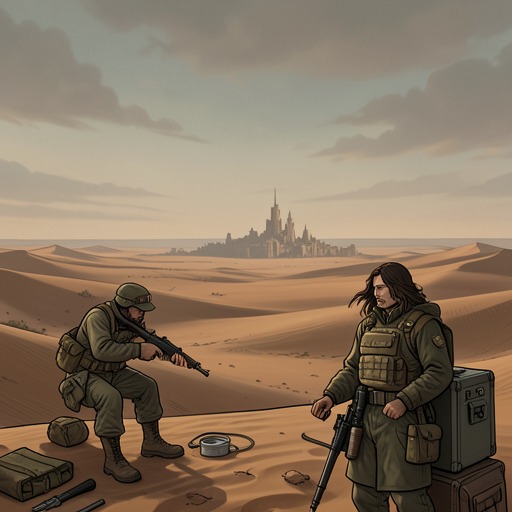
2666The desert in 2666 is both a physical environment and a structure of disappearance. Around Santa Teresa, industrial parks, migrant and working-class neighborhoods, border crossings, roads, and illegal dumps press into the desert; the resulting landscape offers no clean division between city and wilderness. It is at once a place of economic movement and a place where bodies and evidence can vanish, while the scale and fragmentation of the region make that vanishing easier to overlook.
A city expanding into the desert
Santa Teresa’s geography is described as continually changing. The critics who drive around it see poor western neighborhoods, neglected central streets, wealthier districts to the east, factories and sheds to the north, and rail lines, informal settlements, and industrial horizons to the south. The maquiladoras stand at the city’s edge, but the boundary does not hold: industrial parks are surrounded by slums, and growth carries the city outward into vacant and sparsely settled land. The critics conclude that Santa Teresa is growing by the second, a city whose development appears less like orderly expansion than the accumulation of incompatible districts.
The city’s vastness is not an abstract impression. Continuing east, the middle-class neighborhoods give way to slums among hills, valleys, dry riverbeds, and the remains of old ranches. Northward, a fence separates Mexico from the United States, with the Arizona desert visible beyond it. In the west, industrial parks are encircled by poor settlements. The desert is therefore crossed by boundaries and routes, yet remains interwoven with the city: an unsettled edge that development keeps remaking without making fully legible.
Industry, waste, and uneven exposure
The industrial landscape gives this expansion an economic framework. Chucho Flores describes Santa Teresa as a large, fully constituted city with factories, maquiladoras, a cocaine cartel, workers arriving from other cities, and Central American immigrants. He also names an infrastructure unable to sustain the pace of demographic growth. Money and poverty, bureaucracy and the desire for peaceful work coexist, but the city, as he puts it, lacks time. His account joins industrial opportunity to a feeling of pressure: the population and economy are moving faster than the systems meant to support them.
That imbalance becomes concrete in the neglected areas around the factories. The industrial parks are surrounded by settlements, while roads connecting workplaces and homes can lack lighting, paving, or drainage. Waste from an industrial park collects in a muddy expanse in Colonia Las Rositas. The environment’s damage is not presented as a separate subject from the crimes: it belongs to the same geography in which workers travel through darkness, services fail to reach neighborhoods, and marginal places become difficult to monitor.
When Albert Kessler investigates the city, he moves from a makeshift market to the Arsenio Farrell industrial park. The plants are tall and enclosed by wire fencing; buses bring workers in and carry others away. Beyond the park lie scrap-roof settlements, and another industrial complex glows in the distance. Kessler’s movement through this landscape connects the factories’ organized flows of labor with the improvised conditions surrounding them. What looks from one angle like an efficient industrial zone is, from another, one bright island in a broader field of deprivation.
The dump El Chile makes that broader field explicit. Kessler is taken to the largest illegal dump in Santa Teresa, where waste comes not only from maquiladora trucks but also from municipal contractors and private vehicles, including those serving areas public services do not cover. The dump is thus produced by overlapping public and private systems, not by an isolated act of disposal. Its scale and location make it part of the city’s ordinary operation even as the city’s neglected residents and discarded matter are pushed toward its margins.
The border as passage and divide
At the northern edge of the region, the desert is also a border landscape. Oscar Fate reaches the American town of Adobe, once the site of an adobe factory and now a string of houses and appliance stores along a main street, ending at a brightly lit lot beside the border post. His journey makes the crossing feel both routine and exposed: he presents a passport and press identification, and the customs officer asks whether he has come to write about the killings. Fate says he is going to cover a boxing match instead.
The next checkpoint lies only three hundred feet farther on, at the Mexican border. There, Fate gets out of the car, opens his suitcase, shows his documents, and fills out forms. From the customs house he sees the long fence between the two countries. He points out four birds perched on its far end and remarks on the cold; the official, occupied with the paperwork, answers in the same terms. The moment puts a small, shared observation against the machinery of inspection and division. The desert is not simply empty space between nations: it is crossed by people, documents, work, and reporting, while the fence marks a political boundary inside a region whose economic and social life continues to connect both sides.
Routes through danger and disappearance
The same regional geography shapes the accounts of women who disappear after leaving work. Margarita Lopez Santos finishes a night shift at a maquiladora at around five-thirty in the morning. Her route home should take about fifty minutes, crossing the Nogales highway and the streets of Colonia Guadalupe Victoria before reaching Colonia San Bartolome. Some homes in Guadalupe Victoria have no electricity, and the roads leading away from the industrial park lack adequate lighting, paving, and drainage. The account can establish her departure and the conditions of the route, but not what happens to her along it. More than forty days later, children find her body near a shack in Colonia Maytorena; her mother had reported her missing on the second day.
In the account of another victim, the landscape offers no route back to identity. A girl of about ten is found in a valley between the Casas Negras highway and a nameless depression of brush and wildflowers. She has no belongings that might help identify her, and no one comes to claim her. The police report says she did not live in Santa Teresa, then leaves unanswered what brought her there. Her description is circulated to police stations across the country, but the case is closed. The valley is not distant from infrastructure: it is set between a highway and the city’s wider network of roads. Yet that proximity does not ensure that a victim will be recognized or that the investigation will continue.
The novel also records the city’s brief public response to the killings. In July, after two women are found dead, the Women of Sonora for Democracy and Peace stages the first protests. One victim is discovered in a car at an auto repair shop near the Nogales highway; the other is found behind Pemex tanks along the Casas Negras highway. Their bodies are recovered in different settings connected by roads and industrial geography. The cases are assigned to separate inspectors, but both soon reach a dead end for lack of witnesses or leads. The desert’s roads permit movement; they also connect sites where violence can remain without explanation.
A landscape of concealment
The desert motif gathers force through recurrence rather than through a single revealing scene. Santa Teresa’s peripheral geography keeps presenting new places—the highway, the valley, the factory district, the border fence, the dump—while the investigations repeatedly fail to turn those places into a coherent account of what happened. The landscape is described and mapped, but its victims may remain unnamed, their movements only partly reconstructed, and their cases prematurely closed. Knowledge accumulates without guaranteeing recognition or justice.
One character’s account of her search for Kelly gives the desert a more inward dimension. Over two years, she has Loya investigate Kelly’s disappearance and gradually pieces together a map of the places and people connected to it. She says the voices she hears come from the desert, and describes herself wandering there with a knife, her reflection in the blade. The surrounding investigation links wealthy men’s properties and parties to the desert estates known as narcorranchos: isolated compounds that may stand empty for long periods, then suddenly fill with workers, guards, and their owners. The desert is not only a place where the poor and missing are pushed out of sight; it is also a setting for the protected wealth and private power that can operate beyond ordinary scrutiny.
Across these episodes, the desert’s apparent openness is sharply contradicted by the conditions of life there. Industrial expansion, inadequate infrastructure, border controls, public-service gaps, illegal dumping, and investigative failure all shape who can move safely and who can disappear without an effective search. The desert does not explain the crimes or act as their sole cause. Its narrative significance lies in how it joins distant and ordinary places into a geography of exposure and concealment: a landscape that surrounds the city, absorbs its waste, carries its traffic, and leaves too many disappearances unresolved.