Aeneas–Anchises relationship
AeneidThe Aeneas–Anchises relationship gives filial duty its most concrete form in the poem. Anchises is not merely Aeneas’s father but the vulnerable elder whose survival imposes an immediate moral obligation, while Aeneas’s care for him becomes a defining expression of piety, endurance, and obedience to a larger destiny.
Identity and Foundation
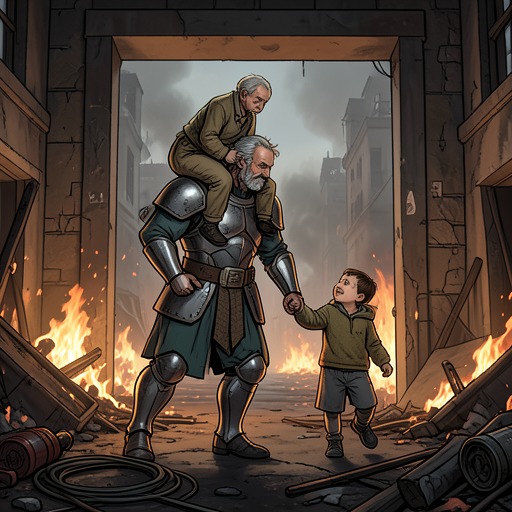
The relationship is established through a stark division of roles. Anchises represents age, memory, and the endangered continuity of the Trojan household; Aeneas represents the strength required to preserve that continuity. When fire approaches the palace, Aeneas does not treat escape as an individual opportunity. He urges his father to climb onto his shoulders and declares that, whatever happens, Anchises’s life will be his care. The language makes protection a personal vow rather than a general sentiment.
Filial Duty in the Fall of Troy
Aeneas’s care is enacted through the physical burden he accepts. He prepares what prudence can provide, covers his shoulders with a lion’s hide and its yellow spoils, and bends beneath the weight of his father. The image joins vulnerability and strength: Anchises is carried because he cannot safely flee alone, while Aeneas transforms his own body into the means of family survival. The surrounding fire, associated with Vulcan’s rage and rising winds, makes the act a response to an immediate and overwhelming disaster rather than a ceremonial display of affection.
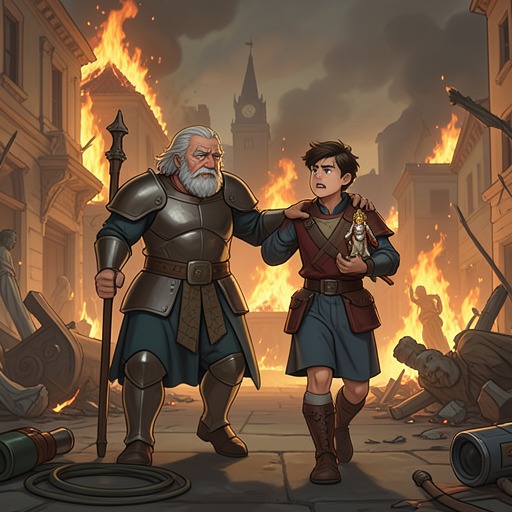
The scene also defines Aeneas’s priorities amid the destruction of Troy. His first responsibility is not conquest or retaliation but the preservation of his father’s life. By carrying Anchises through the burning city, he protects both a person and the ancestral continuity that Anchises embodies. Filial devotion therefore becomes inseparable from the survival of the Trojan remnant.
The Father’s Continuing Authority
Anchises’s influence does not end with physical rescue. Later, when Aeneas encounters him, Anchises receives him with open arms and tears, welcoming him as one descended from the gods and acknowledging the fear he has felt for his son’s fate. His concern reaches back especially to the period when love assailed Aeneas on the Libyan coast, linking paternal anxiety to the danger of Aeneas’s attachment to Dido.
Aeneas answers that his father’s sacred ghost has appeared before his sleeping eyes and repeatedly urged him toward the painful enterprise. Anchises thus remains an active source of direction after death. His authority is transformed from bodily dependence into spiritual guidance: the son once carried the father away from flames, but the father’s ghost now helps propel the son toward the future demanded of him.
Separation, Memory, and Destiny
The relationship is shaped by reversal. In Troy, Aeneas’s duty is downward and immediate: he bears Anchises on his shoulders. After Anchises’s death, the direction of obligation changes. Aeneas must carry his father’s command within memory, allowing the dead father to govern the living son’s choices. The recurring appearance of Anchises in Aeneas’s sleeping vision makes remembrance a form of action rather than passive grief.
This bond also clarifies the cost of Aeneas’s wider mission. The enterprise urged by Anchises is explicitly painful, and Aeneas’s recollection of his father’s ghost places private attachment within the pressure of destiny. Aeneas’s journey is not presented as a clean abandonment of family feeling; it is sustained by the very father from whom separation has made him responsible for carrying the family’s future onward.
Narrative and Thematic Significance
The Aeneas–Anchises relationship is the poem’s clearest human emblem of Pietas. Aeneas’s virtue is shown not through abstract declaration but through repeated acts of care, obedience, and endurance. He accepts the burden of an aged father in the moment of Troy’s collapse, then accepts the burden of the father’s posthumous command when the journey becomes difficult.
The relationship also binds past, present, and future into one chain. Anchises carries the authority of the ancestral past; Aeneas becomes the active bearer of that inheritance; the son’s continued movement preserves the possibility of a future beyond exile. Their bond therefore converts loss into continuity without erasing its pain. The father’s body is carried from the flames, and later his voice is carried through the son’s memory: in both forms, Aeneas’s identity is made through bearing Anchises forward.