Nisus–Euryalus relationship
AeneidThe Nisus–Euryalus relationship binds two Trojan warriors through shared affection, shared danger, and a loyalty that survives even when military judgment collapses. Their friendship gives the night raid its emotional center: what begins as a chosen act of service to the Trojan cause becomes a test of whether one companion can endure the other’s death. The answer is no; each man’s fate is completed through his response to the other.
Identity and Introduction
Nisus and Euryalus appear together among the Trojan defenders as warriors whose attachment is presented before the raid itself. Euryalus is described as Nisus’s friend and as the fairest and most graceful figure in the Trojan host. He is still scarcely old enough for the first down to have begun shading his cheeks, a detail that places youthful beauty beside the danger of battle. Nisus, by contrast, is characterized in the surrounding martial world through action and resolve. Their pairing therefore joins the experienced fighter’s force of purpose to the younger warrior’s beauty and vulnerability.
The narration defines their bond through parallel language rather than through abstract explanation. Their care is one, their delight is one, and they share one common hazard in the war. They are not merely comrades assigned to the same duty: they have chosen together to stand guard. The relationship is consequently both intimate and martial, formed by affection but made visible through the risks that war imposes on them.
Shared Duty and the Night Raid
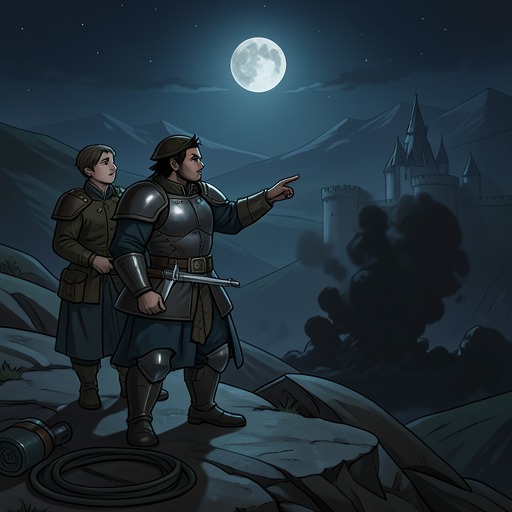
Their friendship becomes consequential when the two choose to leave the guard and penetrate the hostile camp by night. The action belongs to the wider Trojan struggle, but its immediate motive is the bond between the two men as much as military necessity. Their common hazard is transformed into a common enterprise, and the raid allows each to display the qualities the other already recognizes: Nisus supplies daring and concentrated violence, while Euryalus follows into the same peril despite his youth.
The raid’s structure makes companionship the measure of courage. Success cannot be understood as one warrior’s achievement independent of the other, because the pair’s delight and danger have been deliberately made common. The night offers concealment, but it also isolates each man from the protection of the larger Trojan force. Their solidarity is thus both their strength and the condition that makes the eventual catastrophe inseparable from their personal attachment.
Reversal, Loss, and Revenge
The relationship reaches its tragic turning point when Euryalus is captured or placed at the mercy of the enemy after the raid. Nisus does not see the warrior who has dealt the fatal wound, and therefore cannot immediately direct revenge against the correct assailant. In the confusion, he cries that the prisoner will pay for both and rushes at him with his drawn sword. The episode reveals how completely Nisus’s judgment has been overtaken by the need to answer for Euryalus: vengeance becomes an attempt to make the surviving companion bear the cost of the dead one.
The violence that follows is not presented as cold military calculation. Euryalus’s lover is unable to endure the cruel sight, and the emotional force of the scene lies in the collapse of the distinction between his own survival and his friend’s suffering. When Euryalus falls like a rain-laden white poppy sinking upon the plain, the image gives fragile beauty to a death produced by war. Nisus is then driven headlong into the hostile crowd by despair, rage, and a vengeance he has justly vowed. He seeks Volscens alone and directs all his force toward him.
The pursuit of Volscens turns friendship into a final act of retaliatory fidelity. Nisus’s objective narrows to the man he understands as responsible for Euryalus’s death; the wider battle becomes secondary to the private obligation created by their shared life and shared danger. His revenge cannot restore Euryalus, but it prevents the death from becoming anonymous. The surviving friend makes the loss legible as an injury that demands an answer.
The Meaning of the Bond
The Nisus–Euryalus relationship is heroic because it joins personal loyalty to collective warfare, yet it is tragic because the same loyalty also drives the men beyond prudent limits. Their unity gives them the courage to undertake danger together, but it leaves no acceptable future in which one simply returns without the other. The narrative’s repeated emphasis on one care, one delight, and one hazard makes their deaths feel like the breaking of a single moral and emotional unit rather than two unrelated casualties.
Their friendship also belongs to the larger Trojan tradition of inherited struggle. The Trojan ranks include figures renowned for valor and age, while the tale of their raid places beside those older martial identities a younger pair whose distinction lies in chosen companionship. Against the background of Troy’s destruction and the continuing demands of war, their intimacy provides a concentrated image of what the Trojan cause costs at the human level. The relationship is therefore memorable not because it escapes violence, but because it exposes how violence converts affection into courage, grief, and revenge.