Aeneas–Ascanius relationship
AeneidAeneas–Ascanius relationship is the bond between a father carrying the future of his people and the son who will inherit that future. It begins in flight from Troy, where Aeneas promises to lead his little son while sharing danger with Creusa, and it culminates in a political and dynastic horizon in which Ascanius is to wear the promised crown. The relationship therefore unites tenderness, protection, succession, and the larger destiny of the Trojan people.
Identity and Foundation
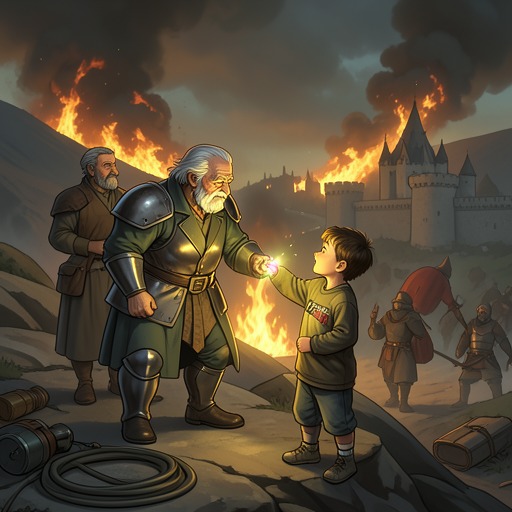
Aeneas’s fatherhood is first defined by physical responsibility. During the escape from Troy, he declares that his hand will lead Ascanius and that the family will share either death or deliverance. The image is deliberately practical: the child is not merely named as an heir but placed under the father’s hand, dependent on his guidance through catastrophe. Aeneas’s care is thus established amid immediate peril, where family survival and the survival of the Trojan remnant become inseparable.
That promise also gives the relationship a collective meaning. Ascanius is the “rising heir,” and Aeneas is urged to regard the boy’s fortunes even when glory and future praise cannot move him. The appeal makes the son the measure of the father’s endurance. Ascanius represents the promised crown, the Ausonian scepter, and the state that will continue beyond Aeneas’s own hardships. His future transforms paternal affection into a duty toward an unborn political order.
Care During Exile and War
The relationship develops under the pressures of Trojan exile. Aeneas’s movement through hostile landscapes and successive dangers is not presented as a solitary heroic adventure: his responsibility includes keeping Ascanius alive and carrying him toward a future that the older generation cannot yet possess. The father’s journey consequently has two directions at once, away from the ruined past and toward the son’s inheritance.
The poem repeatedly places the younger figure within a chain of generations. The memory of Troy’s warriors, the old heroic race descended from Teucer, and the succession of ancestral names all enlarge Ascanius’s position beyond childhood. He belongs to a lineage shaped by loss but projected toward better times and happier years. Aeneas’s relation to him is therefore both immediate and genealogical: he protects one vulnerable body while preserving the continuity of an entire people.
Recognition and Affection
The emotional force of the bond appears in scenes of reunion and acknowledgment. Aeneas is welcomed as one of divine descent, and the love and pious duty shown by his family are said to have survived the perils of an arduous journey. Within that language, Ascanius is not simply an object of protection; he is part of the reciprocal family duty that confirms Aeneas’s identity. The son’s presence validates the father’s endurance, while the father’s survival secures the son’s place in the continuing story.
The relationship is also framed by inherited sacred and cultural memory. In the temple associated with Cumae, images and narratives connect the Trojans with heroic ancestry, while the poem’s recollection of Daedalus and the ancient race of Teucer places the family’s immediate experience within a much older Mediterranean world. These traditions give Ascanius a past before he can fully possess it and make Aeneas the mediator through whom that past is carried forward.
Succession and Public Destiny
Ascanius’s importance becomes most explicit when Aeneas is asked to abandon private pleasure and consider the heir’s future. The promised crown is not an ornamental reward but the basis of a state: Ascanius is destined to receive the Ausonian scepter and political power. The father–son relationship consequently supplies the poem with a moral language for sacrifice. Aeneas must choose actions that preserve the son’s future, even when those actions demand the surrender of immediate happiness.
This dynastic structure distinguishes the relationship from a purely domestic attachment. Aeneas’s love for Ascanius is personal, but it is never confined to the household. The son embodies the transition from wandering Trojan survivor to founder of a durable order. Through him, exile acquires an endpoint, and paternal care becomes one of the means by which the poem connects the fall of Troy to the later rise of Rome.
War, Example, and Continuance
By the final war, Aeneas’s role toward Ascanius includes instruction through example. Before battle he embraces his son and tells him to learn war from his example. The gesture joins bodily affection to martial education: Aeneas kisses Ascanius through the helmet, then turns the son’s attention toward the conduct required of an heir. The helmet marks the child’s entry into a world governed by arms, while the embrace preserves the intimate relation beneath that public transformation.
Aeneas’s example is not only technical instruction in combat. It presents the kind of conduct Ascanius must inherit: courage joined to restraint, authority joined to responsibility, and victory governed by a sense of justice. The later hesitation before striking a yielded Turnus reinforces this lesson. Even at the decisive edge of violence, Aeneas’s action is measured against what can be defended as honorable. Ascanius’s education therefore occurs within an ethical as well as military tradition.
The relationship reaches its strongest symbolic form when the war’s end approaches and the future remains attached to the son. Aeneas has protected Ascanius from the destruction of Troy, carried him through exile, and prepared him to inherit a political order. Ascanius is consequently both the child Aeneas leads by the hand and the successor whose existence gives meaning to the father’s victories. Their bond converts survival into continuity: what Aeneas saves in the present is the possibility of Ascanius’s future rule.