Aeneas–Creusa relationship
AeneidThe Aeneas–Creusa relationship is the tragic marriage at the heart of Aeneas’s escape from Troy. Its decisive significance lies in the conflict between intimate loyalty and the demands of survival: Aeneas tries to return to the abandoned battlefield, while Creusa attempts to hold him back, and their separation becomes permanent when she is lost during the flight from the ruined city. Her later appearance as a ghost transforms a private disappearance into an irrevocable farewell, leaving Aeneas to carry both his grief and the duty of continuing onward.
Marriage Under Siege
The surviving evidence presents Creusa as Aeneas’s wife and as a figure deeply bound to his immediate household. When Aeneas prepares to rush toward the abandoned field, Creusa stops his passage and lies across the threshold, embracing his knees. Her action is physically intimate but also urgent: the threshold becomes the contested boundary between domestic attachment and the violence outside. Aeneas’s impulse is toward the battlefield, whereas Creusa’s intervention seeks to keep him within the endangered family space.
The scene gives the marriage a tragic structure before Creusa’s death occurs. Their bond is not dissolved by indifference or voluntary abandonment; it is placed under pressure by Troy’s destruction and by Aeneas’s responsibility to act. The relationship therefore embodies a larger tension in the poem between personal presence and a destiny that repeatedly demands departure.
Loss During the Escape from Troy
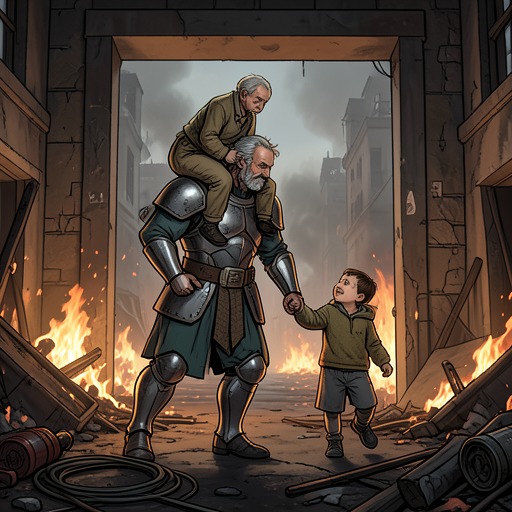
During the flight through winding ways and the shelter of night, Aeneas discovers that he has lost Creusa. He cannot determine whether her fatal destiny has overtaken her, whether weariness has made her sit down, or whether fear has caused her to wander. The uncertainty intensifies the loss. At first, Creusa is not presented as a confirmed corpse but as a missing wife whose fate must be sought through darkness and conjecture.
Aeneas responds by reversing his course and searching for her. The escape, which should carry the survivors away from Troy, is interrupted by his attempt to recover the person who has fallen behind. His movement through the night thus becomes both a literal search and a sign of marital attachment: even amid the collapse of the city, he cannot simply accept her absence and continue without trying to find her.
The Ghost and the Final Farewell
In uncontrolled anguish, Aeneas calls Creusa’s name through the silent streets. At length she hears him and suddenly appears through the shades of night, but she appears no longer as Creusa in bodily life or as his wife in the ordinary domestic sense. Aeneas is left aghast and struck dumb with fear, while her ghost begins by soothing his grief and telling him that tears and cries cannot relieve the dead.
This apparition supplies the recognition that the earlier search could not provide. Aeneas learns that the separation is final, and the uncertainty surrounding Creusa’s disappearance becomes a death whose meaning must be accepted rather than reversed. The encounter permits speech where the ruined city had offered only darkness and confusion, but it does not restore the marriage. Creusa’s ghost can console Aeneas only by ending his hope of recovering her.
Her appearance also changes the emotional function of the relationship. In life, Creusa had physically impeded Aeneas’s departure by embracing his knees at the threshold. In death, she no longer obstructs his path; instead, the ghost’s role is to release him from the search and direct his grief toward endurance. The marriage survives as memory and obligation, not as shared travel into the future.
Grief, Duty, and the Poem’s Larger Design
The relationship’s tragedy arises from the collision of two forms of fidelity. Aeneas’s return to seek Creusa demonstrates fidelity to his wife, while the circumstances of his escape require him to continue carrying forward the surviving household and the larger Trojan future. Creusa’s disappearance exposes the cost of that mission: Aeneas does not preserve every member of his family, even though he attempts to do so.
The relationship therefore gives emotional weight to the distinction between departure and desertion. Aeneas leaves Troy, but the evidence does not portray him as willingly discarding Creusa. He is separated from her during the flight, searches for her, calls her name repeatedly, and receives her final appearance only after the loss has become irreversible. His subsequent task is shaped by a grief that cannot be cured by reunion, only contained within the onward movement demanded by fate.
Creusa’s death also establishes a pattern that later losses repeat across the epic: individuals are mourned, their bodies or deaths disrupt the living, and the survivors must transform sorrow into continued action. Unlike a political truce or a formal peace, this marital rupture cannot be repaired by vows. Its permanence is precisely what makes it foundational to Aeneas’s identity as an exile and as a husband whose first household has been destroyed.
Narrative and Thematic Significance
The Aeneas–Creusa relationship is a compact tragedy of intimacy interrupted by history. Its structure moves from physical closeness at the threshold, through disappearance in the night, to recognition in a ghostly encounter. The repeated calling of Creusa’s name gives the episode the force of traumatic return: Aeneas attempts to restore the lost relationship through voice, but the answer he receives confirms that language cannot restore the dead.
The marriage also complicates Aeneas’s heroic image. His mission is often defined by endurance and forward movement, yet this episode shows that such movement is purchased through a wound he cannot undo. Creusa is not merely an obstacle left behind in the ruins; she is the absent wife whose loss makes the journey morally and emotionally costly. The relationship’s ending consequently turns Aeneas’s future into an act of remembrance as much as an act of destiny.