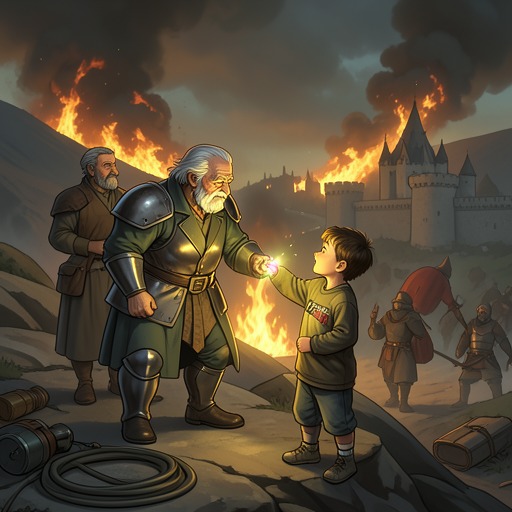
Aeneas–Anchises–Ascanius family relationship
AeneidThe Aeneas–Anchises–Ascanius family relationship is the poem’s most concentrated image of inherited duty. Across catastrophe, exile, war, and prophecy, the three-generation line joins Anchises’s authority, Aeneas’s burden-bearing leadership, and Ascanius’s future inheritance. Its decisive significance lies in the way private family care becomes the human foundation of Trojan survival and the long historical destiny associated with Rome.
Identity and Generational Structure
Anchises represents the elder generation whose life and memory must be preserved; Aeneas stands between past and future as son, father, leader, and bearer of obligation; Ascanius embodies the continuation of the line. The relationship is therefore more than a domestic bond. It is a succession in which responsibility moves through the generations without erasing the claims of the preceding one. Aeneas’s identity depends simultaneously on protecting his father and guiding his son.
The poem repeatedly places this lineage against a wider Trojan ancestry. Ripheus and Iph’itas fight beside the defenders of Troy, linking Aeneas’s household to a larger community of inherited courage and service. Later genealogical and legendary references expand the same principle: Teucer’s heroic race, Assaracus, and Ilus belong to the deep ancestral background from which the surviving family carries forward a renewed Trojan identity.
Aeneas Between Father and Son
The relationship becomes most vivid during the flight from the burning city. Aeneas urges Anchises to let him carry him, declaring that his father’s life will be his care and that they will share either death or deliverance. The gesture makes filial devotion physical: the son becomes literally responsible for the father’s body while the city around them is consumed by fire.
At the same moment, Aeneas takes responsibility for the next generation. He promises that his hand will lead Ascanius, while his faithful consort follows their steps. The family’s escape is thus organized as a chain of protection: Anchises is carried, Ascanius is guided, and Aeneas occupies the dangerous middle position that joins them. The household does not survive through individual escape but through coordinated dependence.
This arrangement also gives Aeneas’s heroism a distinctive shape. His courage is not presented simply as the pursuit of arms or personal glory. It is measured by whether he can preserve those entrusted to him. The family relationship turns flight into an active moral task: to save the father is to honor the past, and to lead the son is to make a future possible.
Ancestry and Rome’s Future
The lineage reaches beyond the immediate crisis through visions and prophetic history. Silvius is identified as Aeneas’s last-born descendant, an Alban figure whose blood combines Dardan and Latin inheritance. The phrase places the family at the meeting point of two peoples and makes descent itself a mechanism of political transformation.
The same future history culminates in Romulus, who is presented as the prince born to restore the crown of his injured grandsire. Through such figures, the family line becomes a sequence extending from Trojan disaster into Alban and Roman power. The relationship between Anchises, Aeneas, and Ascanius therefore carries an implied historical argument: the scattered survivors of Troy are not merely escaping destruction; they are transmitting a lineage that will produce new cities, rulers, and political memory.
The contrast between obscure lands and towns of future fame sharpens this movement. What appears insignificant in the present is revealed as the seed of later greatness. Family continuity supplies the bridge between those two states, allowing the poem to read domestic survival as the beginning of an imperial history.
Family Duty in War and Peace
The lineage remains relevant after the escape from Troy because Aeneas continues to act as both protector of his people and father of Ascanius. In the Italian conflict, he seeks an end to needless violence and addresses the Latian princes as a man conscious of the cost imposed on communities by inherited quarrels. His appeal invokes the history of the Greeks who came to Troy’s destruction, contrasting the present war with the older devastation from which his family fled.
When envoys from Laurentum arrive with olive branches to request a truce, Aeneas grants a suit he considers too just to deny. The later peace is formally tied by solemn vows, with the required sacred rites performed on both sides. These scenes extend the family relationship into political conduct: the future of Ascanius cannot be separated from the kind of world Aeneas leaves him, whether one governed by unending vengeance or by negotiated order.
Aeneas’s role as father also intensifies the stakes of his final conflict with Turnus. At the decisive moment, he hesitates before striking a defeated opponent, and the sight of the Belt of Pallas restores the memory of the young man’s death. The narrative does not present Aeneas as free from violence, but it places his violence within a moral and generational framework: he must act as the guardian of a future represented by Ascanius while answering for the destruction inflicted on those connected to his allies.
Narrative and Thematic Significance
The family relationship concentrates the poem’s governing idea of Pietas. Aeneas’s duty is not an abstract virtue added to his character; it is enacted through the bodies and claims of Anchises and Ascanius. Carrying the father and leading the son make the same hero simultaneously retrospective and prospective, accountable to what has been lost and obligated to what has not yet come.
Its structure also transforms the conventional heroic quest. The central achievement is not isolated triumph but transmission: Anchises’s generation must be preserved, Aeneas must endure the burden of mediation, and Ascanius must inherit a future that the present cannot yet see. The later appearances of Silvius and Romulus confirm that the family’s meaning lies in continuation rather than immediate reward.
By binding intimate care to public destiny, the Aeneas–Anchises–Ascanius family relationship makes the poem’s political vision legible as a family drama enlarged across time. Troy’s fall, the settlement of Italy, the reconciliation of peoples, and the emergence of Rome all become stages in the preservation and transformation of one father-son lineage.