Katabasis
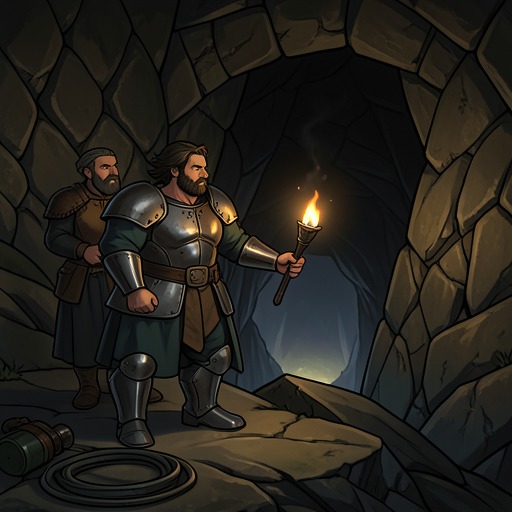
AeneidKatabasis is the descent into the underworld undertaken by Aeneas in Book VI, a passage that makes the invisible foundations of his mission visible. It is not merely an encounter with the dead: it is a ritual crossing from ordinary geography into sacred and prophetic space, where personal grief, ancestral continuity, divine law, and Rome’s future are gathered into one vision. Aeneas enters because he seeks his dead father, Anchises, but he emerges with a clearer understanding of the generations and political destiny that depend upon him.
Definition and Sacred Threshold
Katabasis begins when Aeneas asks the prophetic Sibyl to lead him below. He declares that no frightening face of danger is unfamiliar to him and that he is prepared to endure and dare whatever the Fates demand. His request is therefore framed not as curiosity but as a test of resolve. The road near the Sibyl’s grove leads toward Acheron, the unnavigable river surrounding the dark abode, and the descent requires divine and ritual authorization rather than ordinary courage alone.
The Sibyl presents the underworld as a realm whose gates stand open night and day. That openness does not make entry easy; instead, it emphasizes that death is permanently present while the living remain separated from it by sacred conditions. Aeneas places his hand upon the holy altar as he prays, binding the journey to ritual purity and filial duty. He asks the Sibyl to honor his father and protect his son, so the descent joins three generations: Anchises, whose shade he seeks; Aeneas, who must undertake the journey; and Ascanius, whose future gives the request its urgency.
Preparation, Burial, and Passage
Before Aeneas can proceed, the expedition is interrupted by the discovery of Misenus lying dead on the shore. Misenus is identified as the son of the God of Winds and as a figure of exceptional renown, but fame cannot exempt him from the requirements imposed by death. The Trojans must perform his funeral rites, and Aeneas hastens to the nether world only after the burial has been completed. The sequence makes katabasis dependent upon proper treatment of the dead: the living cannot cross the threshold securely while an unburied companion remains exposed.
The funeral also turns private loss into lasting memory. After the rites, Misenus is interred, and the lofty cape bears his name in deathless fame. The descent thus begins with a double movement: a body is returned to the earth, while a name is preserved in the landscape. Katabasis is consequently not a flight from mortality but an organized passage through it, governed by burial, remembrance, and the recognition that heroic identity survives through communal ritual.
Encounters in the Underworld
As Aeneas approaches the Stygian lake, the underworld’s boundary becomes concrete. The surly boatman Charon sees the approaching travelers from the shore and observes their passage through the shadowy wood. The scene establishes the underworld as a territory with its own guardians, waters, routes, and rules. Aeneas does not simply imagine death from afar; he is admitted into a structured domain in which passage is watched and controlled.
The spirits encountered there include Palinurus, who appears among the dead as a newly admitted guest although he is still fresh from life. His presence brings the violence of the voyage into the underworld itself: the man who had watched the stars while steering has been swept into death after tempests overturned the ship on the Tyrrhenian seas. Katabasis therefore gathers together deaths produced by different forces, placing sudden loss beside ritual burial and showing that the boundary between the living expedition and the dead is porous but irreversible.
The underworld also contains spaces of happiness and ordered continuity. In a flowery vale, old Anchises reviews his assembled race and counts the blessed spirits ordained by fate. His action changes the meaning of Aeneas’s journey. The father is not merely a lost individual awaiting consolation; he stands within a succession of future descendants. By surveying the spirits and presenting them as a race shaped by fate, Anchises converts ancestry into historical vision and makes the family line the instrument through which a larger people will come into being.
Knowledge, Destiny, and Return
The descent functions as a quest whose reward is knowledge rather than treasure. Aeneas enters as an exile burdened by repeated losses and uncertainty, but the encounter with Anchises places those sufferings within a future-oriented order. The dead are not silent remnants of the past: they disclose the continuity from Trojan survival to the people and institutions that Aeneas is destined to found. The underworld therefore reverses ordinary time. The living traveler moves downward into the past and finds there the outlines of the future.
This movement gives katabasis its political force. Aeneas’s mission is no longer only the search for land or the preservation of a displaced household. Anchises’s muster of the future race presents survival as succession, and succession as destiny. The journey binds pietas to Fatum: Aeneas honors the dead precisely by continuing toward the future that their line requires. His return from the underworld consequently carries an implicit mandate to act, settle, lead, and endure on behalf of those who cannot return themselves.
Narrative and Thematic Significance
Katabasis mediates the central opposition between life and death, past and future, private mourning and public foundation. Its spaces are sharply bounded—the grove, the altar, Acheron, the Stygian lake, the shadowy wood, and the flowery vale—yet the journey permits controlled contact across those boundaries. Ritual opens the passage, burial stabilizes the community, the boatman regulates movement, and Anchises transforms the encounter into prophecy. Each threshold is crossed only through an act of recognition or obligation.
The episode also presents the hero’s journey in a distinctive form. Aeneas does not descend to escape his destiny; he descends to understand it. His courage is expressed through submission to the Fates and through responsibility to Anchises and Ascanius, not through an attempt to master the underworld by force. The ordeal yields no simple restoration of what has been lost. Misenus remains dead, Palinurus remains among the spirits, and Anchises can only be encountered in the realm below. What Aeneas receives is instead a vision strong enough to turn grief into historical purpose.
In this sense, Katabasis is the book’s passage from wandering to mission. The hero’s route to the underworld begins beside a body requiring burial and ends among the future dead whom Anchises has assembled. Between those points, death becomes not an interruption of the story but the medium through which its ultimate scale is revealed: the Trojan exile is connected to a race, a succession, and the Roman imperial destiny that Aeneas must carry back into the world of the living.