Fatum
AeneidFatum is the poem’s principle of destined order: the power that converts the fall of Troy into a mission, wandering into settlement, and conflict into the foundation of a future people. It operates through omens, oracles, divine declarations, political commands, ritual agreements, and the pressure of an approaching end. Human beings may resist, delay, mourn, or fight, but the narrative repeatedly presents their choices as occurring within a larger necessity that finally drives events toward Italy and the promised future of Rome.
Definition and Scope
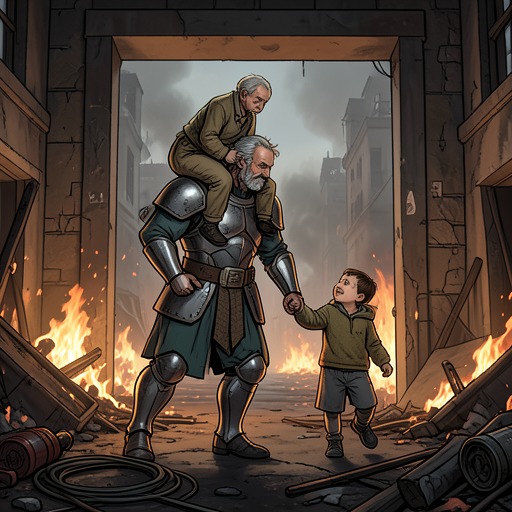
Fatum first appears as the meaning imposed upon catastrophe. After Troy has become the prey of the Greeks and its towers have burned, the survivors are warned by celestial omens and retreat into foreign lands in search of a happier home. Their exile is therefore not represented as aimless flight. The destruction of Troy becomes the opening movement of a new historical purpose, and the omens transform ruin into instruction: the displaced Trojans must leave the old city in order to seek the land assigned to their descendants.
The authority of Fatum is confirmed through sacred consultation. When the Trojans fall prostrate before a manifest god, the divine answer directs them to seek the mother earth from which their ancestors derive their birth. The command joins genealogy to geography: the correct homeland is not simply a place of refuge but the soil connected with ancestral origin. Fatum thus gives the migration both a destination and a rationale, making ancestry a force that reaches forward through generations.
Prophecy and the Promised Homeland
The Delphian oracle gives Fatum a more immediate political direction. While Aeneas is occupied with the relics of Troy and the ruined palace of Priam, the oracle commands him onward, and Fate invites him to the Latian lands. The contrast is decisive. Aeneas may wish to review sacred remains, adore the dust of the dead, and restore Priam’s palace, but the destiny disclosed by the oracle forbids him to make restoration of Troy his final task. The past must be honored, not re-established as the permanent center of Trojan life.
Latium is presented as the promised place toward which Aeneas steers. This language makes navigation an image of obedience: the hero’s movement across foreign seas is also movement along a divinely marked historical course. The destination is not secured by immediate possession. It must be approached through uncertainty, hardship, alliances, and war, yet the promise gives those episodes a common direction. Fatum supplies the continuity that the exiles themselves cannot always see.
Fatum and Endurance
Fatum also shapes the character of the destined hero. When confronted by supernatural fury and frightening danger, Aeneas declares that no terror is new to his view. His identity has been formed by repeated exposure to suffering, and his readiness to endure is inseparable from the mission imposed upon him. The speech does not erase danger; it shows how the pressure of destiny produces a particular ethical posture, in which fear may be felt but cannot determine the course of action.
Aeneas’s endurance is therefore neither passive resignation nor private ambition. He bears the displaced gods and leads the Trojan remnant because the future attached to them exceeds his individual life. The poem repeatedly places personal grief beside public obligation, making Fatum a force that demands sacrifice from the present for the sake of descendants and institutions not yet born.
Divine Recognition and Historical Legitimacy
Fatum receives its most explicit affirmation when a god appears to Aeneas as the long-expected offspring of an ethereal race in the promised place. The recognition joins three claims at once: Aeneas possesses an exceptional lineage, his arrival has been expected, and the land he has reached is the place assigned to him. His presence is consequently not treated as an accidental intrusion. Divine acknowledgment grants his mission legitimacy before the local future has been politically secured.
This recognition also turns displacement into election. The Trojan exile is not simply someone who has survived the collapse of a city; he is the bearer of a destiny that has been anticipated by the gods. The poem’s historical imagination depends on this transformation. Aeneas’s authority derives not only from force or ancestry but from the convergence of prophecy, divine expectation, and the survival of the Trojan household gods through exile.
Fatum, War, and Political Settlement
Fatum does not prevent conflict. Instead, it gives conflict a predetermined horizon. When suppliants from Laurentum come with olive branches to request a truce, Aeneas grants a plea that is too just to deny and condemns the severity of a fate that has drawn the Latian state into causeless quarrels against an unoffending man. Here Fatum is not identical with every act committed in its name. The existence of a destined settlement does not make every violent step morally sound; the poem distinguishes the larger course of destiny from the injustice and confusion produced by human quarrels.
Aeneas then sends to the Latin king to end the rage of arms and ratify peace. The sequence is important because it shows destiny working through deliberate political action rather than bypassing institutions. The promised future requires negotiation, recognition, and a formal cessation of violence. When peace is publicly bound with solemn vows sworn on both sides, with all dues performed according to holy rites, the destined order takes juridical and ritual form. Fatum becomes durable only when communities enact it through recognized obligations.
Appointed End and the Final Resistance
Near the poem’s conclusion, the narrator declares that all things are tending toward their utmost issue, pushed by the Fates to their appointed end. This formulation gathers the scattered strands of the epic into one teleological movement. Exile, prophecy, endurance, divine recognition, truce, and treaty are not isolated episodes; each has helped propel the story toward a final resolution that exceeds the immediate actors.
Yet the final scene preserves a sharp tension between destiny and human judgment. Aeneas stands in deep suspense, prepared to strike Turnus but repressing his hand. His hesitation shows that Fatum does not make action automatic. Even when the narrative has reached its appointed end, the hero must still confront a moment of choice, weighing the possibility of mercy against the claims of memory, justice, and the future community whose foundation depends on his victory. Destiny supplies the pressure and direction, but the moral burden of carrying it remains with Aeneas.
Fatum consequently gives the poem its broadest structure and its hardest question. It explains why the Trojans must leave Troy, why Italy is more than a refuge, why Aeneas can endure repeated suffering, and why war eventually yields to a new political order. At the same time, it does not dissolve grief, responsibility, or ethical conflict. The destined future is achieved through decisions made under pressure, through treaties sealed by sacred vows, and through the hero’s final struggle to determine what justice requires at the very threshold of fulfillment.