Pietas
AeneidPietas is the poem’s central ethic of duty, joining reverence for the gods to loyalty toward family, ancestry, political obligation, and the claims of the dead. Its decisive figure is Aeneas, whose conduct repeatedly places inherited responsibility above private fear, desire, or anger. In the poem, pietas gives moral shape to survival: it carries an endangered father from burning Troy, authorizes appeals for peace, sanctifies public agreements, and finally restrains violence at the very moment when vengeance seems certain.
Definition and Scope
Pietas encompasses several obligations that the narrative keeps in active relation rather than treating as separate virtues. Aeneas honors divine commands, respects sacred rites, protects Anchises, serves the future promised to his people, and recognizes duties even toward enemies and the dead. The concept therefore reaches beyond filial piety. It is an ethic of belonging, in which a person’s freedom is measured by the seriousness with which he bears relations to gods, family, community, and ancestral destiny.
The poem also distinguishes pietas from mere submission. Aeneas acts under pressure, but his obedience requires judgment. He must identify which obligation has priority, translate divine promise into political action, and impose limits on the passions released by war. Pietas is thus both reverence and practical governance: a way of turning authority, memory, and ritual into conduct.
Filial Duty and Sacred Escape
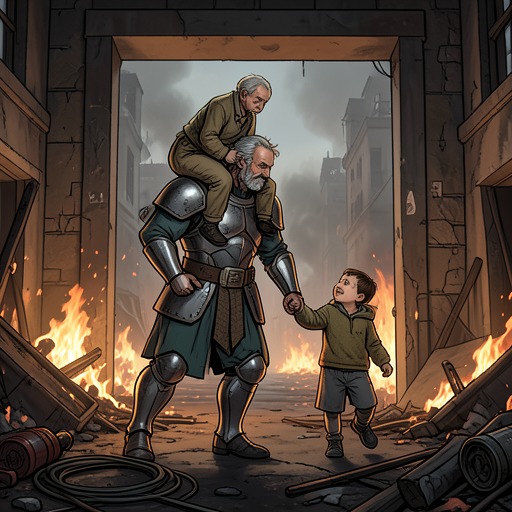
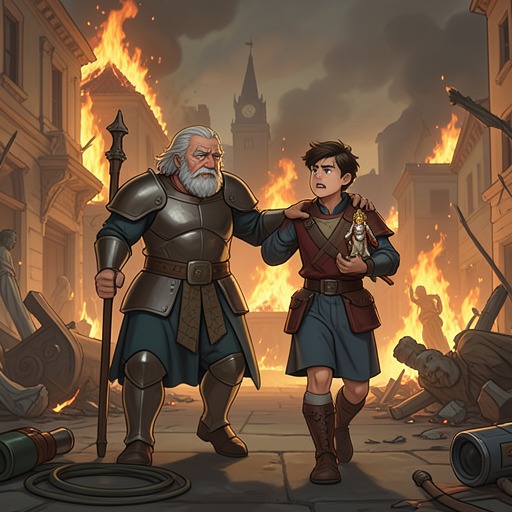
The clearest early image of pietas arises during the destruction of Troy. Anchises, described as an old man with suppliant hands, implores divine protection and worships the star that appears as a guide. His prayer places the family’s flight within a sacred order, while the surrounding palace is threatened by fire and rising winds. Aeneas answers the crisis by urging immediate action and asking his father to be carried on his shoulders. He declares that, whatever happens, Anchises’s life will be his care.
This act joins physical burden to moral inheritance. Aeneas does not abandon the vulnerable past in order to save the future; he carries the past into the future. Anchises’s body becomes the visible weight of ancestry, and Aeneas’s shoulders make duty concrete. The scene also links pietas with divine signs: the star is not an ornament to the escape but a direction, while the son’s rescue of his father is the human response that makes the sign effective.
Pietas in Diplomacy and Peace
Pietas governs Aeneas’s dealings with former enemies as well as his treatment of kin. When he approaches the Greek king with peaceful branches, he comes under fate’s command and presents himself without fear despite knowing the other side’s lineage and power. His appeal rests on recognized bonds: the king’s renown, his virtue among neighboring peoples, their fathers’ mingled blood, and the authority of Apollo’s voice. Aeneas therefore seeks peace through a language of shared ancestry, reputation, and divine sanction rather than through weakness or concealment.
The same ethic appears when suppliants arrive from Laurentum carrying olive branches and requesting a truce. Their petition is framed by the deaths of their companions: once bodies are lifeless, the cause of hatred has ended, and war against the dead can no longer be justified. They ask a king to hear a king’s request, invoking the former relationship in which the opposing ruler had been both son and guest. Aeneas grants the suit because it is just, showing that pietas recognizes obligations created by hospitality, rank, and burial even amid conflict.
His response condemns the severe fate that has drawn the Latian princes into causeless quarrels and armed them against an unoffending man. The language does not erase responsibility, but it reclassifies the conflict: war is not automatically honorable merely because it is politically declared. Pietas requires the ruler to distinguish legitimate necessity from inherited hostility, and to allow grief and burial to interrupt the logic of revenge.
Ritual, Treaty, and Public Order
Pietas becomes fully political when private resolve is translated into public ritual. Aeneas sends word to the Latian king to cease the rage of arms and ratify peace. The proposed settlement is not merely an informal pause; it seeks a recognized end to violence through mutual obligation. The following rite makes that obligation visible and binding.
At the ceremony, Aeneas performs the sacrificial gestures required by the gods. He pours purple wine between the horns of the victim and feeds the flames with the same generous liquid. He then draws his shining sword and addresses the all-seeing Sun and the Ausonian soil in pious prayer. The ritual binds divine witness, territorial belonging, sacrificial action, and the instrument of war into one scene. The sword remains present, but it is placed within an oath-bound order rather than allowed to determine the future by itself.
When peace is tied in public view through solemn vows sworn on both sides, and all dues required by holy rites have been performed, pietas has become a constitutional principle. The agreement gains force because rulers accept limits before gods, communities, and the land they govern. Political peace is therefore not represented as the disappearance of violence alone; it is the successful installation of a sacred and reciprocal form of obligation.
Mercy, Anger, and the Final Test
The hardest test of pietas comes at the end of the poem, when Aeneas is prepared to strike Turnus. The Trojan appears to stand in deep suspense and represses his hand. That hesitation is not simple indecision. It marks the collision between the duty to complete the conflict and the danger that victory may become unrestrained vengeance. Pietas demands that the victor remain answerable to a moral order even when the enemy has been defeated.
The surrounding plea declares that conquest and the royal wife already belong to Aeneas, and that striking a yielded man would be mean and ignoble. This appeal presents mercy as the proper consequence of victory: once the opponent has yielded, continued violence threatens the honor of the victor and the legitimacy of the new order. Aeneas’s restrained hand embodies the possibility that power can accept surrender rather than consume it.
Yet the scene’s suspense also reveals the tension within pietas. Duty is not identical with softness, and the poem places mercy beside claims of justice, memory, and political settlement. Aeneas must decide whether the obligations of the future can be founded through clemency or whether an unresolved wrong still demands punishment. The delayed blow makes visible what pietas costs: the hero’s authority depends not only on his ability to conquer but on his ability to govern the anger released by conquest.
Narrative and Ethical Significance
Across the poem, pietas transforms scattered acts into a continuous pattern. Aeneas protects Anchises during the fall of Troy, obeys divine direction, approaches enemies with peaceful branches, grants a truce to those seeking burial, summons the Latian king to end war, performs the rites of sacrifice, and restrains his sword before a yielded opponent. These moments move from household survival to international diplomacy and finally to the moral psychology of victory.
The concept also supplies the poem’s measure of leadership. A ruler is judged by how he bears obligations that exceed private preference: the gods’ protection, the father’s life, ancestral connection, the claims of guests and kings, the dignity of the dead, the sanctity of treaties, and the future of a political people. Pietas is consequently both personal virtue and the foundation of public legitimacy. It explains why Aeneas’s actions carry more than immediate tactical meaning: each gesture rehearses the kind of community his mission is meant to establish.
Pietas does not remove tragedy from the poem. It makes tragedy morally legible by showing what must be carried through ruin and what must be restrained after victory. Its repeated movement is from passion toward form, from fire toward ritual, and from private grief toward a peace capable of being sworn and witnessed. Through that movement, the poem presents duty not as a burden that merely limits human freedom, but as the discipline through which a devastated people can acquire a future.