Trojans
AeneidThe Trojans are the surviving people of Troy, also identified through the epic’s wider ancestral vocabulary as Dardanians, Phrygians, and Teucrians. Their decisive significance lies in the paradox of their history: they lose their city, yet their lineage is not extinguished. Through exile, battle, ritual, and alliance, they carry Troy’s household gods, family structure, and heroic memory across the sea until their inherited identity becomes the seed of Rome’s future.
Identity and Historical Condition
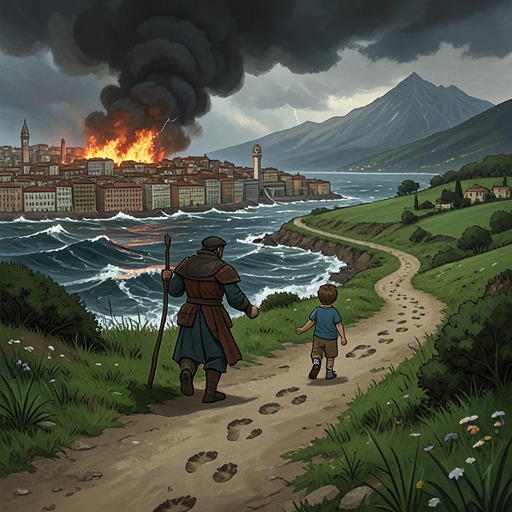
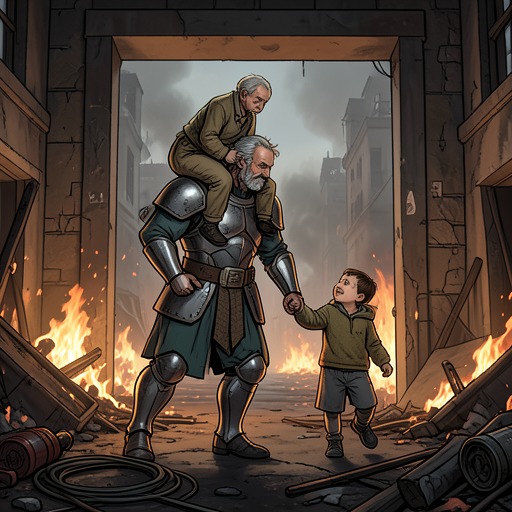
The Trojans first appear in a condition of catastrophe and displacement. Their native shore and the fields where Ilium once stood have been abandoned, but the community does not dissolve into isolated survivors. The departing people travel together with their father Anchises, their son Ascanius, and their lesser and greater gods, making the fleet a moving extension of the ruined homeland. Their exile is therefore both geographic and religious: Troy has fallen as a city, but its family lines, divine obligations, and collective memory remain active aboard the ships.
Their identity is also presented as an ancestral continuum rather than a single generation. In the temple associated with Daedalus, the Trojans encounter images and memories reaching back through heroic and Cretan history. Later, the line of Teucer, together with Assaracus and Ilus, is placed within a vision of an older heroic race destined for better times. The Trojans thus inherit a past that is larger than the immediate disaster of Troy’s fall; their present suffering becomes one stage in a genealogy that the poem repeatedly projects into the future.
Military Courage and Collective Survival
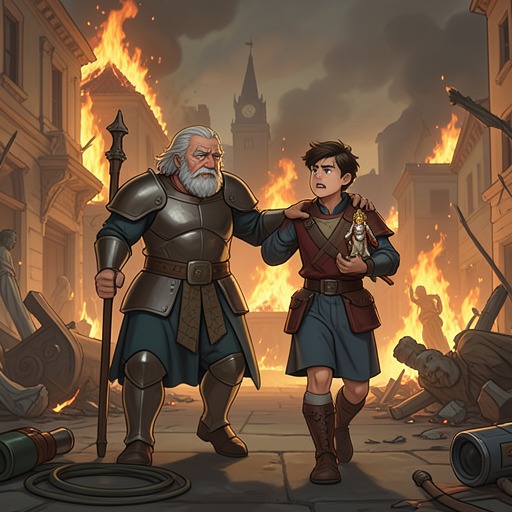
The Trojans are defined by their willingness to defend their walls even when the surrounding battle is filled with clashing arms and tumult. Among those fighting beside Aeneas are Ripheus, renowned for valor, and Iph’itas, distinguished by age. Their presence establishes a martial community in which courage and experience stand together. The defense of the walls is not represented as the action of one isolated champion alone, but as a collective resistance undertaken by companions who share the danger of the city’s destruction.
That military identity survives the loss of the walls by changing its form. The Trojans become sailors, refugees, petitioners, allies, and eventually combatants in Italy. Their struggle is no longer simply to preserve Troy’s physical fortifications; it is to preserve a people through movement and adaptation. They must find new shores, interpret signs, negotiate with rulers, and fight for a place in Latium. Their endurance rests on the ability to transform defeat into continuity without treating the past as disposable.
Ancestry, Prophecy, and Roman Continuity
The Trojans’ future is disclosed through prophetic and genealogical visions. Anchises shows Aeneas the Italian names whose destinies will be joined to the Trojan line, turning the exiles’ journey into the beginning of a larger national history. The Trojans are consequently represented as ancestors in the making: their immediate community is vulnerable, but the line descending from them is destined to spread the conquests of imperial Rome.
This future is not confined to an anonymous population. The vision extends to the Roman race and the Julian progeny, including Julius Caesar and the imperial succession that will follow. Rome’s rising towers are imagined as a power that will reach toward heaven, while the descendants of the Trojans enter a divine and political order far beyond the limits of their lost city. The epic thereby converts migration into a theory of origins: the Trojans’ displacement is given meaning by the empire their descendants will establish.
Yet the process is not a simple preservation of an unchanged Trojan nation. The prophetic language joins Trojan ancestry to Italian names, future Roman institutions, and a new territorial homeland. Trojan identity becomes the material from which another people and state will be formed. Their survival is therefore simultaneously an act of remembrance and a process of transformation.
Relations with Italy and the Making of Peace
The Trojans’ arrival in Italy places them within a contested political landscape rather than an empty promised land. When Ilioneus addresses Latinus, king of the Latins and descendant of Faunus, he speaks on behalf of a community seeking recognition and settlement. The Trojans must explain why they have come, establish their legitimacy before a foreign ruler, and distinguish their migration from an act of needless aggression.
Their relations with the Latins eventually move from war toward formal negotiation. Suppliants sent from Laurentum approach with olive branches and ask for a truce; Aeneas grants a request he considers just and responds by condemning the destructive fate that has drawn the Latian princes into causeless quarrels. The episode shows the Trojans participating in a political and moral order governed not only by force but also by petition, clemency, and the recognition of justified claims.
Peace is later tied in public view through solemn vows sworn on both sides, with the required religious dues performed. This ceremony gives the Trojans a place within a new lawful settlement. Their future in Italy is not secured by conquest alone: it is ratified through public ritual, reciprocal oaths, and the conversion of military conflict into a recognized political arrangement.
Transformation into Roman Ancestors
The Trojans’ final importance lies in the way the poem makes them the bridge between a destroyed eastern city and the western majesty of Rome. Their ships preserve the household gods; their warriors preserve the memory of heroic Troy; their leaders negotiate with Italian kings; and their descendants are placed within a providential sequence leading to imperial rule. The community’s identity therefore operates on several timescales at once—past catastrophe, present exile, and future empire.
The conclusion of this movement is not the restoration of Troy. When the founder of mankind answers the question of whether Saturn’s issue and heaven’s other heir can remain distinct, the poem points toward a new unity rather than a return to the old separation. The Trojans’ historical role is to enter that unity without vanishing as a memory. Their defeat becomes an origin story, their wandering becomes settlement, and their ancestral name becomes one of the foundations from which Rome’s immortal majesty will arise.