Greeks
AeneidThe Greeks are the principal collective adversary in the Trojan war and the force whose stratagem brings Troy to ruin. They appear not merely as an anonymous army but as a coordinated power: they conceal armed men within the Trojan Horse, regroup under royal and heroic leadership, and repeatedly convert military pressure into political consequence. Their role is therefore double. They are the immediate agents of destruction, yet the Greek past also supplies the heroic and cultural traditions that the poem later absorbs, relocates, and measures against the destiny of Rome.
Nature and Organization
The Greeks operate as a coalition rather than a single undifferentiated people. Their army includes rival kings, celebrated warriors, cavalry, and contingents associated with particular regions. When the Trojans begin their desperate resistance, the brother kings join Ajax and the Thessalian horse, bringing their forces together for a renewed assault. This coalition structure gives Greek power both breadth and command: separate heroic reputations can be gathered into a common military action when the larger objective requires it.
The poem also remembers the Greeks through the language of collective accountability. In a later speech, a representative speaks of himself and the Greeks who came to Troy’s destruction, while explicitly distinguishing those already slain in battle. The formulation presents the war as a shared enterprise whose participants may perish individually but remain joined by a common purpose and historical identity. Greekness thus survives the battlefield as a political and narrative category.
The Fall of Troy
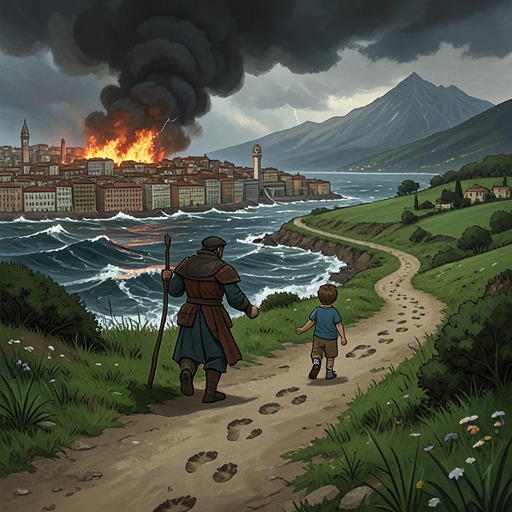
The Greeks’ decisive method is deception followed by coordinated assault. Armed men emerge from the hidden interior of the Trojan Horse, while Sinon throws flames within the gates and other Greek forces press toward the city from outside. The attack succeeds because it turns the city’s own defenses into the setting of its collapse: the gates are no longer a barrier against invasion but the threshold through which destruction enters.
Once the assault begins, Greek force is presented through confusion, compression, and violent reversal. Houses and sacred temples are submerged in blood, and the conflict produces the grim paradox that the defeated can briefly triumph while the victors mourn. The Greeks’ victory is therefore not represented as clean or celebratory. It is a catastrophe whose military success carries grief, sacrilege, and the destruction of a whole civic world.
The Greek victory is especially embodied in Pyrrhus, who kills Priam after dragging the trembling old king through blood and sacred mire. Through this act, Greek conquest becomes an assault on dynastic continuity and ritual order, not simply the defeat of an army. The fall of Troy is made legible through the suffering of its household, and the Greeks’ triumph acquires the moral darkness of violence committed against an aged king amid the ruin of his city.
Warriors, Leaders, and Heroic Memory
Greek power is distributed among named heroic figures. Ajax stands within the coalition that renews the attack, while the brother kings help transform a local clash into a concentrated offensive. Ripheus and Iph’itas fight beside the Trojan narrator during the city’s last defense, showing that Greek warfare is experienced not as a distant mass but as a pressure that reaches individual combatants and tests the courage of both sides.
The poem’s Greek world also extends beyond the immediate war. In the temple encountered near Cumae, the story of Daedalus is preserved as part of the heroic past associated with Greek blood and earlier generations. This memory complicates the Greeks’ identity. They are destroyers in the history of Troy, but they are also bearers of legends, ancestry, craft, exile, and flight. Their cultural inheritance remains available for later peoples to remember even after their military victory has helped scatter the Trojans.
Diplomacy and the Greek Afterlife
Greek influence continues after Troy through requests for military assistance and through the circulation of former Greek heroes. When the Latins face danger, Venulus is sent to Diomede to seek aid for Ausonia. The mission assumes that Diomede, a Greek warrior of the Trojan generation, still possesses enough authority and military significance to affect the balance of power in Italy. The Greek past therefore enters the Italian conflict not as a finished episode but as a reservoir of alliances, reputations, and potential intervention.
The poem also places Greek ancestry within the landscape of Italy. The first inhabitants of Greek blood are said to have vowed a sacred forest to Silvanus, guardian of flocks and fields. This detail gives the Greeks a presence that is older and more settled than the invading army at Troy: Greek identity can signify not only overseas aggression but also an inherited community incorporated into Italian religious and rural space.
Narrative and Historical Significance
The Greeks function as the necessary counterforce against which Trojan endurance and future Roman destiny are defined. Their victory produces Trojan exile, but that exile becomes the condition for a new foundation. The Greeks thus occupy an unusual position in the poem’s historical imagination: they are the destroyers of the old homeland, yet their heroic traditions and dispersed descendants form part of the cultural material through which the later world is understood.
Their portrayal is consequently marked by contrast. Collective organization enables victory, but victory brings mourning; heroic fame coexists with sacrilege; military triumph at Troy does not prevent Greek figures from becoming displaced, remembered, or politically useful elsewhere. By preserving both the Greeks’ destructive force and their continuing cultural afterlife, the poem turns the defeated city and its conquerors into interconnected origins of the Mediterranean order that follows.