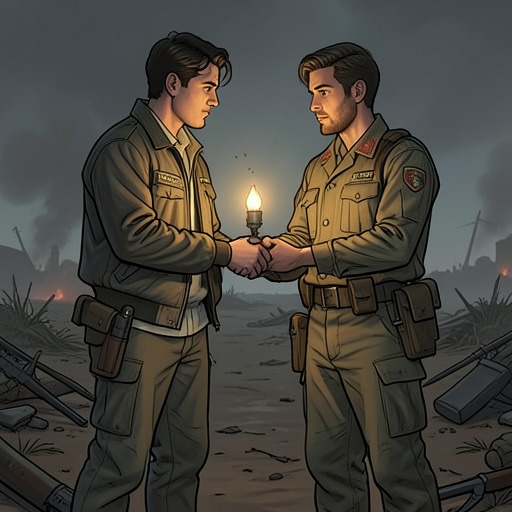
Thomas Magruder–Joyce Flynn relationship
AfterburnThe Thomas Magruder–Joyce Flynn relationship is a deep, combat-forged attachment whose significance lies in its unsettled position between comradeship and possible romance. Their shared danger on the Kola Peninsula gives them an understanding rooted in lived experience, while Thomas Magruder’s engagement to Pamela Drake makes that bond difficult to treat as a private matter between two friends. The narrative neither turns their connection into an established romance nor dismisses its intimacy: it lets the possibility remain present in their memories, their banter, and the ease with which they draw close.
A bond formed under fire
Seven months before the later scenes, Joyce Flynn served as Thomas Magruder’s radar intercept officer during a strike against a Russian Typhoon submarine base on the Kola Peninsula. The squadron was short-handed and needed an alpha strike. Their flight ended in a shootdown and ejection; Joyce Flynn broke a leg on landing. When Thomas Magruder reached her, a Russian soldier was already standing over her. In the confused firefight, they both used their service pistols against him before he could bring his AK to bear.
The circumstances give their bond a practical, reciprocal foundation. They were not simply two people who had witnessed the same danger: each acted in a moment when the other’s life was at risk, and together they stopped an armed soldier from reaching his rifle. Joyce Flynn had fired first, while Thomas Magruder’s shots helped distract the man; neither account makes the rescue a solitary achievement. Their shared survival is consequently remembered as mutual protection rather than as one person’s debt to the other.
After the firefight, Joyce Flynn demanded that Thomas Magruder leave her behind and save himself. He refused. A U.S. Marine Corps reconnaissance force reached the downed aircrew shortly afterward, arriving two minutes before a much larger Russian force. The narrow margin and the choice to stay with her give the episode its defining pressure: their comradeship was tested not only by the attack but by the possibility that one could escape at the other’s expense. Thomas Magruder’s refusal made their attachment concrete in action.
The remembered scene also preserves the bodily cost of the encounter without making Joyce Flynn’s broken leg the whole meaning of her role. She was injured and in danger, but she had already fought back, and the two of them had saved one another. Later, when they revisit the episode, her injury remains part of their shared history, but so does her own decisive action. Their relationship rests on an exchange of courage, not on a simple rescuer-and-rescued pattern.
What the shared experience means
Thomas Magruder understands the connection as a form of comradeship belonging to people who have faced fire and death together. The phrase describes a professional and emotional recognition at once: Joyce Flynn knows what it means for him to be in a Tomcat cockpit and to put his life on the line for his country. Their intimacy comes partly from that knowledge, which is not abstract sympathy but familiarity with the stakes of his work.
He also thinks of the bond as something that could become sexual, while insisting to himself that it is not sexual at that point. That distinction matters. The narrative acknowledges attraction as a possibility without retroactively changing the character of what happened on the Kola Peninsula. The bond can be profound and potentially charged while remaining, in his own understanding, a comradeship rather than an affair.
Joyce Flynn’s later conduct sustains that ambiguity. In the large cargo compartment of a CH-53 carrying the shore party, she watches Thomas Magruder, grins with a trace of nervousness in her dark eyes, and winks. The gesture is personal, but the scene does not define it as a declaration. Thomas Magruder is instead troubled by the fact that she volunteered for the party. He wonders why she, of all the women aboard the Jefferson, had to be the one coming ashore with him. His concern is shaped by the intensity of their history: her presence is not interchangeable with that of another colleague.
Pamela Drake and the limits of comparison
The other central fact about Thomas Magruder’s attachment to Joyce Flynn is that he is engaged to Pamela Drake. After a recent quarrel, he is not even certain that they are still engaged. They have rarely written much to each other even in the best of times, and he supposes that both may have needed time to cool down. The relationship with Joyce Flynn therefore develops in the space created by distance and unresolved strain, but the evidence does not show Thomas Magruder having ended his engagement.
He continues to love Pamela Drake, perhaps more than in the early days of their relationship, and hopes that they might repair the quarrel when she comes out to the area. His uncertainty is not a simple replacement of one woman by another. Rather, he holds affection for Pamela Drake alongside a growing recognition that Joyce Flynn shares a world Pamela Drake cannot fully know. He wonders whether love is enough when the person he loves does not understand what his military life demands.
That contrast is expressed through experience, not merely appearance. Thomas Magruder remembers walking through Bangkok with Pamela Drake, seeing the sights of Thailand’s capital and exploring the floating markets of Thonburi when he first began falling in love with her. Later, walking through Yalta with Joyce Flynn unsettles him because it recalls those earlier walks. The parallel places two forms of intimacy beside each other: the beginning of his love for Pamela Drake and the closeness he now feels with a fellow aircrew member. The comparison does not make the relationships identical; it makes their difference newly difficult for him to ignore.
In his thoughts, Pamela Drake’s beauty is set against Joyce Flynn’s understanding of the cockpit, danger, and military commitment. Thomas Magruder does not say that physical appearance is irrelevant; he notes that Joyce Flynn is no on-camera beauty like Pamela Drake. But the distinction he dwells on is not a contest in attractiveness. It is the difference between loving someone and being understood by someone who shares the risks and hopes of his professional life. His question about whether love is enough grows out of that difference, rather than out of a settled decision to choose Joyce Flynn.
The waterfront and remembered teamwork
During a stroll along the Yalta waterfront, Thomas Magruder again finds himself measuring the present against his earlier walks with Pamela Drake. The setting brings memory into an ordinary shared activity: walking beside Joyce Flynn is disconcerting precisely because it recalls the streets of Bangkok, the sights of Thailand’s capital, and the floating markets of Thonburi. The recollection does not interrupt their companionship so much as make him aware of how closely the two experiences now sit together in his mind.
When Thomas Magruder admits that he has always wanted to make some kind of difference, Joyce Flynn responds that he has, adding that she would not be there without him. She says this simply and matter-of-factly, without coyness or a hidden message. He reacts sharply to the implication, then answers by pointing out that, without him, she might never have wound up on the Kola Peninsula tundra with a broken leg. His reply is both a joke and a reminder that their shared history includes injury and danger as well as rescue.
Joyce Flynn answers that she shot the Russian soldier first and teases him about how often he missed. Thomas Magruder admits that he lost count. In retrospect, the exchange is funny to them; at the time, he had been running across a field while trying to hit a soldier with a pistol, an approach he recognizes as poor marksmanship. He recalls that she brought the man down after his own shots slowed him. Their playful argument distributes credit rather than assigning the scene to a single hero: each revises the other’s account, and both remain part of the action.
The conversation ends by naming their achievement as teamwork, and Joyce Flynn moves closer as they walk. The physical gesture and the shared joke give the relationship a present-tense warmth, while the word teamwork connects that closeness back to the desperate firefight. What once required coordinated action under immediate threat now appears in an easy exchange of teasing and agreement. The scene does not settle what their closeness will become, but it shows that the old bond remains active beyond the moment of survival.
An unresolved intimacy
Across these scenes, the relationship develops through recurrence rather than formal declaration. Thomas Magruder returns mentally to the hours on the Kola Peninsula, wonders what might have happened had events gone differently, and encounters Joyce Flynn again in situations that revive their shared past. The episode is not simply background to a new attraction: it is the experience through which he understands why Joyce Flynn knows him in a way he fears Pamela Drake cannot. Her presence aboard the aircraft and beside him in Yalta repeatedly brings that difference into focus.
Yet the narrative keeps the limits of the relationship visible. Thomas Magruder remains engaged, or at least assumes he may still be, and hopes to make peace with Pamela Drake. He considers the bond with Joyce Flynn capable of becoming sexual but does not describe it as already so. Joyce Flynn’s wink, her arm taken in his, and her closeness during their waterfront walk communicate affection and ease, but they do not amount to an explicit romantic commitment. The distinction between what the two have shared and what might follow remains unresolved.
That unresolved quality is the relationship’s central dramatic function. Joyce Flynn embodies a kind of recognition born from service and danger; Pamela Drake represents a love with its own history, including the early walks Thomas Magruder recalls and the engagement he still hopes to repair. Neither bond is erased by the other. The narrative leaves Thomas Magruder caught between enduring love and the pull of being understood, while allowing the reader to see that comradeship can carry an intimacy that its participants have not yet named or chosen.