United States–Russia relations
AfterburnUnited States–Russia relations are defined less by a settled peace or a continuous war than by the instability between them: American forces have fought Russian power, intervened amid Russia’s internal collapse, and entered the Black Sea under a truce whose meaning remains uncertain. The relationship is further strained by the possibility that a peacekeeping mission could be read as provocation, while nuclear weapons and the carrier group’s dependence on narrow sea passages make the consequences of miscalculation unusually severe.
From military defeat to intervention
The American carrier Jefferson links earlier combat with the crisis in the Black Sea. It had previously cooperated with Dmitriev in the Indian Ocean, but later crippled Soviet naval forces off Norway. That reversal gives the relationship a history that cannot be reduced to simple enmity: the same ship associated with cooperation also became an instrument of decisive force against the Soviet fleet.
By the time of the Black Sea crisis, the revived Union is disintegrating amid civil war between Leonov’s Popular Democratic Front, the Blues, and Marshal Krasilnikov’s hard-line Reds. The United States has intervened in the far north and seized key military facilities on the Kola Peninsula, alleging that Krasilnikov planned to use them. This intervention places American forces inside a conflict over Russian authority, rather than at a clear front between two unified states. The weakening of the Union does not remove the danger; it makes the identity and intentions of the power on the other side harder to determine.
Russian memories of earlier conflict sharpen the meaning of the next American move. Jefferson leads a battle group through the Dardanelles and into the Black Sea. For a Russian observer, the arrival carries the weight of the carrier’s earlier defeat of Soviet naval forces and of a longer historical memory of revolution and foreign intervention. Striking back appears satisfying precisely because the deployment is experienced as an insult. The text presents that impulse as a perception and temptation, not as proof that a Russian attack has been ordered.
The Black Sea and the uncertain truce
The battle group’s entry takes place against an unresolved question: whether the United States and Russia are still at war. Matthew “Tombstone” Magruder and others aboard the carrier cannot be sure. Officially, a truce is in effect, and American forces have been placed under a United Nations mission; neither fact supplies a clear practical answer about how Russian factions will respond. The uncertainty turns routine military presence into a test of interpretation: an operation described as peacekeeping may still look like a threat to an opponent.
The regional crisis also involves Ukraine and Crimea, complicating any bilateral account. Ukraine has long been uneasy with its position as one of the Union’s largest and most productive republics, and the account stresses that ethnic Ukrainians are not simply Russians. Crimea, geographically attached to Ukraine by the mainland to its north, is also the subject of an old dispute between Kiev and Moscow. With Russia absorbed by civil war, Ukraine appears poised to settle the question of the peninsula and the Black Sea Fleet. These rival territorial claims do not make the United States their sole cause, but they create the setting in which American intervention and naval movement can acquire wider strategic meaning.
That instability is also visible in a dispute over what peacekeeping can accomplish. Samantha Reed argues for intervention to maintain peace and notes that Ukraine has not yet attacked. Admiral Scott challenges the description of the situation as peace, pointing to an area already coming apart. Their disagreement captures a central pressure in the relationship: waiting can leave a conflict to spread, while intervening can draw American forces into a struggle whose factions, boundaries, and stopping point are unsettled.
Nuclear danger and a fractured adversary
Russian military power remains consequential even as Russian political authority fragments. Russia still possesses intercontinental ballistic missiles capable of destroying most North American cities. With the civil war accelerating the breakdown of order, American officials cannot know which faction controls how many functioning nuclear weapons, or where those weapons are aimed. The threat is therefore not only the possibility of a deliberate attack by a coherent Russian government. It is also the danger created by an arsenal whose custody and direction have become uncertain.
American peacekeeping forces in the Black Sea are likely to attract Russian attention for several possible reasons, and the uncertainty over nuclear control magnifies the stakes of that exposure. The contrast is stark: American officials are trying to respond to disorder, but the force used to do so operates near a state whose weapons remain capable of catastrophic damage even as its command structure breaks down. The novel makes the danger structural rather than dependent on a single declared decision for war.
Sea access and the limits of force
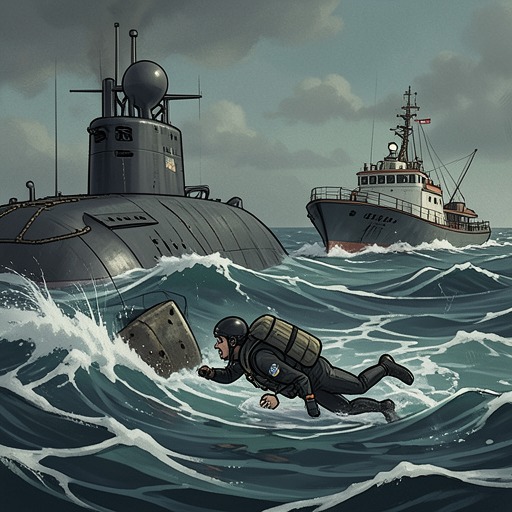
The carrier group’s position turns the relationship’s political uncertainty into a material constraint. A modern carrier such as Jefferson needs replenishment of expendable supplies every two to three weeks. Nuclear propulsion means the ship itself does not require fuel, but its aircraft consume aviation fuel; under ordinary conditions their supply would last no more than ten days, and heavy flight operations could shorten that period. The group depends on the tankers following it at sea, while strained relations with Ankara mean that help from Turkey cannot be counted on.
The Bosporus Strait makes that dependence strategic. With Jefferson’s air operations grounded while the group is pinned in the straits, Magruder cannot even be certain that the United States is at war with Russia. If the passage closes, the carrier and its escorts risk being trapped in the Black Sea. Under a heavy operational tempo, the available flying time could shrink to two to four days, after which the ships would be unable to sustain useful air operations in the enclosed sea. The image of a powerful carrier reduced to an unusable object shows how geography and supply can narrow American options as sharply as an enemy’s weapons.
At a later stage, officials consider whether the trapped force can be reached and resupplied. Samantha Reed asks whether there is any way through; Admiral Scott turns to Thomas Magruder, who distributes estimates of the problem. The details of those estimates are not supplied here, but the exchange makes clear that access is a matter for senior policy and military decision-makers, not merely a shipboard inconvenience. A proposed fuel supply is measured at nearly three million gallons, or about nine thousand tons, of aviation gasoline judged to meet Jefferson’s standards. Transferring it requires flight-deck operations to stop, underscoring that even an avenue toward endurance carries immediate operational limits. The relationship’s decisive condition is thus not simply whether either side wants war: it is whether forces can remain supplied, contained, and understood before uncertainty turns into escalation.