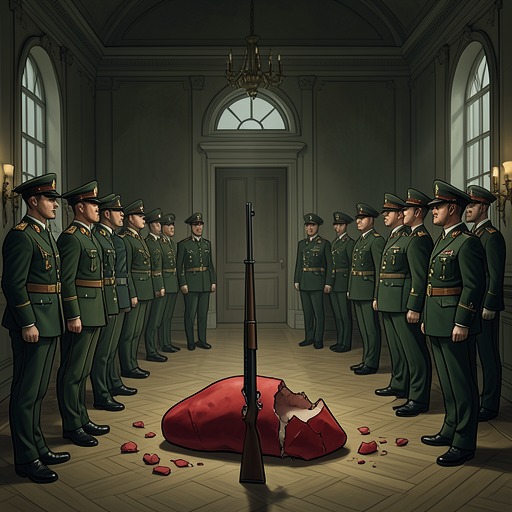
Russian Red Army–Blue Army faction relationship
AfterburnThe Russian Red Army–Blue Army faction relationship is the book’s central internal Russian conflict: Leonov’s Popular Democratic Front, known as the Blues, is locked in an all-out civil war with Marshal Krasilnikov’s hard-line Reds. The struggle unfolds as the revived Union comes apart, making the question of who can speak for Russia as consequential as the opposing factions’ military power. The narrative presents neither a settled national authority nor a reliably enforceable truce; instead, factional war and state fragmentation make political solutions and international intervention increasingly difficult to separate.
Formation and Political Stakes
A failed gamble in Norway marks a decisive moment in the crisis. Dmitriev views it as the final blow to the Motherland: a populist leader, Leonov, has displaced the discredited hard-liners, but the change comes too late to resolve Russia’s problems politically. Leonov’s Popular Democratic Front, the Blues, and Krasilnikov’s hard-line Reds soon enter all-out combat. Their conflict is thus established not as an isolated contest between military units but as a struggle accompanying the disintegration of the revived Union.
The labels identify opposing political camps, but the evidence also emphasizes the weakness of authority behind them. As the revived state breaks apart, no single factional claim can be assumed to represent the country as a whole. The conflict’s significance lies both in the fighting itself and in the absence of an uncontested political structure capable of ending it.
Civil War amid Disintegration
The changing fortunes of the wider Russian military sharpen this instability. After the Scandinavian campaign collapses, the military is exposed as a hollow shell, and American forces land on the once-sacrosanct soil of the Kola Peninsula. At the same time, popular uprisings drive out garrisons that are too weak or too discouraged to hold their positions. These developments describe a weakening of central control, not a clean resolution of the Reds–Blues conflict.
Independence for emerging governments is portrayed as costly and incomplete. Neo-Soviet units remain scattered across the former empire under hard-line Reds and pro-Krasilnikov factions. Fledgling rebel movements are rarely strong enough to break militarists’ control on their own. The resulting political landscape is therefore more complicated than a simple division between two coherent camps: resistance movements, local governments, and surviving units associated with the old order all operate within the wider collapse. The account supports a picture of fragmented authority, while leaving the precise command relationships among these forces unsettled.
Truce and Contested Representation
The uncertainty reaches the question of whether the factions have agreed to stop fighting. From Tombstone’s point of view, the truce is strictly unilateral: conditions inside Russia are so confused that neither people within the country nor outsiders know for sure who speaks for the factions. Even those who appear to have agreed to the truce, on either the Krasilnikov or Leonov side, may not be empowered to bind the forces attributed to them.
This makes the truce fragile for a reason more basic than a stated disagreement over its terms. A ceasefire depends on representatives who can communicate and deliver compliance; the narrative instead stresses uncertainty about representation itself. The Reds–Blues relationship is consequently marked by a gap between the apparent existence of factional leadership and the uncertain reach of that leadership across a disintegrating state. The text does not present a durable settlement that closes this gap.
International Intervention and Limits
The factional war also shapes the limits placed on foreign involvement. As newborn governments appeal to the United Nations for support, the UN attempts to keep pace with spreading chaos by inserting peacekeepers and helping ensure humanitarian deliveries. But the United States’ National Command Authority expressly directs that American forces must not involve themselves in the fighting between the Red and Blue Russian factions. The Marines’ authorized landing at Poti is framed within that restriction: intervention may support a bounded mission without becoming participation in the Russian civil war.
The book places that constraint beside a broader dispute over command and political responsibility. Whether American forces should serve under UN commanders has been debated for years. Later, Washington grants the UN operational authority over U.S. forces in the Crimean Peacekeeping Operational Zone; Tarrant tells his officers that they will operate under UN command until the President directs otherwise. This is not evidence that the Reds and Blues have reconciled or that an international command arrangement settles their war. Rather, it shows the institutional problem surrounding efforts to respond to Russian fragmentation while remaining within political limits.
That problem is contested within the American leadership. Admiral Scott objects that giving the UN more power would surrender American sovereignty, while Heideman argues that national sovereignty cannot remain the sole guide to action. Yet the narrative also affirms the tradition of political control of the armed forces: policy belongs to politicians, and the military’s professional obligation is to follow lawful political direction. The factional conflict thus exposes a distinction between the unresolved Russian struggle and the separate question of who may command the forces sent to manage its consequences. The Reds–Blues relationship remains one of civil war, uncertain representation, and fragmentation; international authority can shape the response, but the evidence does not show it resolving the conflict.