United Nations–Georgia relations
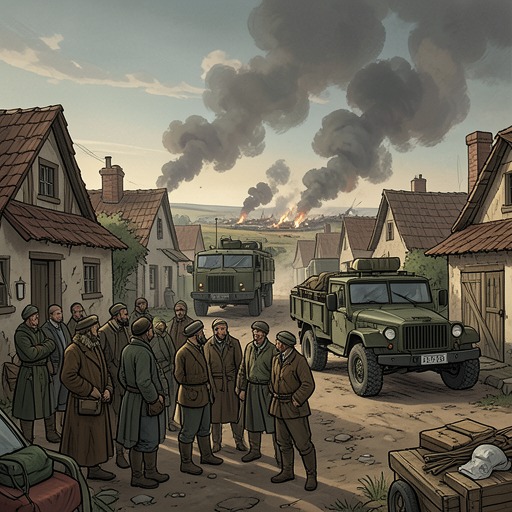
AfterburnUnited Nations–Georgia relations are presented through Operation Sustain Hope, a relief program in which humanitarian access depends on military protection. The arrangement gives the United Nations a means to organize aid and restrain air activity, while U.S. forces supply much of the practical capability. Its promise is also its tension: the mission is intended to create room for peace without drawing the United States into the fighting, even as the surrounding crisis makes that distinction harder to maintain.
A relief mission with military backing
Operation Sustain Hope places Marine Expeditionary Unit 25 under United Nations auspices as part of the Georgian relief program. The unit enters the Black Sea before the Thomas Jefferson battle group, bringing transports and escorts capable of carrying a reinforced Marine Battalion Landing Team abroad at short notice as a peacekeeping force. This is not simply a national deployment later endorsed by the United Nations; the mission is organized under United Nations leadership, reviving the question of how U.S. forces can serve within an international command structure.
The plan links relief delivery to control of access on the ground. If the United Nations Crisis Assessment Team gives approval, Marines are to go ashore at Poti and secure port and airfield facilities so that supplies can arrive by ship and aircraft. The proposed sequence makes the relationship operationally specific: United Nations approval is a condition for the landing, while U.S. military personnel are expected to establish the infrastructure through which the relief effort would function.
The plan depends on a political opening as well as a military one. The Reds and Blues are described as out of the picture in Georgia, clearing the way for the Georgian Freedom Party to cooperate with the United Nations mission. That cooperation is presented as contingent, not as proof that Georgia has become secure. The proposed deployment still awaits the assessment team's go-ahead, and its stated purpose is to make aid delivery possible rather than to settle the wider conflict by force.
Mandate, limits, and the no-fly zone
The National Command Authority, identified in the text with the President, places a firm limit on American participation: U.S. forces are not to involve themselves in fighting between the Red and Blue Russian factions. The restriction defines the intended boundary between peacekeeping and combat. It also exposes an institutional strain in the mission: United Nations auspices support a collective intervention, but U.S. forces remain subject to a national directive that narrows what they may do.
The air component is designed to protect the relief effort and stabilize western Georgia. Aircraft from the Thomas Jefferson battle group are to enforce a United Nations-directed no-fly zone within a triangle marked by Batumi and Sukhumi on the coast and Kutaisi, about fifty miles inland from Poti. The stated hope is that stopping air traffic in this area might help produce a fragile peace among the warring tribes and factions. The plan therefore assigns military power a preventive role: air control is meant to limit the means of escalation while Marines secure the points through which relief could enter.
The proposed mission is deliberately expandable. If the western Georgian restrictions work, United Nations sanctions could extend across all of Georgia and into neighboring Armenia and Azerbaijan. That prospect raises the stakes beyond the initial relief corridor. A limited operation could become a wider regional security framework, lending practical force to the idea of a United Nations with teeth. The text presents this ambition as a hope, not an accomplished result, and the conditional language underscores how much depends on whether the first, narrower measures can hold.
Regional politics and contested authority
The mission is conceived against a volatile regional backdrop. The United Nations hopes that a strong military presence might defuse other problems as well, including repeated Turkish threats to invade Armenia to quell unrest. Yet Turkey will not permit foreign military forces to be based on its soil, removing an apparently useful location for the operation. That refusal illustrates how the relief partnership must work within the political limits of states whose cooperation it may need, rather than assuming that an international mandate can supply unrestricted access.
As the danger expands, the mission's claim to preserve peace becomes contested. The prospect of the northern Black Sea, from Odessa to Gagra, becoming a war zone threatens to make it difficult or perhaps impossible for the United Nations and the United States to prevent or deliver an anticipated attack against the peninsula's defenders. In a later policy exchange, Samantha Reed argues that Ukraine has not yet attacked, while Admiral Scott counters that the whole area is already tearing itself apart. Their disagreement puts the mission's central political problem into sharper focus: whether intervention can still be described as maintaining peace when the surrounding region is already in crisis and the military measures themselves may be drawn into that crisis.
Sustainment and the widening crisis
The partnership also rests on a vulnerable logistical system. A modern carrier such as the Thomas Jefferson requires replenishment of expendables every two to three weeks; nuclear power removes the need to fuel the ship itself, but not the aircraft's demand for fuel. The battle group's replenishment tankers are identified as its only sources of resupply. These details qualify the apparent reach of the United Nations-backed force: its ability to maintain air operations depends on a supply chain that can be interrupted, not merely on the availability of ships and aircraft.
Later developments make that dependence a strategic concern. With the Bosporus closed, the Thomas Jefferson and its escorts risk being trapped in the Black Sea; under continuous maneuvering and round-the-clock flight operations, the available margin is estimated at only two to four days before the ships would become ineffective. At a subsequent meeting, Admiral Scott rejects giving in to Dmitriev's demands as extortion, while Samantha Reed presses the practical question of whether the force can be reached and resupplied. The exchange shows how the international mission becomes entangled with coercion and the danger of abandoning forces that can no longer be supported through their normal routes.
The scale of the fuel requirement is made concrete when nearly three million gallons, about nine thousand tons, of aviation fuel must be pumped aboard the carrier after the fuel is judged suitable for its demanding standards. The operation is a reminder that military protection for relief is not sustained by declarations of mandate alone: it consumes large quantities of fuel and depends on safe access to facilities and transit routes. United Nations–Georgia relations thus develop from a conditional aid-and-security plan into a test of whether international authority, national restrictions, and material capacity can remain aligned as the regional conflict widens.