Will Grant–Julie marriage
AfterburnWill Grant and Julie’s marriage is a private relationship repeatedly pressed against the demands of naval service: while Grant spends months at sea and risks his life, Julie is left to raise their three-year-old daughter, and the distance gives worry and misunderstanding room to grow. Grant still loves Julie and imagines that a later stateside assignment might let them repair a marriage already in tatters, but the events shown leave that hope unresolved rather than confirming a reconciliation.
Identity and Circumstances
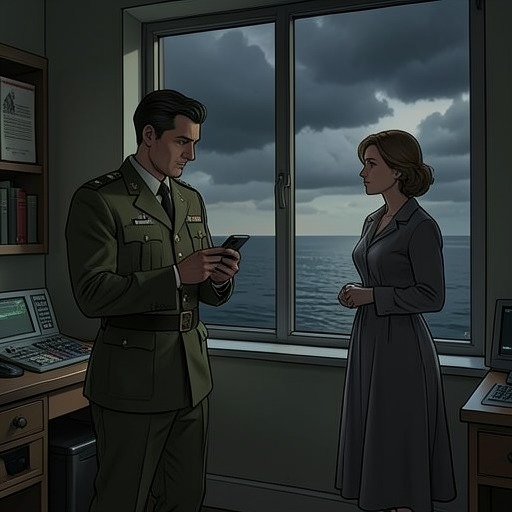
Grant and Julie are husband and wife, with a young daughter whose care falls largely to Julie during Grant’s extended deployments. Their relationship is presented not through a shared domestic scene but through Grant’s account of the strain awaiting him at home and his attempts, from the carrier, to remain connected. The distance is practical as well as emotional: his work takes him away for months, while Julie faces the ordinary responsibilities and anxieties of raising a child without him.
Grant’s naval career is not a passing interruption to the marriage. He understands that he could leave the service for a normal, steady civilian job, but doing so would mean resigning from the Navy. The choice is therefore not between loving Julie and not loving her; it is between the family life he wants and a career whose demands he continues to accept. The account makes that conflict especially sharp by stating both that he loves Julie and that he has a career to consider. Neither commitment simply cancels the other.
Deployment and Accumulating Strain
During Grant’s most recent deployment back to Norfolk, the marriage had been especially troubled. There had been tears and recriminations, and Grant felt there was little he could do about the situation while away. His prospect of a later stateside tour, possibly on the command staff of a Naval Air Station, offers a concrete interval in which he might spend time with Julie and their daughter and try to rebuild the relationship. It is a possibility, not an outcome: the assignment is described as something he could expect after his current Deputy CAG tour, not as an arrangement already secured.
The unexpected orders sending the battle group to the Mediterranean, together with Grant’s move into the carrier’s Deputy CAG position, complicate that hoped-for domestic interval. The passage treats the orders with an uncomfortable irony: Grant had almost been glad when they arrived. They gave him a reason to turn away from a home situation he could not readily mend, even as they extended the separation that helped make the marriage so difficult. His relief is qualified, not evidence that he no longer cares about Julie; the surrounding account emphasizes his love for her and his awareness that simply being present might have helped.
Julie’s worries are described as arising from recognizable circumstances. She is raising a three-year-old girl alone for stretches of time while her husband spends months at sea in a job that places his life at risk every day. The burden is not only the length of his absences but the uncertainty attached to them. Grant believes he could have eased some of her fears quickly if he had been home to show her how much he still loved her. Yet the very fact that reassurance seems straightforward in retrospect underscores how little access he has to ordinary acts of reassurance while deployed.
Suspicion, Work, and Trust
The presence of women aboard Jefferson adds another source of tension. When Grant was commanding the Vipers, he usually flew with Cat Garrity as his RIO, and he made the mistake, as he sees it, of telling Julie how much he respected Garrity as a naval flight officer. That professional respect was then entangled with lurid media stories about sexual-harassment cases and the conduct of the mixed crew. Together, these details raised suspicions in Julie’s mind that the narration explicitly calls unfounded.
The account distinguishes the facts of Grant’s working life from the fears built around them. He is described as having flown with Garrity and respecting her professional ability; it does not establish an affair or misconduct. Instead, a statement meant to convey regard for a colleague becomes, in the context of sensational reports and prolonged separation, material for Julie’s anxiety. Grant thinks the misunderstanding could have been dispelled by his presence, but the deployment prevents the ordinary face-to-face reassurance on which he relies in imagining a repair.
The Navy’s culture supplies a bleak counterpoint to the couple’s predicament. Grant recalls the enlisted men’s old saw, “If the Navy had wanted you to have a wife, they would have issued you one with your seabag,” followed by the saying, “Sex and saltwater don’t mix.” These maxims turn separation into something almost institutional: the service is imagined as incompatible with domestic attachment, and the joke offers no remedy for the people required to live with that incompatibility. In the marriage, the distance is not abstract. It means Julie managing family life alone and Grant being unable to answer suspicions or offer comfort in person.
Attempts at Connection and Unresolved Prospects
A later exchange shows Grant still trying to maintain contact. When Matt “Tombstone” Magruder invites him to dinner, Grant declines because he wants to write a letter to Julie. Magruder recognizes that things are still not good and offers to help; Grant answers that, unless someone can send them home, there is nothing to be done, though he thanks him. The letter is a small, deliberate act of connection, but its circumstances also reveal its limits: Grant can write, while the more direct remedy he names—going home—is beyond his control at that moment.
The episode makes the marriage’s difficulty visible through what Grant gives up and what he cannot change. He forgoes dinner to write; a friend notices the trouble and offers support; Grant acknowledges that support while insisting that it cannot solve the central problem of continued deployment. The scene neither depicts Julie receiving the letter nor supplies her response, so it cannot establish whether the gesture repairs their relationship. It does establish that Grant continues to seek contact even when he doubts what that contact can accomplish.
Grant’s promotion seems to offer another possible first step toward improvement, and the contemplated stateside assignment would allow time with Julie and their daughter. But the evidence stops short of showing that either possibility brings them back together. Their marriage remains defined by the tension between durable affection and constrained presence: Grant says, in thought, that he loves Julie, yet the Navy’s orders keep him away; Julie’s concerns are understandable, yet the available passage identifies the suspicions surrounding Garrity as unfounded. The relationship’s significance lies in that unresolved gap between love and the time, proximity, and trust needed to make love reassuring.