Wolfgang Amadeus Mozart
AmadeusWolfgang Amadeus Mozart is the young composer whose extraordinary musical imagination unsettles the Viennese court and becomes the measure against which Antonio Salieri judges his own talent. The play sets his seemingly effortless invention beside his unruly, comic manner: a musician capable of making music that Salieri experiences as an almost unbearable expression of divine beauty, yet also a restless man whose life ends amid illness and the unfinished labor of the Requiem.
Identity and Arrival
In 1781, Mozart arrives at the court in Vienna and astonishes those around him both with his musical genius and with his eccentricities. His first entrance makes that contrast physical. Constanze Mozart, a cheerful young woman in a party dress, darts across the room pretending to be a mouse and hides beneath the pianoforte; Mozart follows as a cat, crying out in play. The scene introduces him as a small, pale man with large eyes, an elaborate wig, and conspicuous clothes. His hands and feet are almost constantly moving, his voice is light and high, and his penetrating, childish laugh is difficult to forget.
The comedy is not a disguise for ordinary courtly polish. Mozart can be exuberant and socially abrasive, and he shows little sense of the offense his behavior may cause. Yet the play places this disruptive manner beside work that others recognize as exceptional. Salieri, already an established court musician, recognizes Mozart’s genius from the beginning; his admiration becomes inseparable from envy at his own perceived mediocrity.
Musical Invention and Virtuosity
At a gathering, Mozart demonstrates his ability to retain and transform music almost immediately. He casts the manuscript of Salieri’s welcome march aside, sits at the pianoforte, and plays the march from memory, first slowly and then at dazzling speed. On repeating its opening, he stops at an interval that displeases him, substitutes a different one, and develops the change into an improvisation associated with the march from The Marriage of Figaro. He continues without pause, embellishing the melody with increasingly showy flourishes and triumphant chords. Salieri watches with a composed smile, while Mozart remains unaware that his performance has become an affront.
That small episode makes a larger distinction between reproducing music and remaking it. Mozart does not merely recall Salieri’s tune; he listens for what he considers its weakness and turns the correction into new music. His delight is immediate and audible in his laughter. The same ease that astonishes his listeners can also make his brilliance appear careless, especially to Salieri, whose disciplined labor has not brought him comparable invention.
Salieri’s later examination of Mozart’s manuscripts deepens that contrast. He finds what are said to be original scores, yet they look like fair copies: there are no visible corrections. As he reads, musical examples sound in the theatre, including the opening of a symphony, a violin-and-viola sinfonia concertante, and a phrase from a flute-and-harp concerto. Salieri concludes that Mozart has composed the works completely in his head before writing them down. To him, the music’s tightly joined harmonies and phrases seem so exact that moving a note would weaken the whole structure. The manuscripts convince him that the beauty he first heard was no accident.
A Conception of Opera
Mozart explains his ambitions for opera through the potential of an ensemble. In a moment of public awkwardness, he imagines the different thoughts passing through the minds of the people facing one another. A spoken play would have to present those thoughts one after another; a quartet can make them audible at the same time, while still allowing the audience to hear each distinct voice. For him, opera’s power lies in making simultaneous inner lives into musical form.
From that example he imagines a finale that keeps expanding: a quartet becoming a quintet, then a sextet, with more and more sounds multiplying together until they form something new. He compares this to the way God might hear the world, with millions of sounds rising and blending at once. The composer’s task, as he describes it, is to gather the thoughts of people of different stations and transform the audience into something capable of hearing them together. The speech reveals an artistic ideal broader than virtuoso display: music can represent a crowd of individual minds without reducing them to a single voice.
This ideal also exposes a tension in Mozart’s character. He speaks with conviction about the importance and greatness of his art, and, when asked what he thinks of a piece, he calls it the greatest opera ever written and insists that no one else could have made it. Salieri has just praised the work as extraordinary and magnificent; Mozart’s certainty strikes him like a blow. The scene shows both the scale of Mozart’s confidence and how directly it wounds the man who recognizes his ability.
Marriage, Poverty, and the Requiem
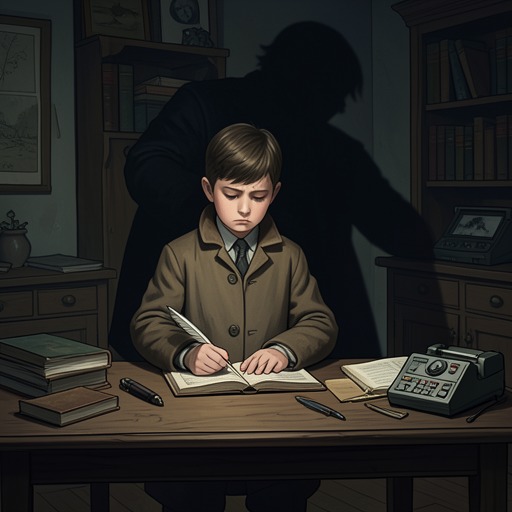
Constanze Mozart is present at both the playful beginning of Mozart’s story and its devastating end. In a later scene, the stage reveals their cramped apartment in Rauhensteingasse against the contrasting, elegant apartment associated with Salieri. Mozart’s domestic setting contains an ordinary table crowded with manuscripts and bottles, and the table becomes his deathbed. Constanze enters looking tired, wearing an apron that indicates an advanced pregnancy. The contrast in rooms gives material form to the different circumstances surrounding the two composers.
When Mozart is dying, Constanze returns to care for him and helps him onto the table, covering him with her shawl. He repeatedly calls Salieri’s name and begins to sob. As the Lacrimosa from the Requiem sounds, he raises himself against Constanze’s shoulders and weakly marks time with his hand. The stage makes clear that he is composing in his head and no longer hears her. She pleads with him to recover, tells him that she and Karl and little Franz need him, and recalls that their wedding day was the happiest day of her life. Her words reach no response: the beat of Mozart’s hand slows and stops, and Constanze realizes that he is dead.
The Requiem is also bound to Salieri’s deception. Salieri confesses that in November 1791 he put on a gray cloak and mask and visited Mozart’s window at one o’clock on seven consecutive freezing nights, making himself appear to be the mysterious messenger Mozart feared. On the final night, he beckoned as if summoning him away. Mozart, weakened but still able to answer, responded with words from Don Giovanni, inviting the statue to supper. The episode joins the actual pressure of the Requiem to Salieri’s theatrical intimidation, without making Mozart’s final act of composition merely a contest between the two men.
Significance and Ending
Mozart’s role in the play rests on a charged opposition: his irreverence and apparent ease coexist with music that Salieri regards as incomparable. The contrast does not make Mozart a simple emblem of effortless success. The scenes show a specific creative practice—memorizing, revising, improvising, imagining simultaneous voices—and then place that invention in a life marked by a straitened home, visible physical decline, and dependence on others at the end.
For Salieri, Mozart’s music becomes evidence of a divine gift that he can recognize but cannot rival. For the audience, the final scene turns musical composition into a visible, fragile action: Mozart listens inwardly, marks the Requiem’s rhythm with a failing hand, and dies before the music’s final sound is complete. Constanze’s silent cry and the unresolved echo leave his death as both a personal loss and the culmination of the play’s conflict between artistic creation and human vulnerability.