Count Orsini-Rosemberg
AmadeusCount Orsini-Rosemberg is the director of the Vienna Opera and a court official whose resistance to Wolfgang Amadeus Mozart’s work makes him an important instrument of institutional pressure. His preference for Italian opera first places him in opposition to Joseph II’s project for a national German opera. Later, his enforcement of the Emperor’s ban on ballet turns an administrative rule into a public confrontation with Mozart, only for Joseph II to reverse his decision and insist that the music be restored.
Identity and Court Position
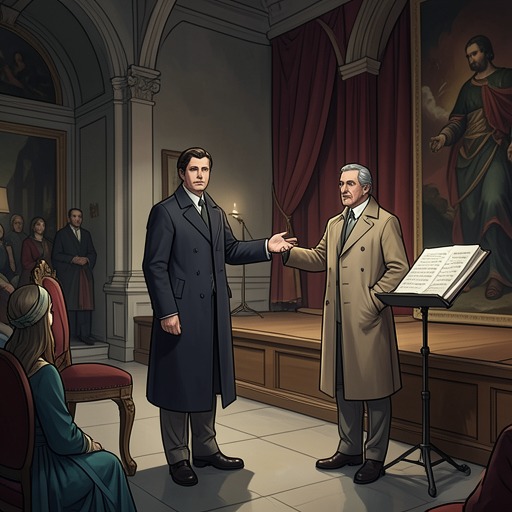
Count Orsini-Rosemberg appears among the senior figures of the imperial court, listening as Antonio Salieri’s music plays in an opening scene. The stage presents him with Johann von Strack and Gottfried van Swieten in a rigid, formal grouping at the back of the set, while Salieri stands apart in the foreground and introduces the court to the audience. Rosemberg is thus established not only as an official within the court’s hierarchy but also as a figure presented through Salieri’s retrospective narration.
Salieri describes him as the director of the Opera and as benevolently disposed toward things Italian, especially toward Salieri himself. That description frames Rosemberg’s artistic preferences as both institutional and personal: he guards the established prestige of Italian opera, while his favorable attitude to Salieri helps explain the composer’s access to the court’s machinery. The characterization is Salieri’s, and the scenes that follow show Rosemberg’s attachment to Italian convention in action.
The German Opera Commission
When Joseph II directs the court to commission a comic opera in German from Mozart, Rosemberg objects to the choice of language. He declares Italian the only possible language for opera, but Johann von Strack answers that the Emperor wants a national opera and specifically wishes to hear works in unadulterated German. Rosemberg’s objection is therefore overruled by an explicit imperial policy. Strack directs him to make the commission that day, and Rosemberg takes the paper reluctantly, warning that the court will have difficulties with the young composer.
Rosemberg’s resistance is sharpened by his judgment of Mozart. He recalls Mozart as a child prodigy and presents that early celebrity as a liability rather than a qualification. In his account, Mozart’s father, Leopold Mozart, was a pedantic musician in Salzburg who dragged the boy around Europe and made him perform tricks, including playing blindfolded or with one finger. Rosemberg generalizes from this history to disparage prodigies as odious and to suggest that they become sterile with age. These are Rosemberg’s prejudices, not a neutral account of Mozart’s ability; the plot soon sets them against the speed and force of Mozart’s composing.
The gap between his skepticism and Mozart’s success is visible when Joseph II asks Mozart whether he has received the commission. Mozart confirms that he has, promises an exceptional spectacle, and says that he has already found a libretto. Rosemberg reacts with alarm that Mozart had not told him. The moment makes plain that the official who had reluctantly carried out the order does not control the creative decision that follows it.
The Marriage of Figaro and the Ballet Ban
Rosemberg’s opposition becomes more pointed when he learns that Mozart intends to set The Marriage of Figaro, based on what Rosemberg calls a shameful work by Beaumarchais. He dismisses it as a vulgar farce and objects to its sexual and social material: nobles desire their maids, while wives wear disguises that are too obvious to deceive anyone. Gottfried van Swieten likewise condemns the subject, but Mozart argues for making an opera about real people in a real place. His defense focuses on the bedroom as a setting, down to the intimate clothes and household objects that conventional stage decorum would omit. Rosemberg’s resistance is part of a broader disagreement over what opera may represent, not merely a dispute about one score.
After Mozart completes the opera in six weeks and a premiere is announced for May 1, Rosemberg asks to see the score. He points to the ballet in the third act and invokes Joseph II’s express prohibition of ballet in opera. When Mozart asks what he is doing, Rosemberg answers through action: he tears pages from the score, declaring that he is removing what should never have been written, and warns Mozart to obey imperial orders in future. Mozart protests that the excision will leave a great gap at the story’s climax and accuses Antonio Salieri of having devised the intervention. Rosemberg dismisses the accusation as absurd; Salieri and Strack watch from the darkness, a staging that keeps the possibility of Salieri’s influence in view without making Rosemberg’s own enforcement any less direct.
The Emperor’s Reversal
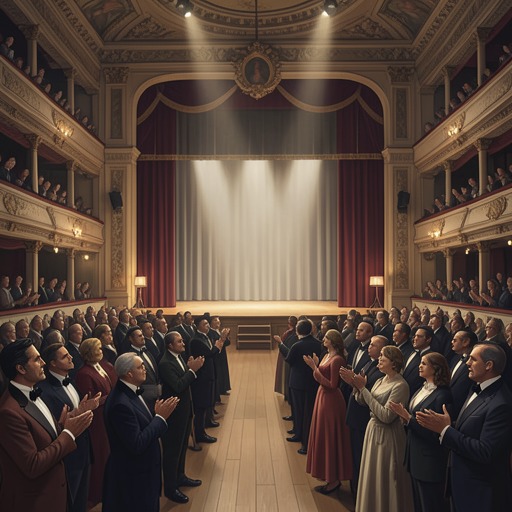
The ban’s practical effect becomes unmistakable when Joseph II arrives during the performance. Because the dance music has been removed, the orchestra stops at the censored passage and the dancers continue in silence. The Emperor watches the unexplained pantomime and asks whether it is modern, then asks what is happening when Mozart answers that it is not. The scene exposes what Rosemberg’s intervention has done: rather than simply excising an unnecessary passage, it has made the missing music conspicuous at the very point where the dance should begin.
Joseph II concludes that the court can defend itself against the objection and orders Rosemberg to restore Mozart’s music. Rosemberg insists that he must object, but the Emperor sharply repeats his demand and asks whether the chamberlain has understood. Rosemberg then yields. Mozart leaps from the piano, throws himself at the Emperor’s feet, and thanks him extravagantly. The reversal exposes the limits of Rosemberg’s authority: he can enforce an imperial edict against the composer, but he cannot maintain his decision once the Emperor personally chooses to hear the complete score.
Aftermath and Dramatic Function
The restoration does not secure the opera a lasting place in the repertoire. Salieri later says that he arranged for The Marriage of Figaro to be performed only nine times that year, working through the person of the resentful director. Rosemberg is identified in the surrounding action as the director, but the account of the arrangement comes from Salieri; it should be read as Salieri’s claim about how he used the official’s resentment, not as an independently narrated confession by Rosemberg. Mozart announces that the opera has been taken off the program with no prospect of revival, while Salieri offers him a courteous expression of regret that contrasts with his private satisfaction.
Rosemberg’s dramatic role is consequently defined by a recurring tension between delegated authority and personal judgment. He resists a German-language commission, disparages Mozart’s promise, objects to the subject of The Marriage of Figaro, and uses the ballet ban to alter its score; yet he must obey Strack’s instruction to commission the work and Joseph II’s later order to restore it. His actions show how court officials can constrain artistic work through language policy, censorship, and programming, even when their decisions remain subordinate to the monarch. In Salieri’s narrated account, Rosemberg’s resentment also becomes a channel through which a temporary imperial victory over censorship can be followed by the opera’s marginalization.