Giuseppe Bonno
AmadeusGiuseppe Bonno is the seventy-year-old court Kapellmeister whose death changes the balance of office in the court’s musical hierarchy: the post he holds passes to Antonio Salieri by royal decree. Presented first at the keyboard and later among the audience at Wolfgang Amadeus Mozart’s opera, Bonno is a quiet but consequential presence. His age, incumbency, and eventual absence make visible the difference between a long-established position and the ambitions it can reward.
Identity and Place at Court
Bonno enters as an old courtier in a wig, takes his place at the keyboard, and is identified as Kapellmeister. In Salieri’s account of Vienna in 1781, Bonno is seventy years old and apparently immortal. The wry description belongs to Salieri, who names Bonno as the holder of the office he most wants: First Royal Kapellmeister. Bonno’s advanced age is therefore more than a biographical detail in this introduction. From Salieri’s perspective, it makes the incumbent seem almost immovable, while marking the position as the summit of his own professional ambition.
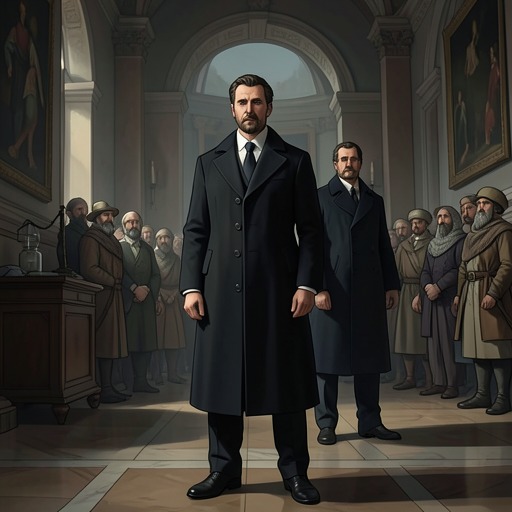
The first presentation locates Bonno within the court’s ceremonial world. The Emperor sits in a gilded setting listening to music, with Bonno among the musicians and courtiers assembled around him. Bonno is not given dialogue in this scene; he takes his place at the keyboard. The staging makes his position legible through service and presence rather than explanation: he belongs to the musical establishment that performs for the ruler, and his office is part of the order Salieri describes to the audience.
Music and Musical Company
Bonno’s playing is heard when Katherina Cavalieri enters and mimes a forceful concert aria. A soprano’s singing is faintly audible, while Bonno accompanies her at the keyboard with an appreciative manner. The moment gives him a specific musical action, not merely a title: he supports a singer’s performance and responds to it as a musician. Katherina’s entrance is vivid and animated; Bonno remains at the instrument, his contribution sustaining the musical setting around her.
That accompaniment also places Bonno near Salieri’s private and professional world. Salieri says that Katherina is his prized pupil and describes her as the object of his desire, while explaining that his religious bargain has kept him from acting on it. Bonno’s documented part in this episode is narrower: he accompanies Katherina. The contrast matters to the scene’s composition. Salieri’s spoken account supplies ambition, desire, and self-justification; Bonno’s visible task is to make music for the performance taking place before him.
Presence in the Opera’s Courtly World
Bonno’s name also identifies the setting of a later gathering: the Venticelli say that the previous night’s encounter took place at his house. In the ensuing scene, Wolfgang Amadeus Mozart arrives with Johann von Strack very drunk, holding a glass, and one of the Venticelli fills it. The scene does not show Bonno or establish what part, if any, he played in the gathering. His house functions here as a location associated with the court’s musical and social circle, while the action belongs to Mozart, Strack, and the informants.
At the first performance of The Marriage of Figaro, Bonno is again visible as part of the audience. He sits in the front row beside Katherina Cavalieri, who is dressed in feathers and sequins; Wolfgang Amadeus Mozart’s wife, Constanze Mozart, and the Venticelli sit behind them. The stage picture gathers performers, courtiers, and spectators around the opera, while Salieri watches from a separate box and recounts that the work has been staged despite his efforts. Bonno is described as older than ever. The detail extends the earlier portrait of an aged incumbent into the public setting of Mozart’s success, but the play does not report Bonno’s response to the performance.
Death and Succession
Bonno’s death is announced by the Venticelli, who repeat his name before declaring that he has died. The report comes after Wolfgang Amadeus Mozart leaves Salieri, and Salieri opens his mouth in surprise. The announcement is brief and carries no account of the circumstances of Bonno’s death; the event is conveyed through news rather than represented onstage. Its immediate dramatic force lies in what it makes possible at court.
The Venticelli tell Salieri that he has been appointed to Bonno’s place by royal decree. Joseph II then confirms the appointment, formally naming Salieri First Royal and Imperial Kapellmeister of the court. Bonno’s death thus converts Salieri’s long-stated ambition into an office he actually holds. The succession is presented as a decisive reversal: Salieri has just described himself as having damaged Mozart’s court career, and the next news is that the vacancy created by Bonno’s death has elevated Salieri himself. Bonno’s importance in the episode rests not on a final speech or a depicted deathbed, but on the unmistakable institutional consequence of his absence.
Narrative Function
Bonno appears without a developed speaking role, yet his position links several parts of the court’s musical life. He accompanies Katherina, is named as host of a gathering attended by Mozart and Strack, appears among the spectators at Figaro, and finally becomes the absent incumbent whose office passes to Salieri. These appearances do not establish Bonno’s opinions about Mozart, the opera, or the court. Instead, the play uses his title and successive stage presences to give the musical hierarchy a visible continuity—and then uses the report of his death to show how quickly that continuity can break.
Salieri’s description of Bonno as apparently immortal carries an irony that the later announcement resolves. The incumbent who seemed fixed in place does die, but the account does not turn him into an antagonist or make his death a personal contest. It is Salieri’s response and appointment that shape the transition. Bonno’s limited characterization is itself significant: the office he occupies is vivid in the ambitions of others, while the man who held it remains largely silent.