Leopold Mozart
AmadeusLeopold Mozart never appears in person, yet his influence reaches across his son’s childhood, marriage, music, and grief. The play presents him through other people’s judgments, Wolfgang’s shifting recollections, and the letters he left behind. He is at once the father who formed and watched over a prodigy, the authority his son resisted, and the absent figure Wolfgang can no longer question or reconcile with.
Identity and Reputation
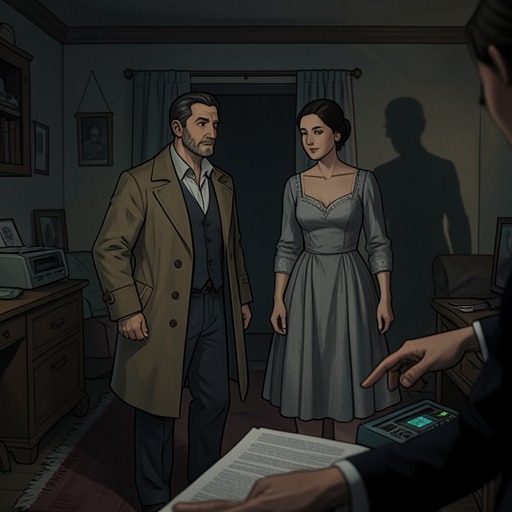
Leopold is identified as a musician from Salzburg serving the Archbishop, and as the father of Wolfgang Amadeus Mozart. Count Orsini-Rosemberg describes him as pedantic and recalls that he took his son around Europe, exhibiting him in feats such as playing the piano blindfolded or with one finger. That account makes Leopold a force in Wolfgang’s early public life: the child’s extraordinary abilities were not merely discovered but repeatedly put on display.
The adults discussing Wolfgang treat the prodigy’s childhood fame as a potential burden. Orsini-Rosemberg generalizes that prodigies are odious and become sterile with age; he also dismisses Wolfgang as a young man trying to impress beyond his talent, with too many embellishments and notes. These are the observers’ judgments, not a neutral account of Leopold or his son. In this scene, Leopold’s history as the father of a touring prodigy supplies a frame through which the court interprets Wolfgang before his work is fully considered.
The play also gives Leopold a paternal vigilance that his son later acknowledges. The Venticelli say that he writes from Salzburg every day, while Wolfgang’s mother would like the young couple’s relationship to end in marriage and his father does not. His concern is thus represented as both sustained attention and resistance to his son’s choices. The play does not resolve that tension into a single motive: Leopold’s watchfulness can be remembered as care even as his opposition becomes a source of conflict.
A Father and Son at Odds
As an adult, Wolfgang recalls that he was adored in England as a child, but says he cannot return there because he has a wife and a son and no money. He had written to Leopold asking him to keep the child for a few months so Wolfgang could travel; Leopold refused. Wolfgang presents the refusal as part of a larger betrayal, then accuses his father of jealousy and says Leopold could not forgive his son for being more intelligent.
That accusation comes in a charged, intimate moment. Wolfgang leans excitedly over Salieri’s chair to disclose what he calls a secret, and ends by expressing hatred for his father before laughing guiltily. His account also contrasts the father who took him across Europe with the man who, according to Wolfgang, stayed year after year in Salzburg, kissed the Bishop’s ring, and lectured him. The remembered history therefore contains both dependence and repudiation: Wolfgang resents the father’s authority, while his own story of childhood remains inseparable from Leopold’s actions.
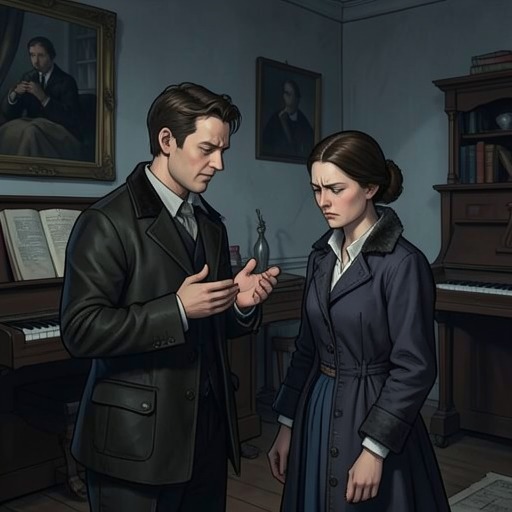
The conflict extends to Wolfgang’s marriage. After Leopold’s death, Wolfgang says he married against his father’s wishes and abandoned him. He imagines Leopold alone, night after night, in an empty house without a woman to care for him, while Wolfgang danced, played billiards, and made a fool of himself. These details are voiced as part of Wolfgang’s self-accusation; the scene does not independently establish how Leopold experienced the separation. What it does establish is how, once reconciliation is impossible, Wolfgang recasts ordinary acts of independence as injuries for which he is responsible.
Death and the Son’s Remorse
The Venticelli announce Leopold’s death, and Wolfgang recoils before a long pause. Salieri tells him that death is inevitable, but Wolfgang’s response shows that the loss is not simply an abstract fact. He asks what he is to do now, explaining that he has no one else in the world to warn him of the evil around him. Leopold, he says, watched over him throughout his life, while he himself betrayed his father and spoke against him.
Wolfgang’s grief does not erase his earlier anger; it changes its force. The father he had described as jealous and bitter becomes the person whose protection he believes he has lost. Salieri offers support in a broad, paternal gesture, and Wolfgang approaches the embrace before avoiding it. He moves away, falls to his knees, and cries out for his father. The interrupted embrace and the address to Leopold make the death scene a moment of need without consolation: Salieri can offer sympathy, but he cannot take the father’s place.
Letters and Dramatic Afterlife
The play links Leopold’s memory to Don Giovanni. After Wolfgang calls for his father, Salieri tells the audience that this is how the father’s ghost in the opera was born. The severe opening chords sound through the theatre; Wolfgang appears frightened by them. Leopold is not shown as a literal apparition in this scene. Instead, the play stages the transformation of bereavement into music, making the father’s absence part of the work’s dramatic origin.
Leopold’s letters provide a more material trace of the relationship. Constanze Mozart recalls a fire lit on a very cold night, when the ink would not flow, and tells Wolfgang that the old papers they burned were all the letters his father had written since their marriage. She says those letters criticized her as foolish and as a poor housekeeper. The revelation gives the marriage conflict a domestic and documentary dimension: Leopold’s opposition is not only remembered through Wolfgang’s account, but also through a collection of repeated judgments about Constanze that the couple destroyed without, as Constanze’s recollection suggests, initially recognizing what the papers were.
The letters, the death announcement, and the opera’s father ghost create three distinct forms of Leopold’s continuing presence: written criticism, irreparable loss, and artistic transformation. Wolfgang’s memories do not settle whether his father was chiefly controlling, protective, or both. Their force lies in holding those versions together. The son who resented being watched comes to mourn the watcher, and the father who remains offstage becomes central to the way the play connects family conflict with Wolfgang’s music.